If you’ve ever felt like your hair products either sit on top of your strands or disappear into a black hole, you've already had a run-in with hair porosity. It’s the single most important factor you might be ignoring.
Simply put, porosity is your hair's ability to absorb and retain moisture. It's all about the condition of your hair's cuticle, which is the outermost, protective layer of the hair shaft.
Understanding Your Hair's Porosity

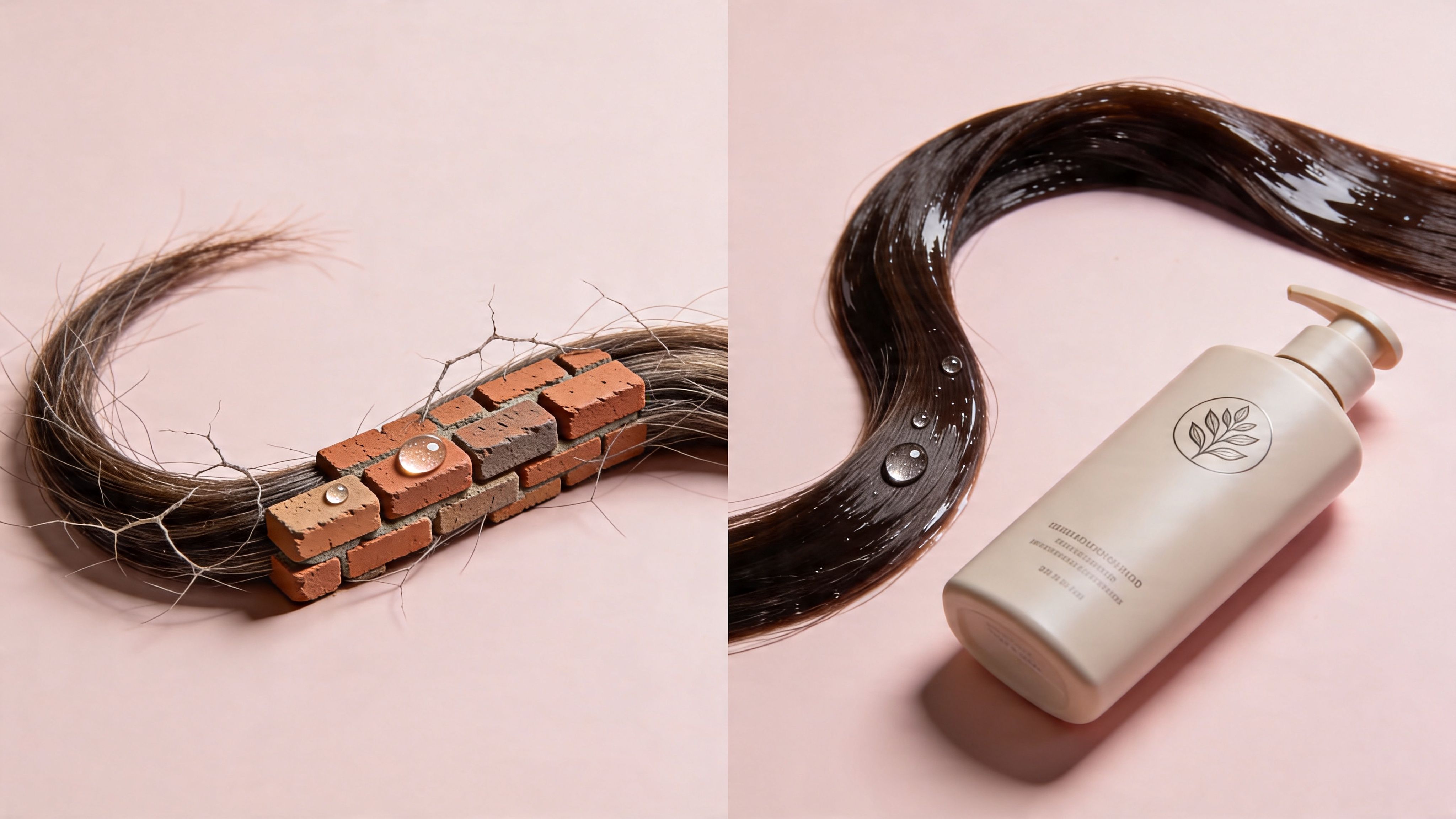
Think of your hair's cuticle layer like shingles on a roof. On healthy, low porosity hair, these shingles are packed tightly together, forming a protective barrier that locks moisture in. On damaged, high porosity hair, the shingles are lifted and full of gaps, letting moisture pass in and out freely.
This structural difference explains why some products feel like a miracle for one person and a greasy mess for another.
The Science Behind Porosity
Your hair’s porosity level is largely genetic, but it’s not set in stone. Things like bleach, heat styling, and even sun exposure can damage the cuticle, shifting your hair towards higher porosity over time. This determines how water, oils, and the ingredients in your products will behave.
Low Porosity: The cuticles are shut tight. This makes it tough for moisture to get in, but once it’s there, it’s not going anywhere. Hair takes a long time to get wet and a long time to dry.
Normal Porosity: The cuticles are slightly raised, striking the perfect balance. Moisture is absorbed easily and retained well. This is generally the easiest hair type to manage.
High Porosity: The cuticles are wide open, with gaps along the hair shaft. Hair soaks up moisture in seconds, but it loses it just as quickly, often leading to a cycle of dryness and frizz.
Key Insight: Knowing your porosity is often more critical than knowing your curl pattern. Porosity explains why your hair behaves the way it does, finally letting you choose products that actually work.
It’s why two people with 3A curls can have completely opposite needs. One might need lightweight hydrators, while the other needs heavy creams and oils. The first step is to figure out where your hair falls on the spectrum. The easiest way is to check your hair porosity with a guided quiz that analyzes your hair's real-world behavior.
| Feature | Low Porosity Hair | High Porosity Hair |
|---|---|---|
| Cuticle Structure | Tightly packed, smooth, and flat | Raised and open with gaps |
| Moisture Absorption | Slow; resists water and products | Fast; absorbs moisture quickly |
| Moisture Retention | Excellent; holds onto hydration | Poor; loses moisture rapidly |
| Primary Challenge | Getting moisture into the hair | Keeping moisture in the hair |
So, you're ready to figure out your hair's porosity. There are a few popular at-home methods that can give you a starting point, but it's crucial to know what they can—and can't—tell you about your hair. Let's walk through the two most common DIY tests: the Float Test and the Spray Bottle Test.
The Float Test Method
This is probably the most famous porosity test you'll see online, though its accuracy is a hot topic of debate. The idea is to see how a single strand of your hair reacts when placed in water.
- Start Clean: Your hair needs to be completely free of any products. Oils, leave-ins, and creams will absolutely skew the results.
- Collect a Strand: Grab a single hair that has shed naturally. You can usually find one on your brush or comb.
- Drop It In: Place the clean strand into a clear glass of room-temperature water.
- Observe: Now, just watch what it does for the next 2-4 minutes.
If your hair floats right at the top, it's a sign of low porosity. If it hangs out in the middle or sinks very slowly, you're likely looking at normal porosity. And if it plummets to the bottom quickly, you probably have high porosity hair.
The Spray Bottle Test
This test is great because it gives you real-time feedback on how your hair handles water, without you having to pull a strand. It's a fantastic way to see porosity in action.
Simply take a small section of your dry, clean hair and give it a good spritz with a water bottle.
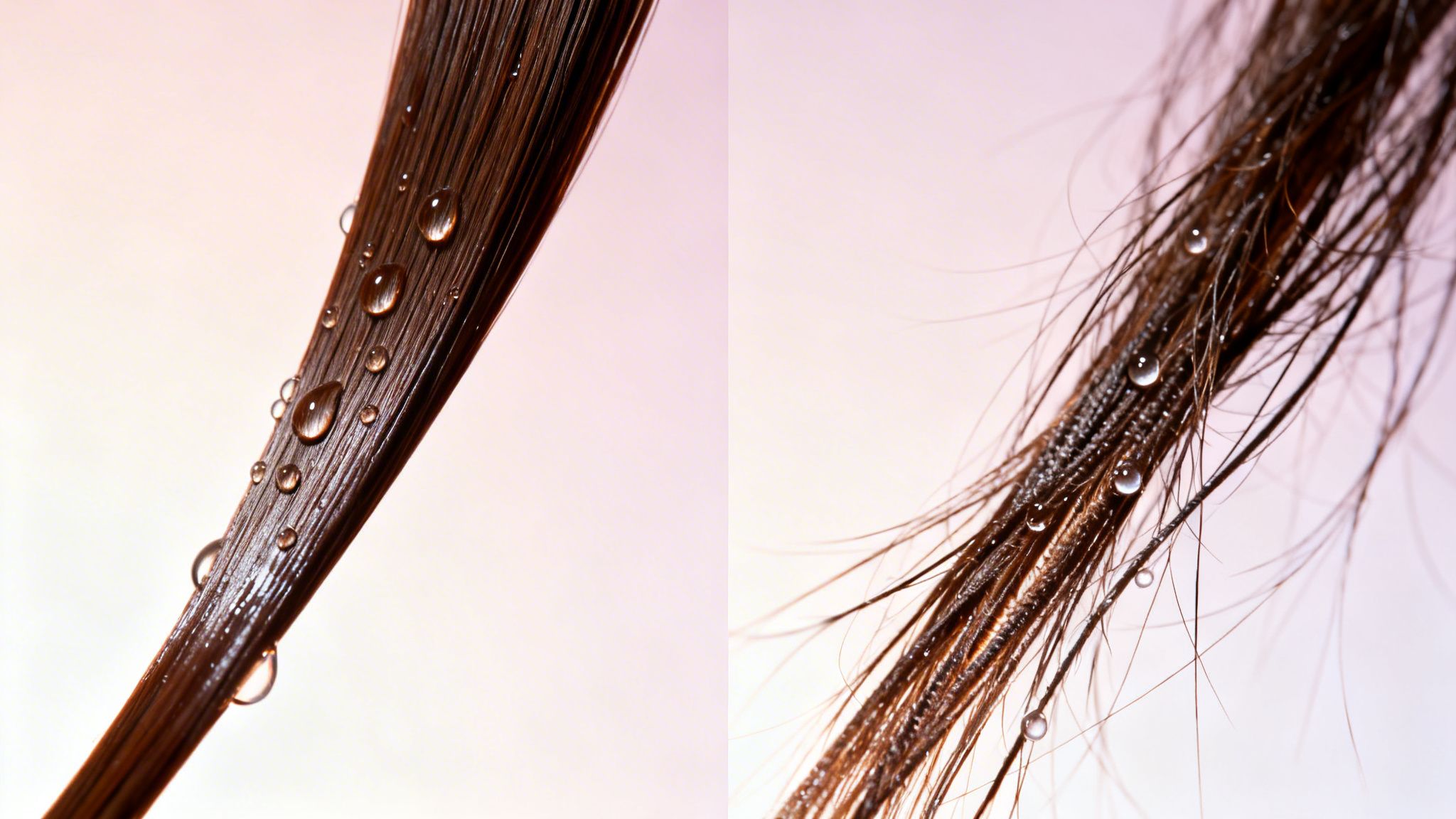
- Beads Up: Does the water form little beads on the surface of your hair? That’s a classic sign of low porosity. The tightly sealed cuticle is doing its job and resisting the water.
- Absorbs Quickly: If your hair soaks up the water almost instantly, you’re likely dealing with high porosity. Those more open cuticles are practically drinking it in.
A Quick Word on DIY Tests: While these tests can give you a general idea, they're far from foolproof. The float test, in particular, can be thrown off by things like product residue you didn't even know was there, the natural oils on your hands, and even the thickness of the hair strand itself.
This push for deeper hair knowledge is changing the game. The global hair care market is on track to hit USD 99.8 billion by 2026, largely because consumers are becoming more educated on specific needs like porosity. Learn more about hair care market growth.
Ultimately, for a truly reliable answer, you need to look at your hair's consistent, day-to-day behavior. A guided quiz can paint a much more accurate picture than one strand of hair in a glass of water.
This screenshot shows the beginning of the IsItClean Hair Porosity Test, which asks about how your hair behaves when wet.
Instead of relying on a one-off experiment, a quiz like this analyzes real-world patterns—like how long your hair takes to dry or how it responds to products. Paying attention to these daily clues will give you the most definitive answer.
Low Porosity vs High Porosity Hair Compared
Figuring out the difference between low and high porosity hair is the key to finally understanding why your hair acts the way it does. It's not about which one is "good" or "bad." It's all about what your hair actually needs to look its best.
At its core, the comparison boils down to two opposite problems: one hair type struggles with absorption, while the other struggles with retention.
Think of it this way: low porosity hair has a tightly sealed, almost waterproof cuticle layer. High porosity hair, on the other hand, has a cuticle full of gaps and holes. This single structural difference explains everything, from how your hair feels when it's wet to why some products are your holy grail and others are a greasy mess.
Key Behavioral Differences
The most telling sign of your hair’s porosity is how it behaves with plain old water. When you wet low porosity hair, you’ll notice water tends to bead up and roll right off. It takes a while for the hair to actually feel saturated.
High porosity hair is the complete opposite. It soaks up water almost instantly, feeling completely wet in just a few seconds.
This directly impacts how long your hair takes to dry.
- Low porosity hair can take ages to air dry—sometimes even a full day. The sealed cuticle that keeps water out also does a great job of trapping it inside once it finally gets in.
- High porosity hair often dries shockingly fast. Those same gaps that let moisture in so easily also let it escape just as quickly, leaving your hair thirsty again.

While at-home methods like the float test can offer clues, the most reliable way to figure out your porosity is to simply pay attention to your hair's daily behavior. How it feels in the shower and how long it stays damp are your best indicators.
Product Interaction and Feel
For low porosity hair, product buildup is the number one enemy. Because the cuticle is so smooth and flat, heavy creams and oils just sit on the surface. This leads to that classic greasy, weighed-down feeling where your hair feels slick but not actually moisturized.
High porosity hair deals with the opposite problem: it can feel like a bottomless pit for products. You can slather on a rich, thick hair mask, and an hour later, your hair feels dry again, as if you applied nothing at all. The hair absorbs it quickly but just can't hold onto it.
Key Distinction: Both types can feel dry, but for completely different reasons. Low porosity hair feels dry because moisture can't get in. High porosity hair feels dry because moisture can't stay in.
This concept is so fundamental that it's changing the entire hair care industry. We're seeing a huge rise in products made for specific porosity types, especially treatments for low porosity hair. It’s a perfect example of how educated customers are shaping the market. You can learn more about hair care market growth trends to see how big this shift really is.
Low Porosity vs High Porosity Hair At a Glance
This table breaks down the core traits of each hair type to help you quickly pinpoint where you fall on the porosity spectrum.
| Characteristic | Low Porosity Hair | High Porosity Hair |
|---|---|---|
| Moisture Absorption | Slow; water beads up and resists getting wet. | Fast; hair soaks up water like a sponge. |
| Drying Time | Very long; can take hours or even a full day to air dry. | Very fast; air dries in a surprisingly short time. |
| Product Feel | Products tend to sit on top of the hair, causing buildup. | Products are absorbed quickly; can feel like it's never enough. |
| Cuticle Structure | Tightly packed and smooth, lying flat against the shaft. | Raised and open, with gaps and tears along the shaft. |
| Main Challenge | Getting moisture to actually penetrate the hair shaft. | Sealing moisture in and preventing it from escaping. |
| Common Look & Feel | Often looks shiny but can feel stiff or get greasy easily. | Often looks dull or matte and can feel perpetually dry or frizzy. |
Knowing these differences is the first step to ending the cycle of frustrating hair days for good.
Once you know whether your hair is putting up a fight to keep moisture out or struggling to hold it in, you can choose ingredients and techniques that work with your hair's nature, not against it. This knowledge empowers you to build a personalized hair routine that finally fixes the root cause of your concerns.
Instead of guessing your way through the hair care aisle, you can move forward with a clear strategy. For low porosity, the goal is lightweight hydration that can penetrate. For high porosity, the goal is rich moisture paired with sealing ingredients to lock it all in. This targeted approach makes all the difference.
Building Your Low Porosity Hair Care Routine

If you have low porosity hair, you know the struggle. It’s not about finding the richest, thickest products; it's about being strategic. Your hair has a tightly sealed cuticle, which is great for locking in moisture once it's there, but getting it in is the real challenge. The goal is to gently coax that cuticle open just enough to let hydration in, without creating a greasy, weighed-down mess.
The biggest mistake people make with low porosity hair is thinking heavy creams and butters equal more moisture. They don't. Those products just sit on top of the hair shaft, making it feel coated and slick but leaving the core of the strand completely dry. You have to think light. Think watery.
Choosing the Right Ingredients
For low porosity hair, reading the ingredient label isn't just a good idea—it's essential. You need to look for ingredients that can actually penetrate the hair shaft or attract water to it. The easiest way to do this is to analyze your ingredients with a dedicated checker.
Your Go-To Ingredients:
- Glycerin: This is a classic humectant for a reason. It literally pulls moisture from the air and draws it into your hair, offering hydration without the weight.
- Aloe Vera: It’s mostly water, which is exactly what low porosity hair needs. Aloe absorbs in a flash, delivering a quick hit of moisture and nutrients.
- Lightweight Oils: Not all oils are created equal. You need oils with smaller molecules that can slip past that tight cuticle. Think argan oil, grapeseed oil, and jojoba oil.
- Water-Based Leave-ins: Your best friends will be mists, serums, and any leave-in conditioner with a milky, thin texture.
On the flip side, some ingredients are just not for you. Heavy oils and butters like castor oil, olive oil, and shea butter are famous for causing buildup because their molecules are too large to get in. Some silicones can also create a seal that blocks moisture out, making the problem even worse over time.
Key Insight: The best routine for low porosity hair is one of finesse, not force. It’s about choosing ingredients that can penetrate the hair, not just coat it. Focus on water-based products and small-molecule oils to get the job done right.
Essential Application Techniques
How you apply your products matters just as much as what you're applying. A few simple technique changes can make all the difference in helping your hair get the moisture it needs.
1. Apply Products to Damp, Warm Hair Stop trying to style dry hair. It’s a losing battle with low porosity. Applying your conditioner and leave-ins right after you shower, while your hair is still damp and warm, is the perfect time. The warmth from the water helps lift the cuticle ever so slightly, making it more receptive.
2. Use Gentle Heat When you deep condition, a little heat is your secret weapon. Trapping warmth with a thermal heat cap or even just a warm towel wrapped around your head helps lift the cuticles so the conditioner can penetrate deeply. Even 15-20 minutes can make a huge impact on your results.
3. Clarify, Clarify, Clarify Low porosity hair is a magnet for buildup. A clarifying shampoo is your reset button. Using one every 2-4 weeks strips away all the product residue, hard water minerals, and oils that have been sitting on the surface, giving you a clean slate.
To get the cleansing and conditioning balance just right, check out our detailed guide to a low porosity hair routine.
Building Your High Porosity Hair Care Routine
If you have high porosity hair, you know the struggle all too well. Your hair gets soaking wet in seconds but feels parched just a few hours later. This happens because your hair's cuticle has gaps that let moisture flood in, but they also let it escape just as fast.
The entire strategy for high porosity hair boils down to three things: seal, strengthen, and protect. Your routine needs to focus on filling those gaps in the cuticle and then locking that precious moisture in for good. Unlike low porosity hair that thrives on lightweight products, your hair craves richer ingredients that create a protective barrier and deliver lasting hydration.
The Best Ingredients to Seal and Strengthen
For high porosity hair, your product choices should do more than just moisturize—they need to help repair the hair's structure. This means embracing richer oils, butters, and the right kinds of proteins.
Your go-to ingredient list should include:
- Sealing Oils: These are the heavy hitters that are perfect for trapping moisture inside the hair shaft. Think castor oil, olive oil, and avocado oil.
- Rich Butters: Ingredients like shea butter and mango butter are incredible for smoothing down that rough cuticle and giving your hair a soft, supple feel that actually lasts.
- Protein Treatments: Protein is non-negotiable for high porosity hair. It acts like spackle, temporarily patching the holes in the damaged cuticle. This strengthens the strand and drastically improves its ability to hold onto moisture.
The LOC and LCO Methods
The LOC (Liquid, Oil, Cream) or LCO (Liquid, Cream, Oil) methods are lifesavers for high porosity hair. It's a simple layering technique designed to get moisture in and then seal it so it can't escape.
- Liquid (L): Always start with a water-based product to hydrate the hair. This can be plain water from a spray bottle or a lightweight, watery leave-in conditioner.
- Oil (O): Next, apply a sealing oil like castor or olive oil. This layer traps the water molecules inside the hair shaft.
- Cream (C): Finish with a cream-based product to further smooth and seal the cuticle while helping to define your curls or style.
So, should you use LOC or LCO? Honestly, it depends on your hair. The only way to know for sure is to experiment and see which sequence leaves your hair feeling moisturized for longer.
Key Takeaway: For high porosity hair, deep conditioning isn't a luxury—it's a necessity. Regular deep conditioning, especially with protein-based masks, helps to temporarily patch the cuticle, which reduces moisture loss and improves your hair's overall health and resilience.
Balancing Protein and Moisture
While high porosity hair needs protein to rebuild its structure, there's a fine line. Too much protein can cause the hair to become stiff, brittle, and prone to snapping—a frustrating state known as protein overload.
If your once-soft hair suddenly feels like straw, you might have tipped the scales. Don't guess. You can use a quick protein overload test to see if you need to adjust your routine. Finding the right balance is key to keeping your hair both strong and soft.
Building the perfect high porosity routine can feel like a constant experiment. We have a complete guide to a high porosity hair routine that breaks it all down, step by step.
Create Your Perfect Porosity-Aware Routine
Okay, so you've figured out your hair's porosity. That's the "aha!" moment, but the real transformation starts when you put that knowledge into practice.
This is where you graduate from generic advice and build a strategy that actually works for your hair. It’s the difference between guessing in the product aisle and confidently choosing what your hair needs.
From Knowledge to Action
The gap between frustrated and healthy hair often comes down to one simple thing: using the right products in the right order. For low porosity, that means leading with lightweight hydrators. For high porosity, it's all about sealing in that much-needed moisture with richer formulas.
Understanding the science behind your hair is a game-changer. It lets you stop guessing and start making targeted choices that deliver real, visible results, turning frustrating hair days into a thing of the past.
A targeted routine is everything. A product that works miracles for your friend might be a total disaster for you, even if you have the same curl pattern. Your porosity dictates the rules.
Build Your Custom Regimen
The IsItClean Hair Routine Builder was designed to do the heavy lifting for you. It takes your porosity, hair type, and goals to build a step-by-step regimen with product recommendations that fit your unique profile.
These principles are even more critical when you factor in texture. If you have curls, for example, you'll find a more focused approach in our guide on creating an effective curly hair routine. It breaks down how to integrate porosity-specific techniques to get defined, healthy curls, making sure every step moves you closer to your hair goals.
Common Questions About Hair Porosity
Once you start digging into the world of hair porosity, a ton of questions pop up. It's easy to get lost in the details.
Let's clear up some of the most common questions to help you get your routine right, once and for all.
Can Hair Porosity Change Over Time?
Absolutely. While you’re born with a certain porosity, it's definitely not a life sentence. Think of your genetic porosity as your starting point.
Things like chemical treatments, heat styling, and even sun exposure can rough up and damage the hair's cuticle layer. This damage forces the cuticles to lift, which means your hair becomes more porous over time. This is why it’s a great idea to re-test your hair every so often, especially if you’ve recently colored it or started using a new heat tool.
Is It Possible to Have Different Porosities on One Head?
Yes, and it's incredibly common. This is often called ‘mixed porosity’ or ‘combination porosity,’ and most people have it to some degree.
Your ends are the oldest part of your hair—they’ve seen the most heat, styling, and general wear and tear. This makes them more porous than the newer, healthier hair growing from your roots. The solution is a targeted routine: use richer, sealing products on your high-porosity ends and stick to lightweight formulas near your scalp to keep your low-porosity roots from getting greasy.
How Do Silicones Affect Different Porosity Types?
Silicones are one of those ingredients that act completely differently depending on your hair's porosity. It’s not a simple "good" or "bad" situation.
For low porosity hair, they can be a real problem. Because the cuticle is already so tightly sealed, silicones just sit on the surface. This quickly leads to heavy buildup that suffocates the hair strand and blocks moisture from getting in.
For high porosity hair, on the other hand, certain silicones can be a lifesaver. They create a thin, protective film that helps seal the open cuticle, which is exactly what that hair type needs to lock in moisture and fight frizz. The trick is to use the right kind of silicones and to clarify your hair regularly to prevent them from building up over time.
Ready to stop guessing and start building a routine that actually works for your hair's unique porosity? The IsItClean Hair Routine Builder takes your specific hair data—including porosity, type, and goals—to generate a personalized care plan with product recommendations, helping you achieve healthier hair with confidence.