You buy a “repair” shampoo, add a strengthening mask, and finish with a leave-in that promises resilience. For a week or two, that sounds like a smart plan. Then your hair starts feeling rough, rigid, and oddly harder to manage.
That’s the part many people miss. Hair can feel damaged not only because it needs more support, but because it’s getting the wrong kind of support too often. If your strands feel straw-like after products that are supposed to help, a shampoo without protein may be the missing adjustment.
The Frustrating Truth About "Healthy" Hair Products"
You switch to a shampoo labeled “repair,” add a strengthening mask, and expect your hair to feel more resilient. Instead, wash day gets harder. Your strands catch on each other, curls lose their spring, and the ends feel dry in a strange way, almost stiff instead of thirsty.

A lot of products marketed as “healthy” are built around protein. That can be useful for some hair, especially hair with surface damage. But protein is not a universal fix. For some people, repeated exposure from shampoo, conditioner, masks, and stylers starts to act like too many reinforcing patches on the same weak spot. The strand may feel stronger at first, then gradually lose softness and bend.
That pattern confuses people because the labels sound right. “Fortifying” and “strengthening” suggest your hair needs more of the same. In practice, hair care works more like seasoning food. The same ingredient that improves one recipe can ruin another if the amount is off. Protein-sensitive hair often reacts badly not because protein is harmful on its own, but because the routine keeps adding it without checking whether the hair is responding well.
One clue is the gap between what the product promises and what your hair does after a few washes. If softness drops, detangling gets slower, and breakage increases during ordinary handling, it makes sense to test for protein overload before buying another repair product. That is the angle many routines miss. Diagnosis should come first, product hunting second.
Hair that feels dry and hard at the same time often needs a routine audit, not more “strength.”
Shampoo deserves special attention because it is your first and most repeated exposure point. If your cleanser contains proteins your hair does not tolerate well, every wash can reset the problem. A protein-free shampoo gives you a cleaner starting point so you can observe your hair more accurately, use a simple Protein Overload Test, and decide whether the issue is protein sensitivity, plain dryness, or something else entirely.
If hair thinning is also on your mind, separate strand behavior from scalp and growth concerns. Brittle hair from product buildup and reduced density are different problems, and they often need different solutions. For readers looking into scalp-focused options, this overview of non-invasive hair restoration explains treatments aimed at density rather than strand coating.
What Is Protein Overload and Why Does It Happen
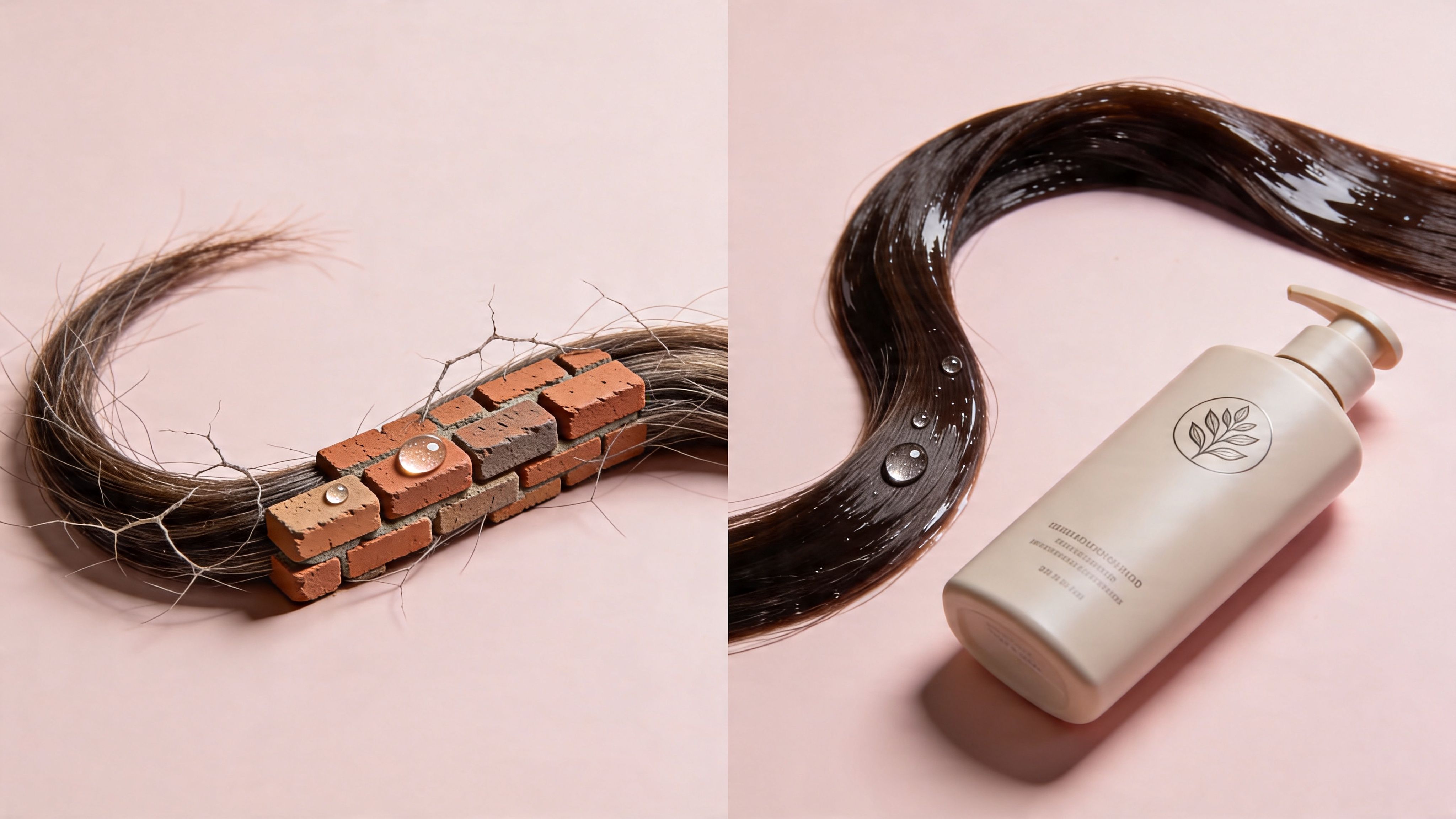
Think of hair like a brick wall. Moisture is the brick. Protein is the mortar. You need both, but in the right ratio. Too little mortar and the wall is weak. Too much mortar and not enough brick, and the wall becomes rigid and easier to crack.
That’s protein overload. The strand gets less flexible, less elastic, and more likely to break during everyday handling.

What protein does on the hair
Proteins in hair products often act as patchers or film-formers. They can help fill in rough areas and make hair feel stronger for a while. That’s useful in some routines, especially after heavy damage.
But proteins don’t behave the same way on every head of hair. For protein-sensitive hair, ingredients such as keratin and amino acids can build up and create brittleness. A review discussed in PMC’s overview of hair cosmetics connects the rise of milder, often protein-free shampoos with the need to reduce aggression on the hair shaft, and verified summaries note protein overload affecting 20 to 35% of high-porosity or relaxed hair users globally.
Why overload shows up slowly
A single shampoo typically doesn’t trigger overload. It’s usually created with a stack:
- A strengthening shampoo that contains hydrolyzed protein
- A repair conditioner with amino acids or keratin
- A mask marketed for bond support or rebuilding
- A styler that sneaks in silk or wheat protein
Each product may seem harmless on its own. Together, they can push sensitive hair past its comfortable limit.
Practical rule: If your wash day leaves hair cleaner but stiffer, inspect the whole routine, not just the shampoo.
There’s also a naming problem. “Moisturizing” products sometimes still contain protein. “Natural” bars can too. If you’re curious how protein-based cleansing bars are framed by brands, this explanation of a rice water protein shampoo bar is a good contrast point because it shows how easily protein can be built into products that sound gentle.
Protein overload is not the same as plain dryness
Dry hair usually feels thirsty, rough, and better after rich moisture. Protein-overloaded hair often feels dry and hard at the same time. It may resist softening even after conditioning.
That difference matters. If the problem is moisture loss alone, adding more conditioning can help. If the problem is protein buildup, adding another “repair” mask can make it worse.
How To Know If You Need a Protein-Free Shampoo
You wash with a shampoo labeled strengthening, follow with a repair conditioner, and expect your hair to feel healthier. Instead, it dries stiff, tangles faster, and seems less cooperative than before. That pattern is often the clue.
A protein-free shampoo makes sense when your hair reacts badly to repeated protein exposure, not just when it has one rough wash day. The goal is diagnosis first. If you can tell the difference between ordinary dryness and protein sensitivity, you are much less likely to waste money on products that keep pushing your hair in the wrong direction.
Signs that point toward protein sensitivity
Start with how the hair behaves, not what the product promises. Hair that needs less protein often shows the same few signals again and again.
- It feels rigid after drying. The strand is not just rough or frizzy. It feels hard, straw-like, or slightly crunchy.
- It breaks with very little stretch. Hair normally acts a bit like a spring. Protein-sensitive hair often loses that give.
- Your curl pattern looks off. Curls may turn limp, stringy, uneven, or frayed at the ends.
- Conditioner does not seem to soften much. Products sit on the surface, but the hair still feels resistant.
- Detangling becomes noticeably rougher. The cuticle feels less flexible, so strands catch on each other more easily.
One sign alone is not enough. A cluster matters more than any single symptom.
Use context before you make the call
The fastest way to misread your hair is to judge it in isolation. Look at what changed in the last few weeks. Did you add a keratin shampoo, a bond-repair mask, a rice water treatment, or a leave-in marketed for strength? Protein sensitivity often shows up after a routine shift, especially when several “repair” products are layered together.
Porosity affects how strongly you notice that shift. High-porosity hair can take in ingredients quickly, but it can also get overloaded faster if the routine is heavy on strengthening products. Low-porosity hair may show a coated, inflexible feel because ingredients linger on the surface. If your hair is porous and easily overwhelmed, a high porosity hair routine that balances cleansing, conditioning, and sealing can help you interpret whether the problem is protein, moisture loss, or both.
A simple check you can do at home
Use a small test instead of guessing. Take a shed strand after wash day and gently stretch it between your fingers. You are not trying to yank it apart. You are checking how it behaves.
- If it stretches a little and returns, elasticity is probably decent.
- If it stretches a lot and stays limp, moisture imbalance may be the bigger issue.
- If it barely stretches and snaps quickly, protein overload moves higher on the suspect list.
This is not a lab test, but it is useful. It turns a vague feeling, “my hair hates everything lately”, into something you can observe.
Ask these four questions
A short checklist can keep you from blaming the wrong product.
- Did my hair problems start after I added more strengthening or repair products?
- Does my hair feel hard and brittle, even after conditioning?
- Does softness disappear quickly, sometimes within hours of wash day?
- Am I using protein in more than one step of my routine, such as shampoo, conditioner, mask, and styler?
If you answer yes to several of these, a protein-free shampoo is a reasonable experiment.
One more clue helps. Remove protein-heavy products for a couple of washes and watch for change. If your hair becomes softer, easier to detangle, and more elastic, that response supports the diagnosis. If nothing changes, the issue may be buildup, dehydration, harsh cleansing, or mechanical damage instead.
You can also use a hair type quiz to identify your curl pattern. That does not diagnose protein sensitivity by itself, but it gives useful context for how easily your hair gets stiff, loses definition, or needs a narrower balance between strength and softness.
Decoding Labels How To Spot Hidden Proteins
You buy a shampoo labeled “hydrating,” wash with it, and your hair still dries stiff, rough, or oddly straw-like. Often the problem is not the word on the front. It is the ingredient list on the back.
Protein rarely appears as a plain, obvious word. Brands usually list the specific type or fragment instead. That is why label reading matters so much during a protein-free trial. If your goal is to test whether protein is part of the problem, you need to catch the hidden forms, not just avoid products that say “keratin” on the bottle.
What to scan for first
Start by looking for repeating patterns in ingredient names. “Hydrolyzed,” “amino acids,” “keratin,” “collagen,” and the names of grains or silk are common clues. You do not need to memorize every cosmetic ingredient. You are looking for families.
| Ingredient Name | What It Is |
|---|---|
| Hydrolyzed Keratin | Broken-down keratin protein used to reinforce the hair surface |
| Hydrolyzed Wheat Protein | Wheat-derived protein that can coat or bind to hair |
| Silk Amino Acids | Small protein fragments from silk |
| Hydrolyzed Soy Protein | Soy-derived protein often used in “strengthening” formulas |
| Collagen | A protein ingredient sometimes added for film-forming effects |
| Keratin Amino Acids | Small keratin-related fragments marketed for repair |
| Hydrolyzed Rice Protein | Rice-derived protein common in volumizing or repair formulas |
| Oat Protein | Grain-derived protein used for smoothing and conditioning |
A useful shortcut is to read the first third of the list carefully, then scan the rest for protein words. Ingredients near the top are usually present in larger amounts, but even lower-listed proteins can matter if your hair is very reactive.
Why some labels are harder to read than others
Hair formulas often use proteins in two forms. Larger proteins tend to sit more on the hair surface, a bit like a thin coating. Smaller fragments, such as hydrolyzed proteins and amino acids, are chopped into pieces that can cling more closely to the strand.
That is where beginners often get confused. A bottle may avoid big front-label claims like “protein treatment” and still include several repair ingredients in the fine print. “Moisture,” “bonding,” “repair,” “strengthening,” and “anti-breakage” products deserve an extra-close look because those marketing categories often overlap with protein use.
Read the ingredient list, not the promise on the front. “Hydrating” describes the marketing. Ingredients tell you what the formula actually contains.
Porosity can add another layer here. Hair that resists absorbing products often gets coated more easily, so if your strands are low porosity, a low porosity hair routine can help you judge whether protein-free products are also light enough for your hair type.
A faster way to check a formula
Manual label reading gets easier with practice, but it can still be slow, especially with long ingredient lists full of botanical extracts and conditioning agents. An ingredient checker speeds up the process. You can analyze your ingredients with the IsItClean Ingredient Checker by pasting an ingredient list or uploading a label image, then checking whether proteins appear anywhere in the formula.
Use it as a filter, not as a substitute for your own observations. If the tool flags a low-listed protein, that does not automatically mean the shampoo will cause problems. It means the product may not be ideal for a clean protein-free test phase.
What if I’m still unsure whether protein is the issue? Keep the experiment simple. Choose a shampoo with no obvious protein ingredients, pair it with a protein-free conditioner, and track how your hair feels for a few washes. Softer texture, better slip, and less brittle breakage give you better evidence than marketing language ever will.
Building Your Perfect Protein-Free Hair Routine
You buy a shampoo labeled “moisture,” use it for two washes, and your hair still feels rough, snags at the ends, and looks puffier than it should. That usually means the shampoo is only one piece of the puzzle. Hair responds to the full routine, the same way a recipe depends on every ingredient, not just the cooking oil.

A useful protein-free routine does two jobs at once. It removes the ingredients that may be making hair feel stiff or brittle, and it replaces them with ingredients that improve slip, water retention, and flexibility. If you are testing for protein sensitivity, that matters more than buying one “good” shampoo.
Build the routine in layers
Start by looking at each step your hair touches on wash day and between washes.
- Cleanser: choose a shampoo without hydrolyzed proteins, keratin, collagen, silk amino acids, or similar “repair” ingredients
- Conditioner: look for slip-building ingredients such as fatty alcohols, conditioning agents, and oils
- Leave-in: keep it simple and moisture-focused, especially during your test phase
- Styler: avoid products that market themselves around strengthening or reconstruction if they also rely on protein
- Clarifier: keep one on hand for occasional reset washes if old buildup is confusing the results
This structure gives you cleaner feedback. If your hair softens after a few washes, you can trust the result more because fewer variables are muddying the test.
Match the routine to how your hair behaves
Hair type changes how a protein-free routine should feel.
Fine, low-porosity hair usually prefers lighter conditioning. Too many heavy butters or layered stylers can sit on the surface, leaving hair coated and dull instead of soft. If that sounds familiar, compare your products with a low porosity hair routine so you can judge both protein content and formula weight.
Coarse, curly, highly textured, or heavily processed hair often needs richer moisture. The key difference is that “richer” does not automatically mean “protein-heavy.” It usually means more lubrication from fatty alcohols, more softness from emollients, and enough water-friendly ingredients to keep strands flexible after drying.
A simple way to sort it:
| Hair situation | What to prioritize |
|---|---|
| Fine and easily weighed down | Lightweight moisture, simple cleanser, fewer layers |
| Curly and frizz-prone | Slip, humectants, soft hold, low-protein styling |
| Color-treated and rough | Gentle washing, richer conditioning, less protein stacking |
| Sensitive scalp with dryness | Mild surfactants, low irritation, scalp comfort first |
Use a test window, not one wash
Protein overload rarely disappears after a single shampoo. Hair fiber does not “reset” overnight, especially if a mask, leave-in, or gel has been adding protein for weeks.
Give your routine a short test window of several washes. Keep the core steps stable. Watch for changes in detangling, softness, elasticity, and how the ends behave on day two or three. Those signals tell you more than marketing claims on the bottle.
A visual walkthrough can help if you want to see how people structure moisture-first routines in practice.
If you already own products, check them as a group rather than judging each one in isolation. You can also analyze your full routine if you want to see whether hidden protein is still showing up through a mask, leave-in, or styler.
The right routine should make your hair feel more predictable. Softer after wash day, easier to detangle, and less brittle across the week.
Common Mistakes When Going Protein-Free
The biggest mistake is treating protein like a permanent villain. It isn’t. Some hair eventually benefits from a little structural support again. The issue is dose, timing, and tolerance.
If your hair becomes very limp, overly soft, or “mushy,” it may be asking for balance in the other direction. That doesn’t mean going back to a protein-rich routine all at once. It means reassessing.
Three problems that derail the switch
- Removing protein without adding moisture. A shampoo without protein won’t help much if the rest of your routine still lacks humectants and softening ingredients.
- Skipping a reset wash. If buildup is already on the hair, one new shampoo may not fix the coated feeling immediately.
- Changing too many things at once. When you replace every product in a panic, it gets hard to tell what helped.
Keep your routine flexible
Protein-free care works best as a diagnostic phase and then a maintenance strategy if your hair responds well. Watch the feel of the strand over time. More elasticity and softness usually mean you’re moving in the right direction.
If hair concerns overlap with shedding or reduced density, keep those separate from texture diagnosis. A routine for thinning hair should focus on scalp habits and breakage prevention, not only whether protein is present.
A monthly check-in helps. Run your current products through a routine review, note how your hair feels wet and dry, and adjust one variable at a time.
Your Protein-Free Questions Answered
Can a shampoo without protein help with dandruff or itchiness
Sometimes. It depends on where the irritation starts.
If flakes come from a scalp condition such as seborrheic dermatitis, psoriasis, or a yeast-driven dandruff pattern, removing protein will not fix the root cause. But if your scalp feels tight, itchy, or reactive at the same time your hair has become stiff, rough, and harder to manage, protein may be part of the problem. In that case, a protein-free shampoo can reduce one source of irritation while you watch for changes over a few washes.
A simple way to separate the two is to look at the full pattern. Scalp-only symptoms point one way. Scalp symptoms plus brittle-feeling strands point another.
How often should I use protein-free shampoo
Wash on your scalp’s schedule, not a protein schedule.
Your scalp produces oil. Your shampoo removes sweat, sebum, and buildup. Protein-free matters because of what the formula does not add back onto the hair shaft during cleansing. If you wash every other day, a protein-free shampoo can still fit. If you wash once a week, it can still fit. The better measure is trend, not timing. After several washes, hair should feel less rigid when wet, softer when dry, and easier to detangle.
Will my hair become weak if I avoid protein
No. Shampoo without protein does not strip your hair of its natural keratin.
Hair fiber works like a rope made of many tiny bonds and layers. Added protein in products can sometimes patch weak spots, but too much can make the outer layer feel coated and inflexible, especially on hair that is already low porosity or sensitive to protein-rich formulas. Going protein-free stops adding more during wash day. For the right hair type, that often improves stretch and movement.
What if I’m still unsure whether protein is the real issue
Treat it like a short experiment.
Start with the signs you have already noticed. Does your hair feel worse after products marketed for repair or strength? Does it snap more easily than it stretches? Does it feel strangely hard even after conditioning? Those clues matter more than the word "healthy" on the bottle.
Then use the tools mentioned earlier together, not one by one. A protein overload check helps you spot the pattern. A porosity result explains why your hair may react that way. A scalp sensitivity screen helps separate strand stiffness from true scalp irritation. That combination gives you a better diagnosis than guessing from one symptom.
Do I need all my products to be protein-free
For the first testing phase, yes. Keep the routine clean enough that you can read the result.
If shampoo is protein-free but your conditioner, leave-in, and styler all contain hydrolyzed proteins, your hair is still getting repeated exposure. That is like trying to find out whether a food bothers you while still eating small amounts of it at every meal. A short, fully protein-free reset gives you clearer feedback. Once your hair feels flexible again, you can reintroduce one product at a time and watch what changes.
If you want help organizing that process, IsItClean and its hair care routine builder can sort products by hair goals and formula traits so you can build a routine with fewer blind spots.