Wavy Hair Routine:
Build the Perfect Routine
for Your Waves
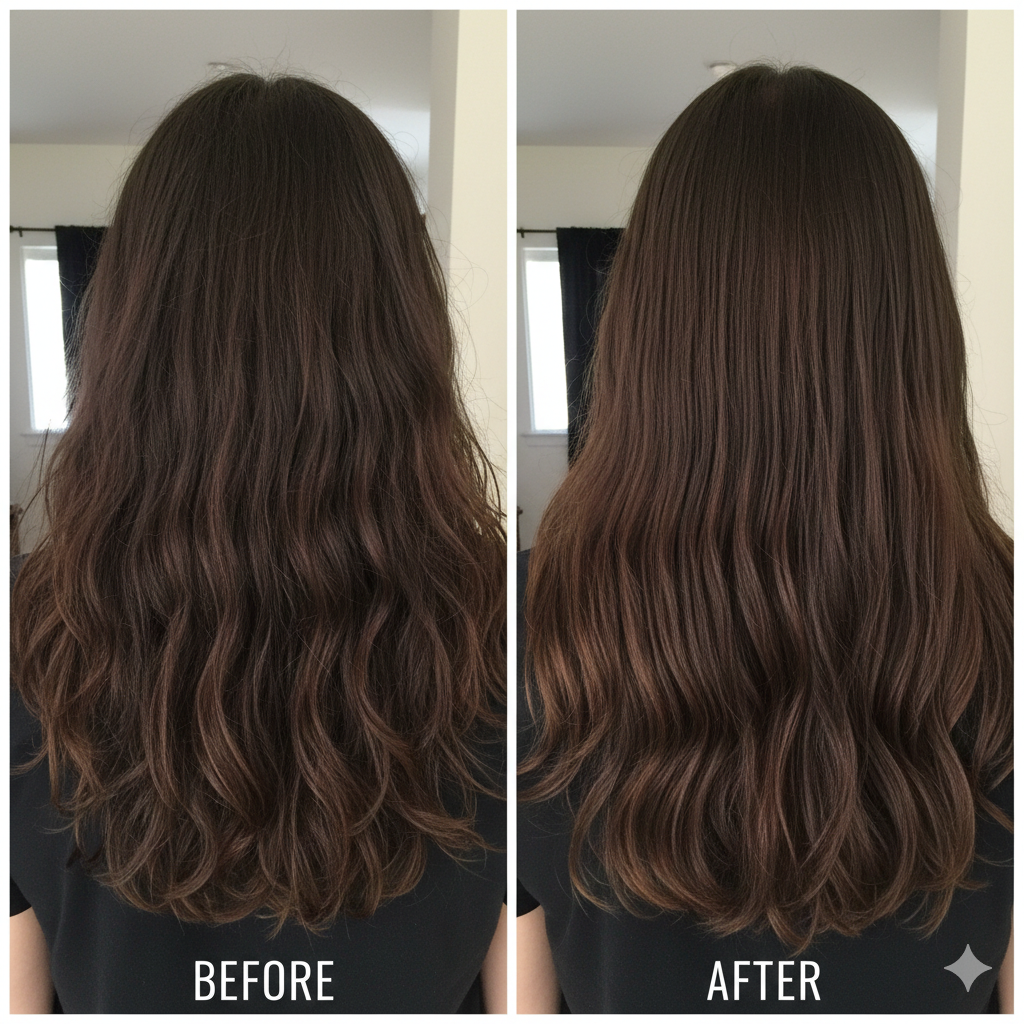
Stop treating your waves like "frizzy straight hair" or "loose curls." A successful wavy hair routine balances frizz control and definition without weighing down your natural volume.
Opens the Hair Routine Builder — quiz, product picks, and a plan you can follow.
1,200+
Routines built
4.8
Avg user rating
98%
Ingredient accuracy
30 sec
Average analysis time
What is a wavy hair routine?
A wavy hair routine is a specific set of products and techniques tailored to Type 2 hair. Unlike curly hair, waves are easily weighed down by heavy oils and butters. A proper routine focuses on enhancing the natural "S" shape of your strands while maintaining moisture and preventing the "poof" factor.
This approach is essential for identifying whether you have 2A (slight tousle), 2B (defined S-shape), or 2C (thick, borderline curls) hair — and choosing products that respect each sub-type.
Step-by-step wavy hair routine
Cleansing
Start with a sulfate-free shampoo or a lightweight co-wash. Wavy hair is prone to buildup, so focus the product on your scalp to remove excess oils while keeping your ends hydrated.
Conditioning
Apply a lightweight conditioner from mid-lengths to ends. Use the "Squish to Condish" method — scrunching water and conditioner into the hair — to encourage the wave pattern to form while hair is soaking wet.
Leave-in & styling
Apply a pea-sized amount of leave-in conditioner followed by a weightless mousse or a light-hold gel. Apply to soaking wet hair using "praying hands" to coat strands without breaking up the wave clumps.
Drying techniques
Avoid the terry cloth towel. Use a microfiber towel or a cotton T-shirt to "plop" your hair, absorbing moisture without friction. Finish with a diffuser on low heat to set definition and add root volume.
Refresh between wash days
Waves often fall flat by day two. Use a fine-mist spray bottle with water and a touch of leave-in conditioner to reactivate your styling products. Scrunch gently to bring the bounce back.
Common mistakes that ruin wavy hair
Dry brushing
Brushing your hair when dry is the fastest way to turn waves into a cloud of frizz.
Heavy products
Using thick shea butter or heavy oils that "suffocate" the wave and stretch it straight.
Over-washing
Stripping natural oils leads to scalp overcompensation and limp, flat hair.
Touching during drying
Playing with your hair while it dries breaks the "cast" and creates instant frizz.
Best products for wavy hair
| Product category | What to look for | Why it works |
|---|---|---|
| Shampoo | Sulfate-free, clarifying | Removes buildup without stripping. |
| Conditioner | High "slip," silicone-free | Detangles without weighing hair down. |
| Styling | Mousse or volumizing foam | Provides hold while keeping waves airy. |
| Sealant | Lightweight gel | Locks in moisture and maintains frizz control. |
How to know your hair type (2A, 2B, 2C)
2A
Fine, thin, easy to style. Slight "S" curve with minimal volume. Easily pulled straight by weight.
2B
Flatter at the crown, defined S-shape from eye level down. More prone to frizz, medium density.
2C
Coarser, thicker. Waves start at the root and are very defined, often hiding actual curls underneath.
Why your routine isn't working
If your waves feel "crunchy," look greasy, or disappear by noon, your routine isn't matching your hair's biology. Most generic routines ignore porosity — how your hair absorbs moisture. High-porosity waves need more protein, while low-porosity waves need heat to let moisture in.
Without a personalized approach, you're just guessing. Let our algorithm do the heavy lifting and match you with the perfect ingredients for your wave type.
Build your personalized wavy hair routine
Our tool takes the guesswork out of hair care. By analyzing your hair's specific needs, we provide:
Custom product matching
Only see products that won't weigh your waves down.
Weather-adaptive tips
Adjust your routine based on local humidity levels.
Step-by-step tutorials
Interactive guides for plopping, diffusing, and scrunching.
FAQ
Explore more hair routines & tools
Curly hair routine
Deep conditioning, frizz control & curl definition for Type 3
High porosity hair routine
Seal moisture, protein treatments & LOC/LCO method
Low porosity hair routine
Boost absorption, prevent buildup & heat-assisted conditioning
Routine for thinning hair
Scalp health, volume & gentle strengthening
Hair porosity test
Find out if your hair is low, normal, or high porosity
Ingredient checker
Scan any product for sulfates, silicones & parabens
Check your products: sulfate checker · silicone checker · paraben checker · alcohol-free shampoo finder · protein-free conditioner · low pH shampoo finder
Create your custom wave plan now
Don't waste another dollar on the wrong products. Let our algorithm match you with the perfect ingredients for your wave type.