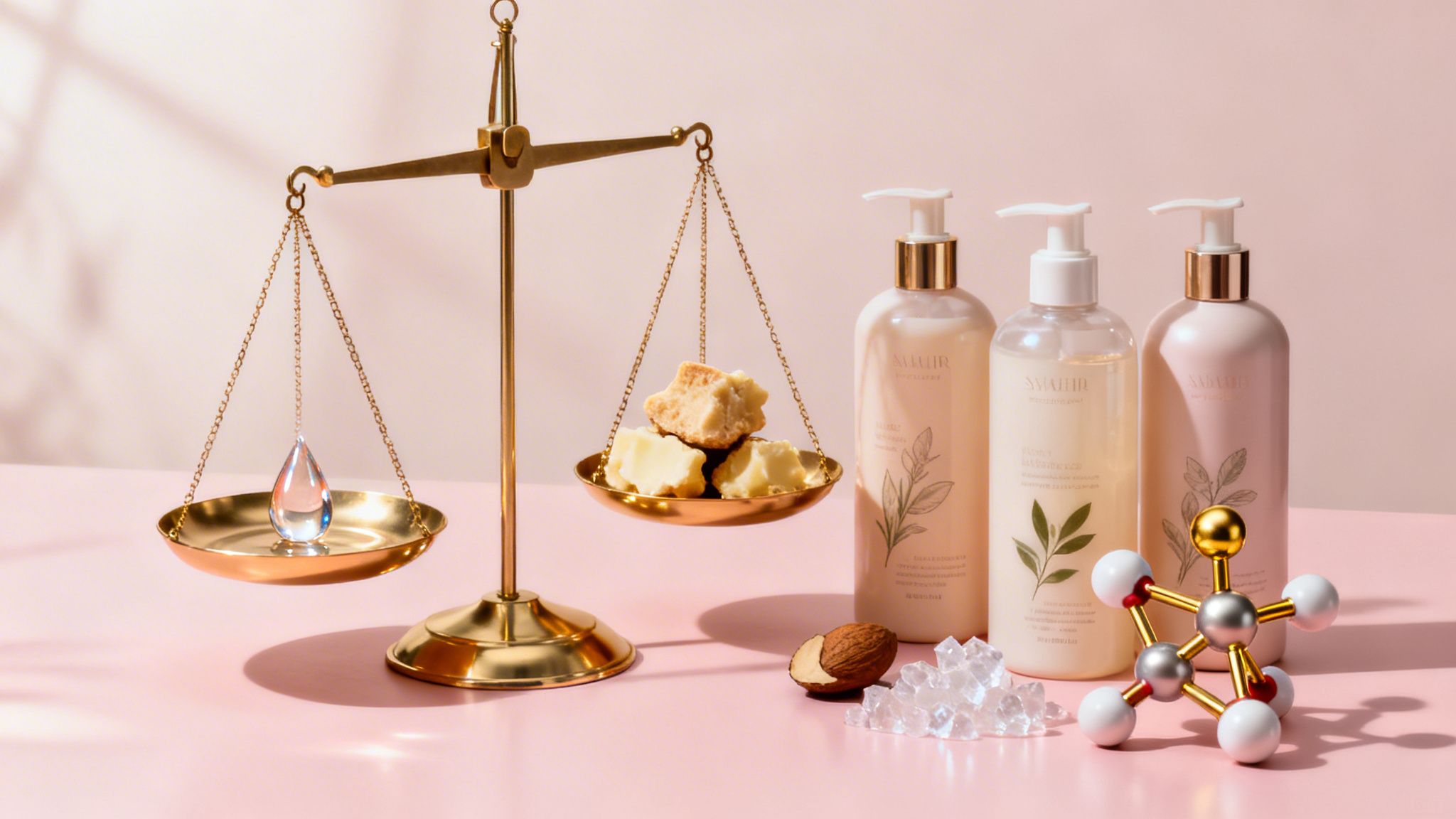
Let's get one thing straight: the secret to finding the best hair products for healthy hair has nothing to do with buying a single, hyped-up "miracle" product. The only products that truly work are the ones matched to your hair's unique biology.
This is how you turn your hair care routine from a frustrating gamble into a predictable success.
Why the 'Best' Hair Product Is the One Made for You

We’ve all been there—a bathroom cabinet overflowing with half-used bottles that promised the world but delivered disappointment. The truth is, that viral conditioner your favorite influencer raved about might be a total disaster for you.
Why? Because great hair care isn't universal. It’s deeply personal.
The most important shift you can make is to stop chasing popular brands and start learning what your hair is actually asking for. It's time to focus on the core pillars that build a routine that works, giving you the power to choose products that lead to genuinely healthy hair.
The Three Pillars of Your Perfect Hair Care Routine
To find what actually works, you have to look past the marketing hype on the front of the bottle and get familiar with three key biological factors. Once you get these down, you'll never look at a product shelf the same way again.
Think of these pillars as your new strategy, moving you from guesswork to a science-backed approach for choosing the right products every time.
The Three Pillars of Your Perfect Hair Care Routine
| Pillar | What It Means for Your Hair | Why It's Your Secret Weapon |
|---|---|---|
| Ingredient Knowledge | Understanding which ingredients to look for (like humectants) and which to avoid (like harsh sulfates). | This gives you direct control over your hair’s health, letting you spot the heroes and villains on any label. |
| Hair Porosity | Your hair's unique ability to absorb and hold onto moisture. Low porosity resists moisture, while high porosity soaks it up fast. | It’s the #1 factor in determining which product formulas will actually work for you, not just sit on top or disappear. |
| Protein-Moisture Balance | Just like a healthy diet, your hair needs a specific balance of protein (for strength) and moisture (for flexibility). | Knowing this balance prevents the two biggest problems: brittle, straw-like hair (too much protein) or limp, gummy hair (too much moisture). |
This focus on personal hair biology isn't just a trend; it's a fundamental shift in how we approach hair care. The global market is projected to hit $216.94 billion by 2034, driven by people like you demanding ingredient transparency and products made for their specific needs.
You're part of a movement that's forcing brands to be better. It's about making informed, science-backed decisions instead of just crossing your fingers and hoping for the best.
The most effective hair routine is not one you find, but one you build. It starts with knowing your hair's unique blueprint—its type, porosity, and specific needs.
The first step in building that custom regimen is to master different hair textures, tailored care, and product tips. Getting this knowledge under your belt is what will finally deliver real, lasting results.
Instead of trying to figure it all out alone, you can get a head start. A great first step is to build your personalized hair routine with a tool designed to analyze your hair profile and point you toward the right types of products from the get-go.
Decoding the Ingredient Label Like a Pro

Ever stared at a shampoo bottle and felt like you needed a chemistry degree? You're not alone. The front of the bottle is all about marketing—empty promises of "silky," "revived," and "luminous" hair.
But the back of the bottle? That’s where the truth lives.
Learning to read an ingredient list is the single most powerful skill you can develop in your search for genuinely healthy hair. It lets you see right through the hype and focus on the science, giving you the confidence to know exactly what you’re putting on your scalp and strands.
The Heroes and Villains of Hair Care
Think of an ingredient list like a cast of characters in a movie. Some are the heroes, working hard to hydrate and strengthen your hair. Others are the villains, causing dryness, buildup, and damage over time.
Your job is to learn how to spot them.
Common "Villains" to Watch For:
- Harsh Sulfates (e.g., Sodium Lauryl Sulfate): These are powerful detergents, a lot like what you’d find in dish soap. While they create that satisfying lather, they can strip your hair and scalp of their natural, protective oils, leaving you with dryness, irritation, and frizz.
- Drying Alcohols (e.g., Alcohol Denat, Isopropyl Alcohol): Not all alcohols are bad, but these short-chain types evaporate in a flash, taking your hair's precious moisture along with them. They're often used in styling products and can leave your hair feeling brittle and weak.
- Certain Silicones (e.g., Dimethicone): Some silicones offer that instant slip and shine, which feels amazing at first. The problem is, non-water-soluble silicones build up on the hair shaft, creating a plastic-like film that blocks moisture from getting in. Your hair ends up dull and lifeless underneath.
Instead of trying to memorize every impossible-to-pronounce chemical name, focus on understanding ingredient categories. Knowing the difference between a humectant and an emollient is far more useful than remembering "behentrimonium methosulfate."
If you’re ever stuck on an ingredient, don't just guess. You can instantly analyze your ingredients with our label scanner to get a simple, clear breakdown of what’s helping and what’s hurting.
Celebrating the Ingredient Heroes
Now for the good guys. These are the ingredients that actively work to give you healthy, resilient hair. When you spot these high up on the list (ingredients are always listed in order of concentration), you know you’re on the right track.
Beneficial "Heroes" to Look For:
- Humectants (e.g., Glycerin, Hyaluronic Acid, Panthenol): These are moisture magnets. They literally pull water from the air and draw it deep into the hair shaft, delivering serious hydration and making your hair more elastic and less prone to snapping.
- Emollients (e.g., Shea Butter, Coconut Oil, Argan Oil): These ingredients lock it all down. They create a soft, protective seal over the hair cuticle, trapping all the moisture that humectants attracted. The result is smoother, softer, and much shinier hair.
- Proteins (e.g., Keratin, Collagen, Silk Amino Acids): These are the actual building blocks of your hair. They act like spackle, filling in the tiny gaps and cracks in a damaged hair cuticle. This reinforces the hair's structure, making it stronger and more resistant to breakage.
To get an even better handle on how these ingredients come together, especially in targeted treatments, you can go deeper into decoding hair growth serum ingredients and see what they really do for your hair.
Ultimately, the goal is simple: find products where the heroes far outnumber the villains. This knowledge transforms you from a confused shopper into an empowered expert on your own hair care. You'll finally be able to choose products based on performance, not just promises.
Mastering Your Hair's Protein and Moisture Balance
Think of your hair like it needs a balanced diet. Just like your body, it thrives on the right mix of nutrients to stay strong and healthy. For your hair, the two most critical "nutrients" are protein and moisture. Getting the balance between them right is the key to finally finding products that actually work.
When that balance gets out of whack, your hair will definitely let you know. Too much of one and not enough of the other creates a whole set of predictable problems. Understanding these signs is what will transform your shopping trips, letting you choose between a strengthening treatment and a hydrating mask with total confidence.
What Is Protein Overload?
Does your hair feel brittle, wiry, or almost like straw? Does it snap with just a little bit of tension? If so, you're likely dealing with protein overload. This is what happens when you've piled on too many products packed with proteins like keratin or collagen, making the hair shaft too rigid and stripping it of its natural elasticity.
It’s an incredibly common problem, especially for those of us trying to fix damage and maybe going a little too hard with the strengthening treatments. While protein is absolutely vital for building structure, too much of a good thing leaves your hair stiff and prone to breaking.
What Is Moisture Overload?
On the flip side, we have moisture overload, sometimes called hygral fatigue. If your hair feels mushy, limp, or almost gummy when it's wet, you might be here. Hair that’s overly soft and just won't hold a curl or style has too much moisture and not enough protein to give it structure.
This usually comes from over-conditioning or constantly using super-hydrating products that don't have any strengthening ingredients. Your hair becomes so elastic that it loses its internal backbone, leading to that frustrating, lifeless look with zero volume.
A quick strand test can give you a pretty good clue. Gently stretch a single, clean strand of hair that has naturally shed. If it snaps almost immediately with no give, you could have excess protein. If it stretches on and on before finally breaking, you might have too much moisture. A healthy strand will stretch just a bit, then bounce back.
How to Diagnose the Imbalance
Guessing whether you have too much protein or moisture can send you down a rabbit hole of buying the wrong products and accidentally making things worse. For a clear answer, you need a more reliable way to diagnose the problem.
Here’s an example of what an interactive diagnostic tool can do for you.
This shows how a simple quiz can analyze your hair's specific symptoms and give you an immediate, actionable result. A tool like this takes the guesswork completely out of the equation and gives you a clear path forward.
Instead of just guessing, you can quickly take our Protein Overload Test and get an instant analysis. This empowers you to fix the specific issue head-on, whether that means finding a protein-free deep conditioner or adding a light protein treatment to your routine. Nailing this balance is also a huge part of building an effective low porosity hair routine, since that hair type is notorious for protein buildup.
When you can accurately identify the issue, you can pick products that give your hair exactly what it’s craving. This targeted approach is way more effective than randomly trying different masks and conditioners, saving you time, money, and a lot of frustration on your journey to healthier hair.
Why Hair Porosity Is Your Most Important Statistic
If you’ve ever felt like you’re just throwing spaghetti at the wall with hair products—trying what works for your friends only to be disappointed—porosity is the reason why. Forget curl pattern or thickness for a second. Porosity is the single most important trait determining how your hair behaves with products.
Think of your hair’s outer layer, the cuticle, as being covered in tiny shingles. Porosity simply describes how open or closed those shingles are. This one factor dictates whether your expensive conditioners and fancy creams can actually get inside the hair shaft or if they just sit on top, weighing your hair down without doing much good.
The Three Levels of Hair Porosity
Every head of hair falls into one of three porosity categories: low, medium, or high. Each one has a completely different personality, and if you’re using products designed for the wrong one, you’re setting yourself up for failure. It’s the root cause of countless bad hair days.
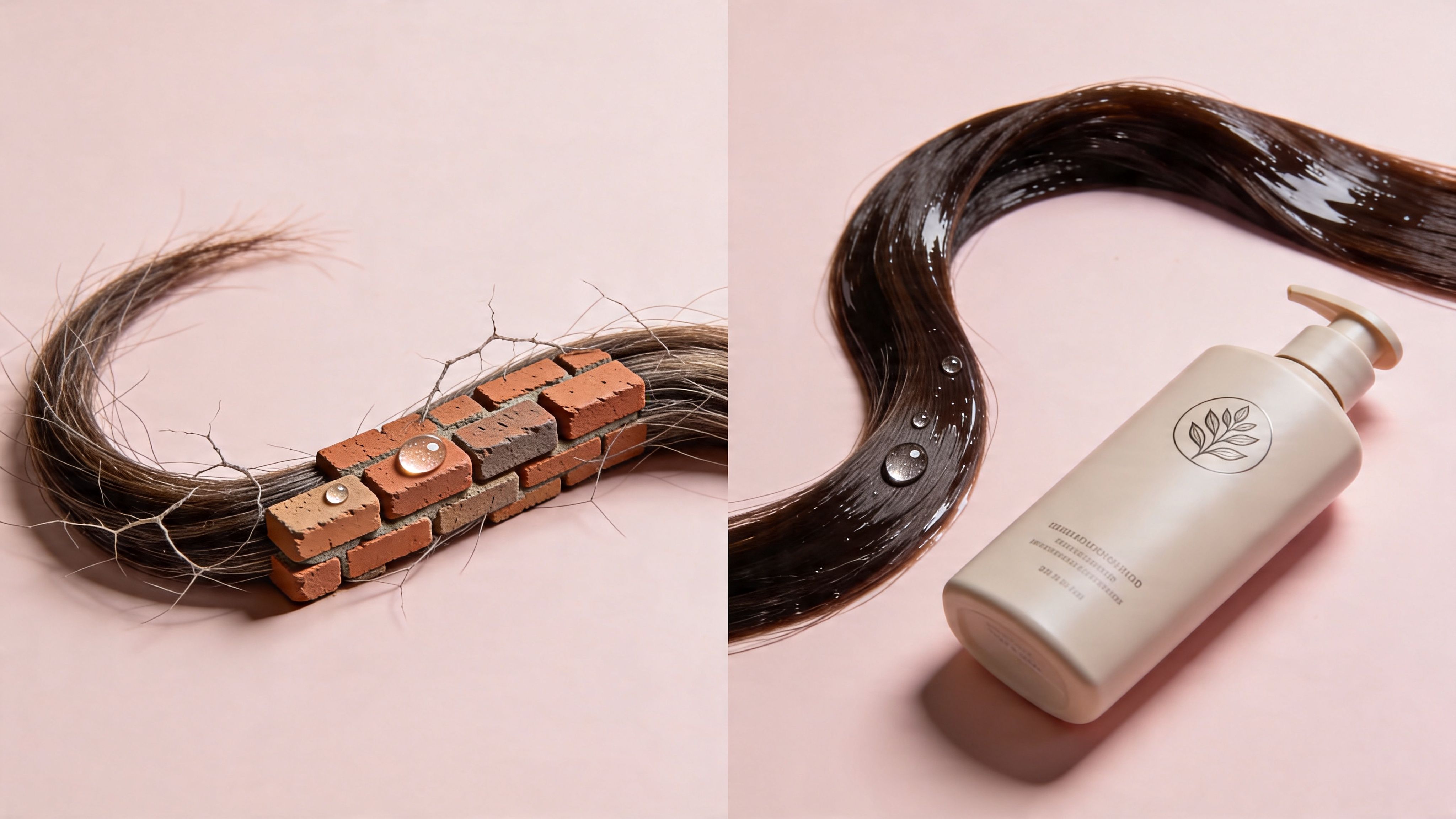
Low Porosity: The shingles on this hair type are clamped down tight, like a sealed-up raincoat. It’s naturally resistant to moisture, which means water and products have a hard time getting in. This hair is often shiny and healthy-looking, but it’s notorious for product buildup because formulas just coat the surface instead of sinking in.
Medium Porosity: This is the “just right” sweet spot. The cuticles are slightly looser, allowing moisture to get in easily but not escape too quickly. It’s the easiest to manage, holds styles well, and generally plays nice with most products.
High Porosity: This hair is more like a sponge. The shingles are wide open, often due to damage from heat or chemical treatments, but it can also be genetic. It soaks up water and products instantly, but it can't hold onto that moisture. The result? Chronic dryness, frizz, and a tendency to break.
At its core, great hair care is all about balance—the balance between protein (for strength) and moisture (for elasticity). Porosity is the gatekeeper that determines how your hair achieves this harmony.
This is the constant push-and-pull your hair routine is trying to solve. You need both structure and flexibility for healthy hair.

Matching Products to Your Hair's Porosity Level
Once you know your hair's porosity, you can finally choose products with confidence. This quick guide will help you match the right product textures and ingredients to your hair's needs.
| Hair Porosity | Ideal Product Texture | Key Ingredients to Look For |
|---|---|---|
| Low Porosity | Lightweight lotions, milks, sprays, water-based formulas | Glycerin, aloe vera, honey, panthenol, lighter oils (jojoba, argan) |
| Medium Porosity | Creams, lotions, light oils | Can use a mix of light and rich ingredients depending on hair needs |
| High Porosity | Rich creams, butters, heavy oils, sealing ointments | Shea butter, mango butter, coconut oil, castor oil, protein treatments |
Getting this right means no more greasy buildup for low-porosity folks and finally locking in moisture for the high-porosity crowd.
How To Find Your Porosity Level
You don’t need a science lab to figure this out. There are simple at-home tests, but the most reliable way is to observe how your hair behaves.
Does your hair take forever to get wet in the shower? Or does it get soaked instantly? Does it air-dry in an hour or take all day? These are all clues.
To take out the guesswork, a well-designed quiz can give you a definitive answer in minutes. It walks you through targeted questions about your hair's habits to pinpoint your type. You can easily check your hair porosity with our free tool to get a definitive answer.
For instance, knowing you have high porosity hair is a game-changer. You can immediately start building a high porosity hair routine focused on sealing the cuticle with richer creams and oils to trap hydration.
This isn't about just buying more stuff; it's about buying the right stuff. Understanding your porosity is the shortcut to finally building a routine that feels like it was designed just for you.
Building Your Personalized Healthy Hair Routine
Alright, you’ve done the hard part. You know what to look for on an ingredient label, you get the whole protein-moisture balance thing, and you’ve figured out your hair’s unique porosity.
Now for the fun part: putting it all together. Think of this as the final assembly, where you take all the right pieces and build a routine that’s perfectly engineered for your hair.
This isn’t about buying a bunch of popular products and hoping for the best. It’s about being strategic. We’re going to choose each product—from your shampoo to your styler—so they all work together. This is how you finally break that frustrating cycle of trial-and-error and start seeing the healthy, consistent results you’ve been aiming for.
The Core Building Blocks of Your Routine
A solid routine always comes down to four essential stages. The "best" product for each stage is simply the one that meets the specific needs you’ve already uncovered. Your porosity, density, and protein needs should be the driving force behind every single choice.
Cleansing: The goal here is simple: get rid of buildup without stripping your scalp and hair. If you have low-porosity hair that gets weighed down easily, a good clarifying shampoo is your best friend. But if your hair is high-porosity and always feels thirsty, a gentle, sulfate-free co-wash will be a much better fit.
Conditioning: This is where you put back the moisture you lost during cleansing. High-porosity hair drinks up richer conditioners packed with butters and oils to help seal that open cuticle. On the other hand, low-porosity hair does much better with lighter, water-based formulas that hydrate without leaving a greasy film.
Treating: This is your chance to really target specific issues like damage, extreme dryness, or a cranky scalp. Based on what your hair is telling you, you’ll know whether to reach for a strengthening protein mask or a deeply hydrating, protein-free treatment.
Styling: Your stylers should do more than just hold a curl or tame frizz; they should protect your hair. This means picking leave-in conditioners and gels that are full of ingredients that support your hair's health all day long.
Think of yourself as an architect for your hair. Every product you choose is a deliberate decision based on a single blueprint: your unique hair profile. When every piece is selected for a reason, the final result is a routine that's strong, balanced, and incredibly resilient.
Your Personal Hair Care Architect
Instead of trying to remember all these variables yourself, you can use a tool that does the heavy lifting for you. A smart system can take your hair’s data and build a complete, step-by-step plan.
Here’s a look at how your concerns get translated into a routine built just for you.
This shows how specific issues—like frizz or damage—are used to construct a custom routine with clear product functions for every step. It takes all the guesswork out of the equation and makes sure every product has a purpose.
A smart tool essentially becomes your personal hair care architect, factoring in everything to create a plan that just works. If you're ready to stop guessing, you can build your personalized hair routine and get a clear roadmap today.
For those with textured hair, you can also dive deeper into the specifics of a great curly hair routine to make sure every product works together for your healthiest hair ever.
Frequently Asked Questions About Healthy Hair Care
Switching up your hair care always brings up a few questions. Let's tackle some of the most common ones so you can build your new routine with total confidence.
How Long Does It Take to See Results?
This is a marathon, not a sprint. While a great conditioner can give you instant softness, the real, foundational changes take time.
You'll likely notice less breakage within a few weeks. But for significant improvements in hair health, density, and growth, you need to stick with it for at least three to six months. Consistency is everything—it's far more important than any single "miracle" product.
Is Clarifying Shampoo Safe for My Hair?
Absolutely, as long as you use it correctly. Think of a clarifying shampoo as your hair’s reset button. It’s a deep cleanse that removes all the stubborn stuff your regular shampoo leaves behind, like product buildup, heavy oils, and hard water minerals.
If your hair is dry, damaged, or color-treated, be strategic. Use it once or twice a month at most, and always follow up with a deep conditioner to put that moisture right back in. It’s a specialized tool, not your daily driver.
For ongoing issues like an itchy or flaky scalp, a more targeted solution is usually better. You can take our Scalp Sensitivity Quiz to pinpoint exactly what your scalp needs and find the right products.
I'm on a Budget, What's the Most Important First Step?
If you can only change one thing, start with what's free: knowledge. The most powerful first step you can take is to truly understand your hair's unique profile. Before you spend a dime, find out your hair type and porosity.
The most expensive product is the one that doesn't work for you. Understanding your hair is free and provides the greatest return on investment by ensuring every future purchase is an effective one.
Taking a quick Hair Type Quiz is the fastest way to get started. Once you know your hair's needs, you can easily find affordable, effective options with the right ingredients.
Ready to stop the guesswork and start building a routine that actually delivers? The IsItClean Hair Routine Builder is the smartest place to begin. It analyzes your unique hair profile to generate a personalized plan, ensuring every product you choose moves you closer to your healthy hair goals.