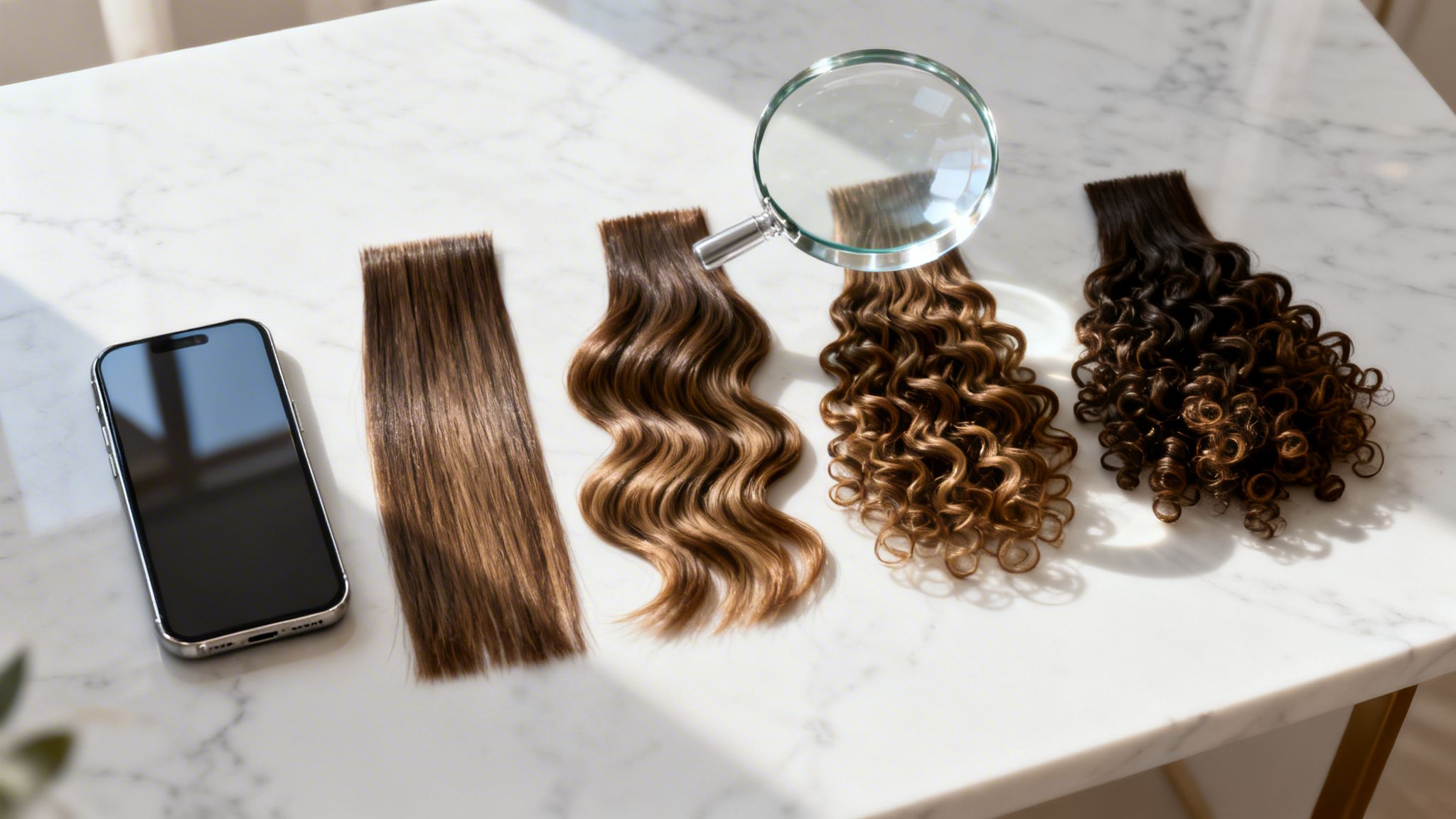
A hair type quiz is your personal roadmap to understanding what your hair actually needs. It’s a set of simple questions that goes way beyond just "is it curly or straight?" to give you a full picture of your hair's personality—its curl pattern, porosity, density, and more. Think of it as the cheat sheet for choosing the right products and finally building a routine that works.
Your Journey to Finally Understanding Your Hair
Let's be honest—walking down the hair care aisle feels like a high-stakes guessing game. You see products promising miracles, spend your money, and end up with hair that’s greasy, frizzy, or just… meh.
The problem isn't your hair. It's the one-size-fits-all marketing that completely ignores your hair's specific needs. This guide is your first real step toward a hair care routine that’s actually designed for you, and it all starts with a proper hair quiz.
We're going to break down why knowing details like your porosity and density is the secret to unlocking your best hair ever. It’s time to end the cycle of confusion and frustration and discover what your hair has been trying to tell you all along.
Key Hair Characteristics a Quiz Uncovers
A good quiz won't just ask if you have frizz. It dives deeper to measure the core factors that dictate how your hair behaves and reacts to everything you put on it. Getting this information is like finally being handed the instruction manual for your own hair.
Here’s a quick look at the essential data points a comprehensive quiz will give you.
Key Hair Characteristics Your Quiz Will Uncover
This table provides a quick overview of the essential hair attributes measured by a comprehensive hair type quiz and why each one is critical for your routine.
| Hair Characteristic | Why It Matters for Your Routine | Common Question It Answers |
|---|---|---|
| Curl Pattern | Determines the shape of your hair (straight, wavy, curly, coily) and its basic styling needs. | "Why won't my hair hold a curl?" or "How do I get my curls to clump?" |
| Porosity | Measures how easily your hair absorbs and holds onto moisture. This is key for product selection. | "Why do some products just sit on my hair while others disappear instantly?" |
| Density & Thickness | Density is how many hairs you have; thickness is the width of each strand. This dictates product weight. | "Why do heavy creams make my hair greasy and flat?" or "Why do my styles lack volume?" |
| Scalp Sensitivity | Identifies if your scalp is oily, dry, balanced, or prone to irritation. | "Why is my scalp always itchy, even after I wash it?" |
Understanding these four pillars is the foundation for building a routine that delivers consistent, healthy results instead of just hoping for the best.
Curl Pattern: This identifies the shape of your hair strands, from pin-straight (Type 1) to tight coils (Type 4). It's the most visible trait and a major factor in how you'll style your hair.
Porosity: This is all about how well your hair can absorb and hold onto moisture. It’s the reason some products feel like they sit on top of your hair, while others soak in immediately. Getting this right is a game-changer, and you can always confirm your results with an at-home hair porosity test.
Density & Thickness: Density tells you how many individual strands are packed onto your scalp (low, medium, or high), while thickness refers to the width of a single strand (fine, medium, or coarse). These two metrics are crucial for knowing if your hair needs lightweight lotions or can handle rich, heavy butters without being weighed down.
Ready to stop guessing? The first step is getting your personalized results. Take our IsItClean Hair Type Quiz to begin your path to healthier, happier hair.
What a Hair Type Quiz Actually Measures
A good hair type quiz does way more than just tell you if your hair is "straight" or "curly." Think of it as a diagnostic tool, one that decodes your hair's unique biological blueprint. It goes beyond what you see in the mirror to measure the core traits that dictate how your hair behaves, reacts to products, and holds a style.
The most obvious thing a quiz looks at is your curl pattern, which is usually broken down using the Andre Walker Typing System. This gives you a simple visual language for your hair, from Type 1 (straight) and Type 2 (wavy) to Type 3 (curly) and Type 4 (coily). But just knowing your curl pattern is only the first piece of a much bigger puzzle.
More Than Just Curls
To get the full story, a truly great quiz has to dig into several other critical factors. These are the metrics you can't always see, but they have a massive impact on your hair's health and how it looks. Getting this information is like finally receiving the official owner's manual for your hair.
This diagram breaks down the main components a comprehensive quiz will measure to define your true hair type.

As you can see, your real hair type is a combination of your curl pattern, porosity, and density—not just one of these on its own.
These traits vary wildly between people. For instance, did you know that thick hair is most common in African populations at 40.7%, but only 26.2% in Asians? And with wavy hair showing up in about 40-43% of people across different ethnicities, it's pretty clear there's no such thing as "normal" hair. A quiz helps you find your specific place on this spectrum. If you're one of the 29.2% of women with thin hair, what you need is completely different from someone with thick hair. You can check out more fascinating hair insights from this global study.
The Big Three Hair Metrics
Let's break down what these crucial metrics actually mean for you. A solid quiz will look at each one to give you advice you can actually use.
Porosity: Think of this as your hair's thirst level. It's a measure of how easily your hair's outer layer—the cuticle—lets moisture in and out. Low porosity hair has a tightly sealed cuticle that resists moisture, while high porosity hair has gaps that soak up water fast but lose it just as quickly.
Density: This is simply the number of individual strands you have on your scalp. Someone with low-density hair might need volumizing products to create fullness, while a person with high-density hair can usually handle heavier creams and butters without their hair getting weighed down.
Thickness (or Texture): This is all about the diameter of a single strand of your hair—is it fine, medium, or coarse? Fine hair is delicate and gets weighed down easily. Coarse hair is strong, but it can also be prone to dryness and often needs a lot more moisture.
Understanding these elements is a game-changer. It’s the difference between randomly grabbing products off the shelf and strategically picking ones that are practically guaranteed to work with your hair's specific biology.
Once you have this data, you stop guessing and start knowing. Instead of wondering why a "hydrating" cream left your hair feeling greasy, you'll understand that it was simply too heavy for your fine, low-density strands. The end goal is to use this knowledge to build your personalized hair routine, making sure every single product you use is a perfect match for what your hair truly needs.
Decoding Your Hair Type Quiz Results
You’ve taken the hair type quiz, and now you have your results. But what does a label like "Type 3a, Low Porosity, High Density" really mean for how you wash, treat, and style your hair every day? Let's translate those terms into a practical, real-world game plan.
Think of your results as a personalized roadmap for your hair. Each piece of information—curl pattern, porosity, density—tells you which ingredients will be your best friends and which ones you need to avoid. For instance, if your results came back as Type 3 curly, you’re in a unique club. Only about 11% of people worldwide have naturally curly hair, a texture that is structurally drier and more fragile than straight hair. Learn more about global curl patterns and their needs.
For you, this means prioritizing hydration isn't just a good idea; it's the entire foundation of a healthy routine.
From Labels to Actionable Insights
Your quiz results aren't just a new way to describe your hair—they're your specific set of instructions. Let's break down how to read each part of your new hair profile.
The IsItClean quiz gives you a clear snapshot of your hair's complete identity, like in this example result.
This visual summary gives you the full picture at a glance, from your wave or curl pattern all the way down to your scalp’s current condition.
Now, let's turn that information into a concrete plan.
If you have Type 3 (Curly) or Type 4 (Coily) Hair: Your biggest battles are probably against frizz and dryness. Moisture is everything. You'll want to look for products loaded with hydrating ingredients and make a deep conditioner or hair mask a non-negotiable part of your weekly routine. For a complete guide, you can dive into our dedicated curly hair routine.
If you have Low Porosity Hair: Your hair has a tightly sealed outer layer (the cuticle), which makes it tough for moisture to get in or out. This is why heavy butters and thick oils often just sit on top, leaving your hair feeling greasy and weighed down. The secret is using lightweight products with humectants (like glycerin or aloe vera) and applying them to damp hair to help them absorb properly.
If you have High Density Hair: This simply means you have a lot of individual hair strands on your head. The good news? Your hair can handle richer, heavier products without looking flat. You can be more generous with leave-in conditioners and styling creams to make sure every single strand gets the nourishment it needs.
Putting Your Knowledge to the Test
Understanding your results is the first, most important step. The next is to take a hard look at the products sitting on your shower shelf. Do they actually align with what your hair needs?
Now that you have your hair's profile, it's the perfect time for a product audit. It’s incredibly common to find out you’ve been using ingredients that work against your hair type. For example, harsh sulfates will strip the essential oils from already-dry curly hair, and you can check your product ingredients to see if silicones are building up on your low-porosity hair, blocking out moisture entirely.
Key Takeaway: Your hair type quiz results are your guide. They empower you to stop the guesswork and start making informed decisions about the products you buy and the techniques you use.
The goal here is to connect your specific results to a perfectly matched routine. Instead of grabbing another random product hoping it will work, you can now use your knowledge to build your personalized hair routine with total confidence, choosing only products that are guaranteed to work for your unique hair.
Why Your Scalp Health Matters Just as Much

We spend so much time focused on our hair strands, but a great hair type quiz knows the secret: it all starts at the root. We often forget that healthy hair grows from a healthy scalp. Think of your scalp as the soil in a garden—if the soil is nutrient-poor or unbalanced, you can't expect the plants to flourish.
When your scalp is off-kilter, it shows. An oily scalp will make even freshly washed hair look weighed down and greasy. On the flip side, a dry, tight scalp often leads to constant itching, flakes, and hair that looks dull and brittle. Trying to fix your hair without addressing your scalp is like building a house on a shaky foundation. It’s a battle you just can't win.
Connecting Scalp Condition to Hair Problems
Figuring out your scalp's unique needs is the key to unlocking the right product routine. It’s not just about what your ends need; your shampoo, in particular, has to work for your scalp first and foremost.
- For an Oily Scalp: You might reach for a clarifying shampoo to cut through the grease, but the trick is to find one that removes buildup without stripping your hair entirely. The goal is a happy balance, not total oil annihilation.
- For a Dry or Flaky Scalp: This is where gentle, sulfate-free shampoos really shine. You'll want to look for products packed with soothing, hydrating ingredients that calm the skin instead of causing more irritation.
- For a Sensitive Scalp: Your mission is to avoid common triggers like fragrances and harsh alcohols. A calm, happy scalp is essential to keeping redness and discomfort at bay.
Key Insight: So many of our biggest hair frustrations—from frizz and flyaways to a total lack of volume—are actually symptoms of an unhappy scalp. The only way to get genuinely healthy hair is with a routine that treats both your scalp and your strands.
If you have a hunch that your scalp is the real troublemaker, you need to get more specific. A great next step is to take a dedicated Scalp Sensitivity Quiz to pinpoint exactly what's going on.
For an even deeper look, advanced methods like a Hair Tissue Mineral Analysis (HTMA) can reveal mineral imbalances and toxins that often show up in our scalp and hair health. Once you have the full picture, you can finally build your personalized hair routine with products that get everything right, from the root down.
Solving Common Hair Problems with Your Results
This is where all that information from your hair type quiz really starts to click. Think of your results as the decoder ring for your hair's frustrating behavior. Instead of just fighting against frizz or limpness, you can finally understand why it's happening and work with your hair's natural tendencies.
Let's connect your new hair profile to some of those all-too-common complaints.
Your quiz results are the "why" behind the daily struggle. For instance, if you discovered you have wavy (Type 2) or curly (Type 3) hair with high porosity, you're basically set up for a battle with frizz. It's not your fault! The raised, open cuticles of high-porosity hair act like a sponge, soaking up every bit of moisture from the air, which causes the hair shaft to swell and create that dreaded frizz halo.
From Problem to Solution
Once you see these connections, you can stop guessing and start choosing real solutions. It’s no longer about grabbing the first "anti-frizz" serum you see. It's about finding a product that specifically addresses your high porosity and your curl pattern.
Problem: Frizz & Dryness: A classic sign of high porosity and curly/wavy hair. Your strands lose moisture just as fast as they absorb it. The solution? Products with sealing ingredients that lock that precious hydration in.
Problem: Breakage: This almost always points to a protein-moisture imbalance or high porosity. You can test for protein overload to see if you have too much, but fragile hair often needs both moisture for flexibility and protein for strength.
Problem: Limp, Lifeless Hair: Usually a symptom of fine, low-density hair that's being suffocated by heavy products. Your hair is begging for lightweight formulas that add volume without weighing it down.
Key Takeaway: Your quiz results expose the root cause. Frizz isn't just a bad hair day—it's a direct symptom of your hair’s physical structure and porosity level.
Your hair's natural state is a huge piece of the puzzle, too. Globally, dark brown or black hair is the most common, making up 75-85% of the population, while only 2-3% of people are natural blondes. This is important because chemically treated hair—especially when bleached to go from dark to light—has a fundamentally altered structure. It becomes far more prone to damage, a major concern for the 47% of women who color their hair. Your quiz helps you account for this damage so you can focus on protective, restorative ingredients.
Applying Your Knowledge
Okay, let's put this into practice right now. The first, most powerful step is to take a hard look at your current products. Are you unknowingly using heavy butters on your fine hair? Or stripping your color-treated, high-porosity strands with a harsh sulfate shampoo?
For a masterclass in building a routine around this specific issue, check out our complete guide to creating a high porosity hair routine.
You can even take the guesswork out completely. Pop your current products into a tool that can analyze your hair care routine to see if they contain ingredients that are secretly sabotaging your goals. This is how you break the cycle of expensive trial-and-error and start building a routine that actually works for your hair's unique blueprint.
Building Your Perfect Hair Care Routine

Alright, you've got your quiz results. Now what? It's time to put that knowledge to work and build a routine that actually solves your hair problems instead of creating new ones.
This is where you stop guessing in the hair care aisle. Your quiz results are the key to making smart, intentional choices, turning your unique hair profile into your most powerful shopping tool.
From Quiz Results to Product Choices
Let's break down how to turn those results into a real-world routine. It all comes down to matching your hair’s specific needs with the right ingredients and product types.
For Low Porosity, Coily Hair: Your biggest struggle is getting moisture past the hair's tightly sealed cuticle. The fix? You need to seek out lightweight, water-based products and steer clear of heavy butters or oils that just sit on top, weighing your hair down. A focused low porosity hair routine will incorporate tricks like using gentle heat with your deep conditioner to help it actually sink in.
For Fine, High Porosity Waves: Your hair is probably a sponge—it soaks up moisture quickly but loses it just as fast, leaving you with frizz and fragile strands. Protein treatments are going to be your best friend for reinforcing your hair structure, but you have to pair them with lightweight stylers that won't kill your delicate wave pattern.
And if you're dealing with more persistent issues like noticeable thinning or loss, your quiz results give you a solid foundation for discussing more advanced hair restoration options with a professional.
Key Takeaway: Your quiz results aren't just labels; they are your personal shopping guide. They tell you exactly what your hair needs to thrive, ending the cycle of buying products that don't work.
This is how you finally graduate from knowing your hair type to loving your hair. The smartest, most foolproof next step is to build your personalized hair routine with our tool. It automatically translates your quiz results into a full, ingredient-safe regimen designed just for you.
Frequently Asked Questions About Hair Type Quizzes
Got a few more questions? Let's clear up some of the most common uncertainties people have after discovering their hair profile. Getting these details right helps you build a routine that actually works.
Can My Hair Type Change Over Time?
Yes, your hair profile isn't set in stone. It can and often does change throughout your life.
Major hormonal shifts from events like pregnancy or menopause can completely alter your hair's texture, density, and even your curl pattern. Similarly, chemical services like bleaching, coloring, or relaxing directly impact the hair's structure, almost always increasing its porosity.
It's smart to retake a hair type quiz once a year or any time you notice a real shift in how your hair behaves.
What if My Hair Seems to Be Multiple Types?
This is perfectly normal—in fact, it's more common than having a completely uniform hair type. You might have looser waves underneath with tighter curls forming your top canopy, or a mix of different porosity levels.
The best strategy is to build your routine around the predominant hair type you have. The aim is to strike a balance that supports all of your hair, without overloading one section or neglecting another.
How Accurate Is an Online Hair Type Quiz?
A well-designed quiz is surprisingly accurate because it focuses on behavior, not just appearance. By asking targeted questions about how your hair handles moisture, its texture, and how it reacts to products, a quiz can effectively pinpoint your porosity, density, and thickness.
This gives you a solid foundation for building a routine. If you want to be even more precise, you can cross-reference your quiz results by doing a quick at-home hair porosity test to confirm exactly how your strands absorb water.
Now that you have the full picture, it’s time to put this knowledge to work. Ready to take control of your hair care for good? Use the IsItClean Hair Routine Builder to turn your quiz results into a perfectly matched routine. Finally get product recommendations that are right for your specific hair type, porosity, and goals.