You notice it in small places first. Short strands on your pillow. Tiny snapped pieces on your sweater. A brush full of hair that looks too short to be shedding. Then your ends start feeling thinner, rougher, and harder to detangle, even though you’re trying oils, masks, serums, and “repair” products that promise a lot and don’t seem to change much.
That frustration usually pushes people toward a miracle cure mindset. One oil. One mask. One expensive shampoo. But if you want to learn how to reduce hair breakage naturally, the answer usually isn’t one product. It’s figuring out why your hair is snapping in the first place and matching your routine to that cause.
Hair breaks for different reasons. Some hair is dry and under-moisturized. Some is overhandled. Some is reacting badly to harsh cleansers or buildup. And a lot of people make the same mistake with DIY care. They keep adding protein-heavy treatments to hair that already feels stiff and brittle, which can make breakage worse instead of better.
The most useful approach is part detective work, part routine repair. You look at your hair’s porosity, its response to moisture, how it handles protein, and how much friction it goes through in a normal week. Once those pieces make sense, natural remedies stop being random and start becoming effective.
The Snap That Started It All
Hair breakage rarely announces itself dramatically. It shows up in patterns. Your wash day leaves a ring of broken strands around the drain. Your ponytail looks shorter at the crown. Your ends catch on each other when you try to finger detangle. You may even think your hair has “stopped growing,” when the problem is that it’s breaking at the same rate it grows.
That’s why breakage feels so discouraging. You can be putting effort into your hair and still see less length, more frizz, and weaker strands. Many people respond by layering on more products without changing the routine that’s causing the damage.
Practical rule: If your hair keeps snapping, assume your routine needs adjustment before you assume you need a stronger treatment.
Natural care can help, but it works best when it’s specific. Coconut oil can be useful for one person and too heavy for another. Egg masks can strengthen some hair and leave other hair feeling harder and more fragile. Even something as simple as brushing can help with styling or increase mechanical damage depending on how and when you do it.
A better starting point is this. Stop asking, “What’s the best natural remedy?” Start asking, “What is my hair missing, and what is my routine doing to it every day?”
That shift changes everything. It moves you away from chasing trends and toward a routine that protects the hair you already have. Stronger hair usually comes from smaller, consistent habits. Gentler washing. Less friction. Better moisture retention. Smarter use of protein. Products that clean without stripping.
When people finally make progress with breakage, it usually isn’t because they found a miracle. It’s because they stopped guessing.
Diagnose Your Hair's True Needs Before You Act
A strand snaps after a wash day mask that was supposed to help. That usually means the hair was treated for the wrong problem.
If you treat every type of breakage the same way, you end up rotating between oils, masks, and DIYs that give mixed results. The mistake I see often in practice is using strengthening treatments on hair that already feels rigid. That hair usually needs flexibility, lubrication, and moisture retention first.
Porosity and protein-moisture balance give you a much clearer starting point.

Start with porosity
Porosity describes how easily hair takes in water and how well it holds onto it. It reflects the condition of the cuticle. A tighter cuticle resists moisture entry. A more lifted or worn cuticle lets moisture in fast, then loses it fast too.
High-porosity hair often breaks because it swells quickly, dries out quickly, and gets roughed up more easily by coloring, heat, rough towel drying, hard water, or weather exposure. Low-porosity hair can break for different reasons. Product sits on the surface, buildup accumulates, and the hair may feel coated while still lacking enough internal moisture.
If you are not sure where your hair falls, check your hair porosity. That result gives context to every conditioner, oil, and DIY treatment you try afterward.
Use these patterns as a guide:
- Low porosity hair usually does better with lightweight hydration, modest layering, and routines that avoid heavy residue.
- High porosity hair usually needs stronger conditioning, better moisture retention, and protection from friction.
- Medium porosity hair is often easier to manage, but repeated heat, color, or rough handling can still push it toward breakage.
If your strands absorb water fast, frizz easily, and dry out again by the next day, a high porosity hair routine will be more useful than copying a generic breakage routine.
Then assess protein and moisture
This is the step many articles skip, and it is where a lot of natural routines go wrong.
Hair needs both protein and moisture, but the right balance shifts with your damage level, texture, porosity, heat use, and chemical history. Protein helps maintain structure. Moisture helps hair stay pliable enough to bend without snapping. Too little structure leaves hair weak. Too little moisture leaves it stiff and fragile.
Signs your hair may need more moisture
Moisture-deprived hair often feels rough, tangles easily, and snaps with light tension. Ends may look dull or feel crisp. Wet hair may seem stretchy at first, then break because the strand has poor resilience.
I see this often with curly hair, color-treated hair, and hair exposed to frequent blow-drying or sun. The strand is not always asking for more protein. Sometimes it is too dry to flex safely.
Signs your hair may be overloaded with protein
Protein overload is one of the fastest ways to make a natural breakage routine backfire. Repeated egg masks, rice water treatments, some bond-repair products, and frequent strengthening masks can leave already stressed hair harder, less elastic, and easier to snap.
Hair that feels stiff, straw-like, or unusually rigid after “strengthening” treatments often needs less protein and more conditioning.
A common response is to keep adding more strengthening products because the hair feels damaged. That can push brittle hair further in the wrong direction. If you want another reference point, this guide on how to stop hair breakage naturally covers broad breakage triggers, but the deciding factor is still how your own hair behaves after protein versus moisture.
Look at the pattern, not just the strand
Single-strand tests help, but the weekly pattern tells you more.
Ask yourself:
- When does it snap most? During detangling, after washing, while sleeping, or after heat styling?
- Where is it breaking? At the ends, near the crown, around the hairline, or through the mid-lengths?
- What changed recently? Color services, stronger shampoo, tighter styles, more heat, more DIY treatments, or longer gaps between trims?
- How does it feel when wet? Mushy and over-stretched, or rigid and quick to snap?
Those answers usually point to the core issue faster than another product recommendation will.
A quick decision guide
| Hair behavior | Likely issue | Better natural direction |
|---|---|---|
| Feels dry, rough, and tangly | Moisture loss | Aloe-based hydration, richer conditioning, sealing oils |
| Feels stiff after protein masks | Protein overload | Reduce protein-heavy DIYs, increase conditioning and softness |
| Gets puffy, frizzy, and weak when wet | Poor moisture retention | Gentle cleansing, regular conditioning, reduced friction |
| Snaps mostly during wash day | Mechanical stress | Better detangling, gentler shampooing, less rubbing |
Once you identify the pattern, the routine gets simpler. You stop chasing every natural remedy that worked for someone else, and you start choosing what your hair can use.
Build a Breakage-Proof Routine with Clean Products
Sometimes the problem isn’t that you aren’t treating your hair enough. It’s that your routine keeps undoing the treatment. You apply a nourishing mask, then wash with a cleanser that leaves your lengths stripped. You use a good conditioner, then follow with styling products that create buildup or dryness over time.
That’s why ingredient quality matters in breakage care.

What harsh formulas do to fragile hair
Sulfate-heavy cleansers can be useful in certain situations, but breakage-prone hair usually doesn’t respond well to repeated stripping. If your scalp and lengths already lean dry, aggressive cleansing can leave the cuticle rougher and the hair less flexible between wash days.
Silicones are more nuanced. They aren’t automatically bad, but heavy or difficult-to-remove silicone layers can create a cycle where the hair feels smooth on the outside while staying dehydrated underneath. Then people add stronger shampoo to remove the buildup, and the hair gets drier again.
Drying alcohols can create a similar problem in some formulas, especially when hair is already brittle, color-treated, or highly porous. The issue isn’t a single ingredient in isolation. It’s the pattern the formula creates on your hair over time.
If your hair feels coated and dry at the same time, don’t assume you need more treatment. You may need a cleaner formula and a simpler routine.
Audit the products already in your shower
Before buying anything new, look at the products you already use most often:
- Your shampoo: Does it leave your scalp clean without making your lengths squeaky or rough?
- Your conditioner: Does it add slip and softness, or does it disappear without helping detangling?
- Your leave-in or styler: Does it help your hair stay flexible, or does it make it crunchy, tacky, or stiff by day two?
- Your oil or serum: Does it reduce friction, or is it only making hair look shinier temporarily?
Ingredient review becomes practical rather than obsessive. If you want to analyze labels more carefully, you can analyze your ingredients to spot hidden culprits that may be working against your breakage goals.
What to look for instead
Better breakage routines usually rely on products that do three jobs well:
- Clean without over-stripping
- Condition with enough slip for detangling
- Support moisture retention without leaving a dense film
For low-porosity hair, that often means lighter conditioners and leave-ins that don’t sit heavily on the strand. If that’s your pattern, a targeted low porosity hair routine can help you avoid the common trap of overloading the hair with rich products it can’t absorb well.
For wavy, curly, or color-treated hair, product interactions matter just as much as individual formulas. A shampoo may be gentle on its own, but paired with a drying styler and skipped conditioning, it becomes part of a routine that leads to breakage.
A broader ingredient perspective can also help. If you want another practical read on ingredient-aware habits and home care, Morfose has a useful guide on how to stop hair breakage naturally.
Clean doesn’t mean complicated
A breakage-proof routine usually gets better when it gets simpler. One gentle cleanser. One reliable conditioner. One leave-in or lightweight oil that adds slip and reduces friction. If you keep switching between protein masks, strong cleansers, and styling products that fight each other, your hair never gets consistency.
A good routine should make your hair easier to handle week after week. If it keeps feeling unpredictable, the formula mix may be part of the problem.
Master Gentle Handling to Minimize Mechanical Damage
You finish wash day, run a comb through what felt like soft hair in the shower, and hear that dry little snap. Then you see short broken pieces on your shirt, on the sink, and caught in the comb. In practice, that is where many breakage cases become clear. The hair is not only dry or weak. It is also being stressed too hard during ordinary handling.
Mechanical damage comes from friction, pulling, twisting, and repeated tension. It affects straight hair, curls, coils, relaxed hair, and color-treated hair. If your protein-moisture balance is already off, rough handling makes the problem show up faster. Hair that is too dry lacks flexibility. Hair that feels overly soft and stretched can still snap if you keep forcing tools through it.

The good news is simple. Technique changes often reduce breakage faster than product changes.
Rethink the way you detangle
Fragile hair does not benefit from frequent brushing. The American Academy of Dermatology advises limiting brushing, using a wide-tooth comb, and avoiding rough towel drying because these habits can worsen hair damage, as outlined in Healthline’s hair breakage overview.
Use a detangling method that respects how your hair behaves that day, not how you wish it behaved.
- Start at the ends: Remove small tangles first, then work upward section by section.
- Add slip before you detangle: Conditioner or a light leave-in reduces drag between strands.
- Match the tool to the hair state: Wide-tooth combs usually work better on damp hair. Fingers can be safer for curls, coils, and very fragile ends.
- Stop when the hair resists: If a knot is not releasing, add more slip and separate it gently instead of pulling through.
For curly or coily hair, detangling during conditioning usually causes less damage than trying to force through drying hair after rinsing. A structured curly hair wash and detangling routine can help if your hair mats easily or shrinks around knots.
One salon rule I come back to often is this. A good detangling session should leave very little hair on your tool beyond normal shed strands.
Wash in a way that protects the cuticle
Wash day creates many opportunities for breakage. Hair swells in water, the cuticle lifts more easily, and wet strands stretch under less force than dry ones. That does not mean you should avoid washing. It means the routine needs less friction and less piling up of the hair.
Use this sequence:
Loosen major knots before washing
If your hair tangles at the ends, separate those areas before water hits them.Use lukewarm water
Hot water often leaves the hair rougher, especially if it is already dry or color-treated.Cleanse the scalp with your fingertips
Let the lather travel down the lengths as you rinse. Scrubbing the ends directly usually adds wear without adding benefit.Apply conditioner with intention
Work it through mid-lengths and ends, then use that slip to gently separate tangles.Keep the hair aligned while rinsing
Avoid bunching it into a ball on top of the head. Hair tangles more when the strands are pushed against their natural direction.
If you are trying to improve growth retention as breakage comes down, that progress depends as much on handling as on supplements. This matters for readers also looking into natural supplements for healthy hair growth, because stronger growth at the scalp does not help much if length keeps snapping off.
Drying habits matter more than people expect
Wet hair is easier to stretch past its limit. The drying stage is where many careful routines fall apart.
Terry cloth towels feel absorbent, but the rough loops catch on raised cuticles. Rubbing also creates tangles you then have to detangle a second time. Pressing or blotting works better.
Better options:
- Pat or press with a microfiber towel
- Use a soft cotton T-shirt if microfiber is not available
- Blot section by section instead of scrubbing the whole head
- Let the hair dry partway before more styling if it tangles easily
A quick demonstration can help if you’re trying to change wash-day technique:
Protect your hair when you are not actively styling it
A lot of breakage happens in the background. It happens from the same tight ponytail, the same rough pillowcase, the same bun sitting on the same stressed section every day.
Small adjustments add up:
- Choose softer hair ties: Avoid metal joins and rough seams.
- Keep protective styles loose enough to move: Tension should secure the style, not strain the hairline or mid-lengths.
- Reduce friction at night: Satin or silk-like fabrics usually snag less than standard cotton.
- Rotate where you place buns, clips, and parts: Repeating tension in one spot weakens that area over time.
These habits sound basic. They are also the habits that separate hair that keeps length from hair that keeps breaking.
Nourish Hair with Natural Treatments and Nutrition
Natural treatments help most when they match the diagnosis. If your hair is dry and fragile, moisture-first remedies usually outperform protein-heavy DIY masks. If your hair feels limp, overly stretchy, and weakened after repeated moisturizing, a modest strengthening treatment may help. The mistake is using every “natural” remedy as if they all do the same thing.
A targeted routine is much more effective.

Coconut oil deserves its place
Among natural options, coconut oil has the clearest support for breakage-prone hair. A 2020 study published in PMC found that regular coconut oil applications reduced hair surface roughness by 30% in lab tests, and hair from regular coconut oil users was approximately 65% smoother than that of non-users. The same research explains that coconut oil helps by coating the hair shaft and reducing protein loss during washing.
That matters because rougher hair catches on itself more easily. Smoother hair usually handles combing, washing, and styling with less friction.
For dry, damaged, curly, or high-porosity hair, coconut oil works best as a support treatment, not as a substitute for cleansing and conditioning.
A practical way to use it is to apply virgin coconut oil to damp hair before washing, leave it on briefly, then follow with a gentle shampoo and conditioner. That tends to work better than pouring large amounts onto dry hair and hoping it will “repair” damage on its own.
Match the mask to the problem
Here’s the simplest rule. If your hair feels brittle and rigid, don’t reach for egg first. If it feels soft but weak and overstretched, don’t keep adding rich moisture without reassessing.
Moisture-focused options
These tend to suit hair that feels rough, thirsty, or easy to snap:
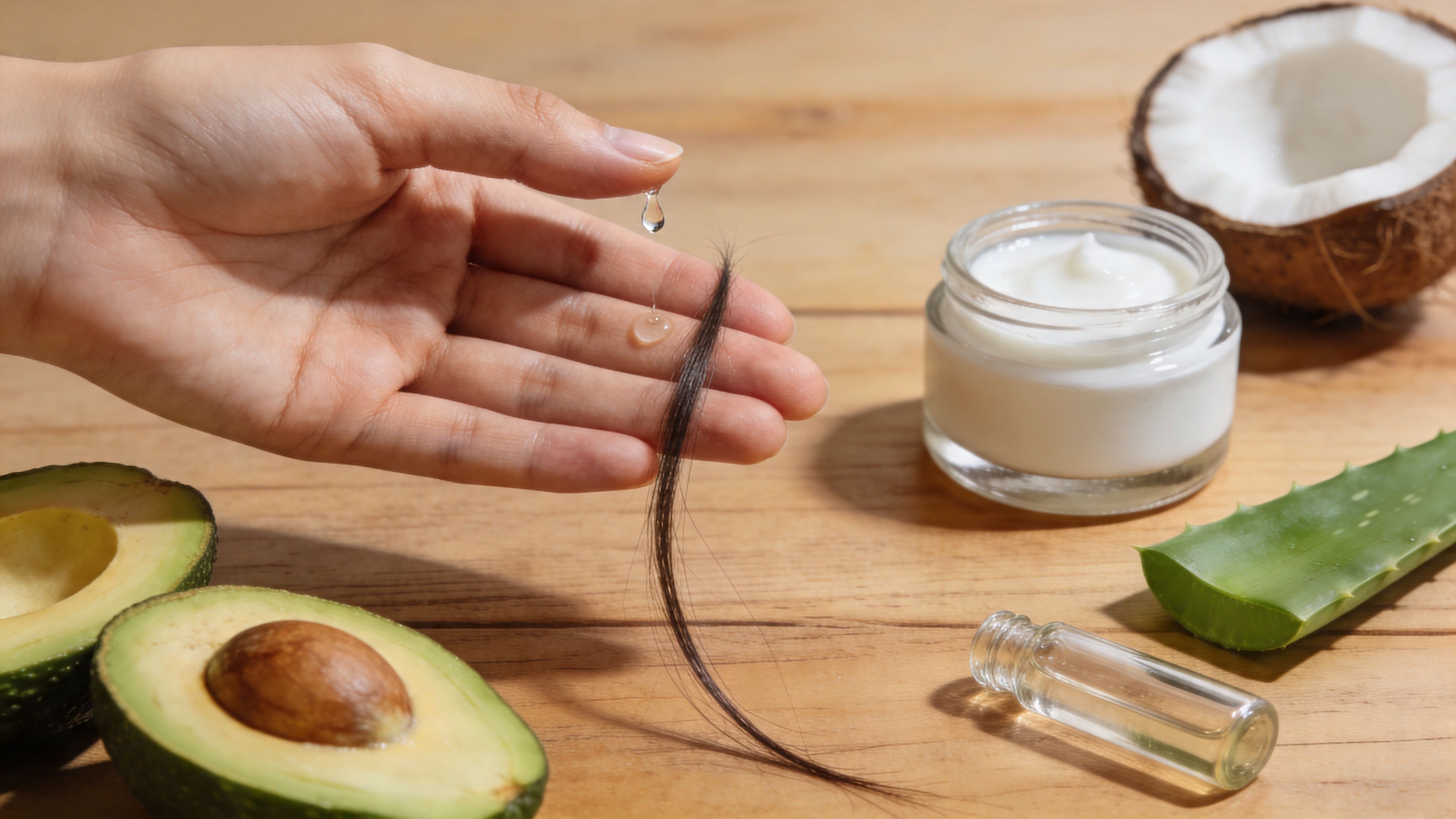
- Aloe vera gel with a little oil: Helpful for lightweight hydration and softness.
- Avocado-based masks: Better for hair that needs richer softness and flexibility.
- Honey in small amounts mixed into conditioner: Can help draw moisture in, though some hair types prefer it diluted and used sparingly.
Protein-leaning options
Use more carefully, especially if your hair already feels hard:
- Egg masks: More suitable when hair lacks structure, but easy to overdo.
- Rice-based rinses: Can leave some hair feeling stronger, but can also make fragile hair feel stiff if used too often.
- Gelatin-based DIYs: Best approached cautiously and not used as a default “repair” step.
Natural Ingredients for Your Hair Needs
| Ingredient | Primary Benefit | Best For |
|---|---|---|
| Coconut oil | Helps reduce protein loss and smooths the hair surface | Dry, damaged, curly, high-porosity hair |
| Aloe vera | Lightweight moisture and slip | Hair that feels dry but gets weighed down easily |
| Avocado | Rich softness and conditioning | Thick, coarse, or very dry hair |
| Egg | Protein support | Hair that feels overly soft or lacks structure |
| Honey | Moisture support when diluted | Dull, dry hair that needs softness |
Don’t ignore what supports the hair from inside
Topical care protects the strand you already have. Nutrition supports the strand being formed. When hair is under stress from restrictive eating, low protein intake, or general nutritional gaps, it often shows up as weaker-feeling growth over time.
It helps to build meals around consistent protein sources and foods that support overall hair health. If you want a practical overview of nutrition-focused options, this guide to natural supplements for healthy hair growth offers a useful starting point.
That doesn’t mean every breakage issue is solved by supplements. Usually it’s both. Better strand care outside the body and better support inside it.
Your Realistic Timeline for Stronger Hair
You start noticing the change in small moments first. Fewer snapped pieces on your sweatshirt. Less hair wrapped around your fingers during detangling. Ends that stop feeling like they are giving way every time you wash.
That usually happens before your hair looks dramatically longer.
Breakage recovery has two timelines. The strand you already have can feel better within weeks if you reduce stress, improve slip, and correct a protein-moisture mismatch. Length retention takes longer because damaged ends do not heal like living tissue. They either hold together better with the right care, or they keep splitting until they are trimmed.
This is why diagnosis matters. Hair that is dry, rough, and inflexible often needs more moisture support. Hair that feels limp, overly stretchy, and mushy may need light protein. Many people delay progress by treating all breakage as a moisture problem or all weakness as a protein problem. Both mistakes can keep hair brittle.
What to expect week by week
In the first 1 to 2 weeks, the goal is control. Hair should feel easier to handle, with less resistance during washing and detangling. If that is happening, your routine is moving in the right direction.
By weeks 3 to 6, the benefit is usually consistency. You see fewer short broken hairs during styling, and wash day feels less chaotic. This is also the stage where people get impatient and start changing everything again. Stay with the routine long enough to judge it properly.
By 2 to 3 months, length retention becomes easier to spot. Your ends may look fuller, trims may feel less urgent, and styles can last longer because the hair is not breaking apart as quickly. Coarser, highly textured, bleached, or high-porosity hair often needs longer to show visible improvement, even when the routine is working.
A workable weekly rhythm
A realistic schedule often looks like this:
- Wash day once or a few times weekly: Use a gentle cleanser, follow with a conditioner that gives enough slip, and let the hair tell you whether it needs softness, structure, or both.
- One pre-wash oiling session if your hair responds well to it: This tends to help dry, porous hair more than fine hair that gets limp easily.
- One targeted treatment: Choose moisture when hair feels hard, straw-like, or rough. Choose light protein when hair feels too soft, overly stretchy, or weak when wet.
- Daily low-tension habits: Keep styling simple, reduce friction, and avoid turning every knot into a pulling session.
Troubleshooting common setbacks
If your hair feels greasy
The routine may be too rich for your density, strand size, or wash frequency. Use less oil, apply it mainly to mid-lengths and ends, or skip heavy layering between washes.
If your hair feels more brittle
Reconsider recent protein exposure. I see this often with DIY routines that rely on egg, rice water, or gelatin too often. Hair can feel harder at first, but if it also starts snapping more, the balance is off. Shift back to moisture and gentler handling for a few wash cycles.
If your hair still breaks during detangling
The problem is often poor timing, not stubborn hair. Detangle when the hair has enough slip, work in sections, and stop trying to force through compact knots. If breakage is concentrated in one area, such as the nape or crown, look at tension, friction, and styling habits in that specific spot.
Improvement comes from repeatable habits. The routine that works is usually the one you can keep doing calmly every week.
Stronger hair rarely comes from chasing perfect products. It comes from matching your routine to what your hair is doing, then giving that routine enough time to work.