To get rid of dandruff, you have to go straight to the source. This usually means tackling an overgrowth of a fungus called Malassezia with the right active ingredients. But it's not just about what you use—it's about how you use it. Consistency is everything. You need to build a routine that treats the problem without stripping your hair or irritating your scalp.
Why Do I Have Dandruff All of a Sudden

It’s incredibly frustrating to suddenly find your favorite dark shirt covered in white flakes. If this is happening to you, the first thing to know is that dandruff is rarely just a case of "dry scalp." In fact, it’s often the complete opposite.
Figuring out the real cause is the only way to find a treatment that actually works. It all comes down to the microscopic world living on your scalp.
The Real Culprit Behind the Flakes
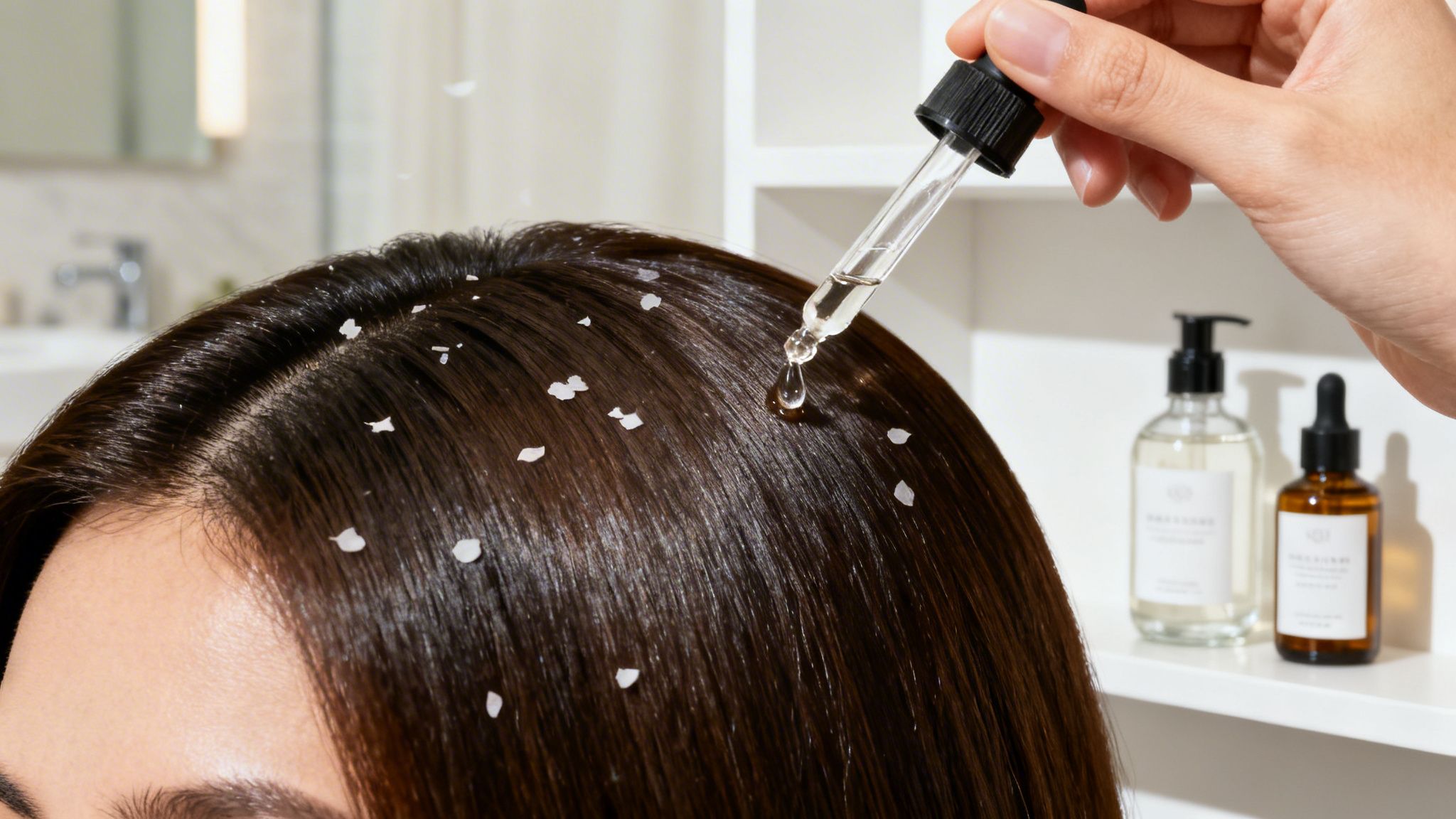
The main driver behind most cases of dandruff is a tiny, yeast-like fungus called Malassezia globosa. This microbe is a normal resident on almost every adult scalp, where it feeds on the natural oils (sebum) your skin produces. For most people, it's completely harmless.
But for about half of us, our scalps are sensitive to a byproduct of this process: oleic acid. When Malassezia breaks down your scalp's oil, it leaves this acid behind, which can trigger a pretty dramatic inflammatory response.
Key Takeaway: Your immune system basically overreacts, telling your skin cells to renew way too fast. Instead of shedding invisibly like they should, these excess dead skin cells get stuck together with oil, forming those visible white or yellowish flakes we know as dandruff.
This is exactly why just slathering on moisturizing products rarely works. You're not just fighting dryness; you're dealing with a specific biological reaction that needs a targeted solution.
Triggers That Fuel the Fire
If Malassezia is always there, why do dandruff flare-ups seem to come out of nowhere? Certain factors can create a perfect storm, either by helping the fungus multiply or by making your scalp more sensitive.
Getting a handle on these triggers is key for long-term control:
- Excess Oil Production: An oily scalp is an all-you-can-eat buffet for Malassezia. Things like hormonal shifts, stress, or just your genetics can ramp up sebum production and kickstart the whole cycle.
- Irregular Washing: If you don't shampoo often enough, you get a buildup of oil and dead skin cells. This creates the ideal breeding ground for the fungus and makes the flaking much more obvious.
- Product Sensitivity: Sometimes, what looks like dandruff is actually contact dermatitis—a reaction to an ingredient in one of your hair products. If the flakes showed up right after you tried something new, that's a huge clue. You can use a tool to analyze your ingredients and screen for potential irritants.
- Stress and Hormones: High stress levels can mess with your immune system and throw your hormones out of whack, making your scalp much more vulnerable to a Malassezia-driven flare-up.
Don't worry, you're not alone in this. Research confirms that about 50% of the general adult population deals with dandruff, making it one of the most common scalp issues in the world. It usually starts around puberty, is most severe around age 20, and tends to be more common in men. You can explore the full research on dandruff prevalence here.
Ultimately, knowing what you're dealing with is the first step. A flaky, oily, and itchy scalp usually points to true dandruff. If your scalp feels tight, dry, and itchy with very small, fine white flakes, it might just be simple dryness.
Once you pinpoint the real cause—that interplay between oil, fungus, and your body's unique response—you can stop just masking the symptoms. This is how you build a targeted plan that finally works, instead of just randomly trying different shampoos. A structured approach, where you build your personalized hair routine, is the most effective way to give your scalp exactly what it needs.
Which Dandruff Shampoo Ingredients Actually Work
Walking down the hair care aisle can feel like a pop quiz in chemistry, especially when you're desperate for dandruff relief. This is your official decoder ring for the most effective anti-dandruff ingredients out there. We’ll break down what they do, why they work, and which one is right for your scalp.
Successfully treating dandruff means looking past the marketing fluff and focusing on the science. Different ingredients work in totally unique ways to break that frustrating cycle of irritation and flaking. The real key is matching the ingredient's function to what your scalp actually needs.
Antifungals: Your First Line of Defense
Since the Malassezia fungus is the main culprit behind most dandruff, using an ingredient that targets it directly is the smartest place to start. These ingredients work by either killing the fungus or slowing its growth, which in turn reduces the irritating oleic acid that causes all those flakes and itching.
Here are the heavy hitters you'll find:
- Ketoconazole: This is a powerful, broad-spectrum antifungal that's incredibly effective at getting Malassezia populations under control. You can find shampoos with 1% ketoconazole over the counter, while stronger 2% versions require a prescription.
- Selenium Sulfide: This ingredient does double duty. It slows down how fast your skin cells turn over and also acts as an antifungal. It’s a great choice for moderate to severe flaking but be warned—it can sometimes discolor light-colored or chemically treated hair.
- Zinc Pyrithione: A classic for a reason. This widely used ingredient has both antifungal and antibacterial properties. It helps reduce fungus on the scalp and also slows down the production of excess skin cells, making it a solid all-around choice for a lot of people.
The data backs this up. Ketoconazole shampoos, for example, are a major player in the dandruff treatment market, holding a commanding 30% market share. It's clear they are the go-to for many. And with over 45% of sales happening through online pharmacies, it's obvious that people value the convenience of shopping for these products from home. You can find more details on these dandruff market trends if you want to dig deeper.
Comparing Key Anti-Dandruff Ingredients

To make it even easier to choose, here's a quick comparison of the most common active ingredients you'll come across. Think of this as your cheat sheet for the shampoo aisle.
| Active Ingredient | How It Works | Best For | Potential Side Effects |
|---|---|---|---|
| Ketoconazole | A powerful antifungal that kills the Malassezia fungus. | Moderate to severe dandruff, especially fungal-driven cases. | Can be drying; may cause irritation or hair texture changes in some users. |
| Zinc Pyrithione | Has antifungal and antibacterial properties; slows skin cell turnover. | Mild to moderate dandruff; a good all-around starting point. | Generally well-tolerated; rare instances of skin irritation. |
| Selenium Sulfide | Slows skin cell turnover and controls fungus. | Moderate to severe flaking and oily scalps. | Can cause dryness or discoloration on light or color-treated hair. |
| Salicylic Acid | An exfoliant (keratolytic) that dissolves dead skin cells and oil. | Oily scalps with thick, stubborn, or adherent flakes. | Can be drying; may cause mild stinging on a sensitive scalp. |
| Coal Tar | Drastically slows the growth of skin cells. | Severe conditions like seborrheic dermatitis and scalp psoriasis. | Has a strong odor; can stain light-colored hair and fabrics. |
Ultimately, the best ingredient for you depends on the severity of your flakes and your scalp's overall condition. Don't be afraid to try a couple of different actives (in rotation, not at the same time!) to see what gives you the best results.
Keratolytics: Clearing Away the Buildup
If your dandruff involves thick, stubborn flakes or a lot of scalp buildup, a simple antifungal might not be enough on its own. You need something that can dissolve and lift away that excess layer of dead skin. This is where keratolytic agents—or exfoliants—come into play.
These ingredients are essential for clearing the path so that antifungals can actually reach your scalp and do their job effectively.
Pro Tip: Think of it like exfoliating your face. You remove the dead skin cells so your serums and moisturizers can penetrate better. The same exact principle applies to your scalp treatment.
The two main exfoliants used for dandruff are:
- Salicylic Acid: As a well-known beta-hydroxy acid (BHA), salicylic acid is oil-soluble. This means it can cut through the sebum on your scalp to dissolve the "glue" holding dead skin cells together. It's fantastic for those with an oily scalp and stubborn, sticky flakes.
- Coal Tar: This ingredient, which is derived from coal, works by dramatically slowing the growth of skin cells. It's very effective for more severe conditions like seborrheic dermatitis and even scalp psoriasis. The trade-off? It has a very distinct, strong odor and can stain light-colored hair, so it’s definitely not for everyone.
What About the Rest of the Formula?
Choosing the right active ingredient is crucial, but it's only half the battle. The shampoo's base formula—all the other stuff like surfactants, fragrances, and preservatives—can either support your efforts or completely undermine them. A harsh formula can easily cause irritation that mimics or even worsens dandruff.
This is why checking the entire ingredient list is non-negotiable. Before you commit to a product, run the full formula through the IsItClean Ingredient Checker. This tool helps you quickly spot potential irritants like drying alcohols or harsh sulfates that could be holding you back from a clear, healthy scalp.
You can also explore our curated list of dandruff-safe products that have already been vetted for clean, scalp-friendly ingredients. Finding the perfect treatment is a personal journey, but with the right knowledge, you're already well on your way.
Building a Scalp Care Routine That Actually Works
So, you’ve found a medicated shampoo with the right active ingredient. That’s a huge win, but it’s only half the battle. To get lasting relief from dandruff, you need a consistent routine that treats the root cause without creating new problems, like a dry scalp or brittle hair. This is where we put the science into practice.
Consistency is everything. Using a medicated shampoo here and there might calm things down for a day, but it won’t keep the Malassezia fungus in check long-term. A smart routine ensures your scalp gets regular treatment while keeping your hair balanced and healthy.
As you build your routine, the goal is to fight the fungus, slow down skin cell turnover, and exfoliate buildup. When you do all three, you create an environment where flakes can't thrive.
Frequency and Rotation Are Key
How often should you actually use your anti-dandruff shampoo? It really depends on how severe your flakes are and which active ingredient you're using.
A great starting point for most people is using your medicated shampoo 2-3 times per week. On the other days, wash with a gentle, sulfate-free shampoo. This is non-negotiable. That "off-day" shampoo cleanses away daily oil and grime without stripping your scalp or hair, which is crucial for preventing the dryness and irritation that often comes with dandruff treatments.
Example Routine:
- Monday: Medicated Shampoo (like one with Ketoconazole)
- Tuesday: Gentle, Sulfate-Free Shampoo
- Wednesday: Rest Day or Co-wash
- Thursday: Medicated Shampoo
- Friday: Gentle, Sulfate-Free Shampoo
- Saturday: Rest Day
- Sunday: Gentle, Sulfate-Free Shampoo
This schedule keeps a steady dose of the active ingredient on your scalp while giving your hair a much-needed break. Once your symptoms are under control, you can often dial back the medicated washes to once a week for maintenance.
The Role of Conditioner and Scalp Scrubs
Conditioner is not the enemy here, but how you use it matters. Slathering a heavy conditioner all over your scalp can trap oil and feed the Malassezia fungus, making your dandruff worse.
The solution is simple: apply conditioner only from the mid-lengths to the ends of your hair. This lets you detangle and moisturize your strands without suffocating your scalp. I always recommend looking for lightweight, silicone-free conditioners that won’t cause buildup.
You can also work a gentle scalp scrub into your routine about once a week (on a non-medicated shampoo day). This helps physically lift away dead skin and stubborn residue, clearing the way for your treatments to work better. Just be gentle—scrubbing too hard will only cause more irritation.
Putting It All Together With Confidence
Building a full routine from scratch can feel like a guessing game. How do you know which gentle shampoo won't interfere with your medicated one? Which conditioner is actually lightweight? This is where many people get frustrated and give up.
Instead of endless trial and error, a smart tool can do the heavy lifting for you. The easiest way to get started is to build your personalized hair routine using our dedicated builder. It takes your specific scalp needs into account, recommends clean and effective products, and lays out a clear schedule. It makes being consistent almost effortless.
And if you want to dive deeper into the science of your hair, you can check your hair porosity to understand its unique properties—another key to unlocking its full potential.
How to Adapt Your Dandruff Treatment for Your Hair Type

Treating dandruff shouldn't mean sacrificing the hair you love. A one-size-fits-all approach almost never works, because what’s good for your scalp can sometimes be terrible for your strands. The real secret is adapting your strategy to your specific hair type. First, you should take a quiz to determine your hair type if you're not sure.
This ensures you’re getting rid of flakes without causing dryness, disrupting your curl pattern, or fading your expensive color. A healthy scalp is the foundation for beautiful hair—let's make sure we're not compromising one for the other.
For Curly and Coily Hair
If you have curls or coils, you already know they’re naturally prone to dryness. Many powerful anti-dandruff shampoos can make this much, much worse. Their strong cleansing agents can easily strip away the natural oils your hair desperately needs, leaving you with frizz, breakage, and a sad, undefined curl pattern.
To get the balance right, you need a smarter approach:
- Protect Your Strands with a Pre-Poo: Before you even think about shampooing, shield your hair. Apply a lightweight oil or conditioner from the mid-lengths to the ends. This creates a barrier that protects your hair from the harsh detergents in a medicated shampoo.
- Target the Scalp Only: When you wash, concentrate the medicated shampoo directly on your scalp. Massage it in with your fingertips, but don’t work it through the lengths of your hair. Let the suds rinse down—that's enough.
- Follow Up with Intense Moisture: After rinsing, always follow up with a deeply hydrating, silicone-free conditioner or mask. This is a non-negotiable step to put back any moisture that was lost during treatment.
The goal is to get the active ingredients right where they're needed—the scalp—while keeping your delicate curls safe and moisturized.
For Color-Treated Hair
The last thing you want is for your dandruff shampoo to strip away the beautiful color you just paid for. Certain ingredients are notorious for causing premature fading, basically washing your money down the drain.
The two main culprits to watch out for are coal tar and selenium sulfide. While they can be effective for severe dandruff, they are known to stain or discolor blonde, gray, or chemically lightened hair.
To protect your color while treating flakes, here’s what to do:
- Opt for color-safe active ingredients. Zinc Pyrithione or Ketoconazole are generally much gentler on hair color.
- Always choose a sulfate-free formula. Sulfates are aggressive detergents that act like tiny wrecking balls, lifting color molecules right out of the hair shaft.
- Turn down the heat. Washing with hot water opens up the hair cuticle, creating an escape route for your color. Stick to lukewarm water instead.
Being selective about your ingredients means you can manage dandruff without booking an emergency salon appointment.
For Oily vs. Dry and Sensitive Scalps
The condition of your scalp dictates your entire treatment strategy. An oily scalp and a dry scalp might both have flakes, but they are worlds apart and need completely different game plans.
If you have an oily, flaky scalp: This is the classic picture of seborrheic dermatitis, where excess oil creates a feast for the Malassezia fungus. You'll get the best results from ingredients that both control the fungus and exfoliate away the buildup, like Salicylic Acid. Don't be afraid to wash more frequently—even daily with a gentle shampoo on off-days—to keep the oil and flakes from getting out of control.
If you have a dry, flaky scalp: Here, the flakes are usually smaller, whiter, and your scalp probably feels tight and itchy. This isn't an oil problem; it's a moisture problem. Using a harsh anti-dandruff shampoo will only make things worse. Instead, look for moisturizing shampoos with gentle active ingredients and make sure you’re conditioning your scalp (yes, your scalp!) with a lightweight, non-clogging conditioner to restore its moisture barrier. If you're unsure if your scalp is sensitive, our quick Scalp Sensitivity Quiz can help you find out.
For anyone struggling to piece together a routine that works, our team at IsItClean has developed several free resources to help you find the right products. You can find all of our guides and tools right here: https://isitclean.app/tools.
What to Do When Your Dandruff Won't Go Away
It’s one of the most frustrating feelings: you’ve followed all the rules, cycled through active ingredients, and you’re still seeing flakes. Before you give up and declare your dandruff untreatable, let’s do some detective work.
Sometimes, the real issue isn’t the active ingredient you’re using. The culprit might be something else entirely—something that's either blocking your treatment or causing irritation that just looks like dandruff.
Are You Dealing With Product Buildup?
If you've been using a medicated shampoo faithfully but aren't seeing any improvement, the problem might be a literal barrier on your scalp. Styling products, conditioners, and even minerals from hard water can form a stubborn film over time.
This buildup can physically block your anti-dandruff shampoo from reaching the skin. Think of it like trying to put a skincare serum on over a thick layer of foundation. It’s just not going to get where it needs to go.
The fix is usually a good clarifying wash. Once a week or every two weeks, swap your medicated shampoo for a dedicated clarifying formula. This will deep-clean your scalp and hair, stripping away all that residue and giving your treatments a clean slate to work their magic.
Could It Be a Sensitivity Reaction?
What if the very products you’re using to fight flakes are actually making things worse? This happens more often than you'd think. Many hair products—even some medicated ones—are loaded with fragrances, harsh preservatives, and other potential irritants.
Your scalp could be having a reaction that looks and feels exactly like dandruff: itchiness, redness, and flaking. This is called contact dermatitis. If your "dandruff" seems to get angrier right after wash day, this is a huge red flag.
Trying to pinpoint the exact trigger can feel like searching for a needle in a haystack. Is it the fragrance? A specific sulfate? A preservative? You can get a huge head start by taking our quick Scalp Sensitivity Quiz. It helps you narrow down common culprits you might be reacting to.
This is a growing concern for many. The global dandruff treatment market, valued at around $9 billion in 2023, is expected to surge past $15.6 billion by 2033. As more products flood the shelves, choosing solutions with carefully vetted ingredients becomes even more critical. You can read more about the dandruff treatment market's expansion to understand the trends.
Is Your Protein-Moisture Balance Off?
Your hair and scalp thrive on a delicate balance of protein (for strength) and moisture (for flexibility). When that balance gets thrown off, it can cause all kinds of problems, including scalp irritation that mimics dandruff.
Protein Overload: Using too many products with proteins (like keratin or collagen) can make your hair and scalp feel stiff, brittle, and dry. This dryness often leads to flaking.
Moisture Overload: On the other hand, a lack of protein can compromise your scalp's moisture barrier, leaving it weak and more susceptible to irritation from Malassezia.
If your hair feels straw-like and snaps easily, you may have too much protein. If it feels mushy and overly soft, you might need more. If you suspect an imbalance is the problem, our Protein Overload Test can give you more clarity.
Before you toss your entire routine, remember that it often takes 4-6 weeks of consistent use to see real, lasting results from a new dandruff treatment. If you’re still stuck after that, it's time for a closer look.
A smart next step is to analyze your current products with our Routine Analyzer. This tool can spot conflicting ingredients or formulas that might be secretly sabotaging your efforts.
Ultimately, tackling stubborn dandruff is all about a little bit of detective work. By looking at buildup, sensitivities, and your hair's internal balance, you can uncover the real reason your flakes are sticking around and finally get on the path to a clear, calm scalp.
When to See a Dermatologist About Dandruff
You've built a solid routine, you’re using the right ingredients, but the flakes just won't quit. While most common dandruff responds well to a consistent over-the-counter (OTC) approach, sometimes self-treatment isn’t enough.
Knowing when to call in a professional is a crucial part of your scalp health journey. If you’ve been fighting a losing battle for weeks, it might be time to book an appointment with a dermatologist.
Red Flags That Signal a Doctor’s Visit
A few flakes are one thing, but some symptoms are your scalp’s way of screaming for help. These red flags often point to a more complex issue that even the best OTC dandruff shampoos can't solve.
Don't ignore these signs:
- Intense, Unrelenting Itching: We're not talking about a little tickle. If the itch is so bad it's disrupting your day or waking you up at night, something more is going on.
- A Painful or Bleeding Scalp: Dandruff shouldn't hurt. Any soreness, open sores, or bleeding—often from scratching—is a clear sign of severe inflammation and possible secondary infection.
- Thick, Silvery, or Yellowish Scales: Simple dandruff flakes are usually small and white. If you're seeing thick, stubborn patches with a silvery sheen or greasy, yellowish scales, you might be dealing with something else. These are tell-tale signs of conditions like scalp psoriasis or a more severe form of seborrheic dermatitis.
- No Improvement After 4-6 Weeks: You've been diligent with a targeted, medicated routine for over a month and see zero improvement. That’s your cue. Your routine isn't failing; the problem likely requires a stronger, prescription-level solution.
These symptoms can point to more serious conditions like aggressive fungal infections, scalp psoriasis, or other inflammatory scalp disorders. A dermatologist has the expertise to give you a definitive diagnosis and get you on the right track.
What to Expect From Your Appointment
Seeing a dermatologist is straightforward. They’ll start by asking about your symptoms, what products you’re currently using, and what you’ve already tried.
Next, they'll perform a close examination of your scalp. In some cases, they might take a small skin scraping to look for fungus under a microscope or send it for a culture. It's quick and painless.
Based on their findings, they can prescribe treatments far more powerful than what you can buy at the store.
These often include:
- Prescription-Strength Shampoos: These contain higher concentrations of active ingredients, like 2% ketoconazole, which is much more potent than the 1% version found in OTC products.
- Topical Steroids: Available as foams, solutions, or creams, these are designed to quickly calm severe inflammation, redness, and itching.
- Oral Medications: For very severe or stubborn cases, your doctor might prescribe antifungal pills to fight the infection from the inside out.
Seeing a specialist isn't admitting defeat—it's being smart about your health. For all non-medical concerns and for building a powerful routine that works for your unique hair, you’ve got the right tools right here.
The fight against dandruff is a marathon, not a sprint. Consistency, the right ingredients, and a routine tailored to your hair type are your best weapons. Stop guessing which products will work and start building a plan based on science. The experts at IsItClean are here to help you navigate the world of hair care with confidence. Try our Hair Routine Builder today and create a personalized roadmap to a healthy, flake-free scalp.