
A low pH hair conditioner is simply a formula that’s designed to match the natural acidity of your hair. Your hair and scalp are happiest at a pH between 3.67 and 5.5. These conditioners work by smoothing down and sealing your hair’s outer layer, the cuticle.
This simple action is what helps lock in moisture, cut down on frizz, and boost shine. It's a game-changer for anyone with damaged, color-treated, or porous hair.
The Unseen Science of Your Hair's pH Balance
Let's be honest, "pH balance" sounds like something you’d forget after a high school chemistry test, not a key part of your shower routine. But what if I told you that understanding this one simple concept could be the secret to solving your biggest hair frustrations?
Think of your hair's outer layer—the cuticle—like a pinecone.
When your hair is at its naturally acidic sweet spot, around a pH of 4.5 to 5.5, the scales of that pinecone lie flat and tight. This creates a smooth, closed, and strong surface. That’s the hair we all want: shiny, easy to manage, and resilient.
The problem is, so many things in our daily lives throw that delicate balance off. Simple things like tap water, harsh shampoos, and chemical treatments (like bleach or color) are often alkaline, which raises your hair's pH. When that happens, the pinecone’s scales are forced open.
An open cuticle is the root cause of most of our hair woes. We're talking frizz, chronic tangles, dullness, and breakage.
This is where a low pH hair conditioner becomes your most valuable player. By re-introducing an acidic environment, it encourages those open scales to lie flat again, effectively sealing the cuticle shut. This one move restores smoothness and protects the fragile inner core of the hair strand.
Why Acidity Matters for Hair Health
The science behind this is all about how your hair's structure responds to its environment. An acidic state helps fortify the hair strand, while an alkaline state weakens it, leaving it vulnerable.
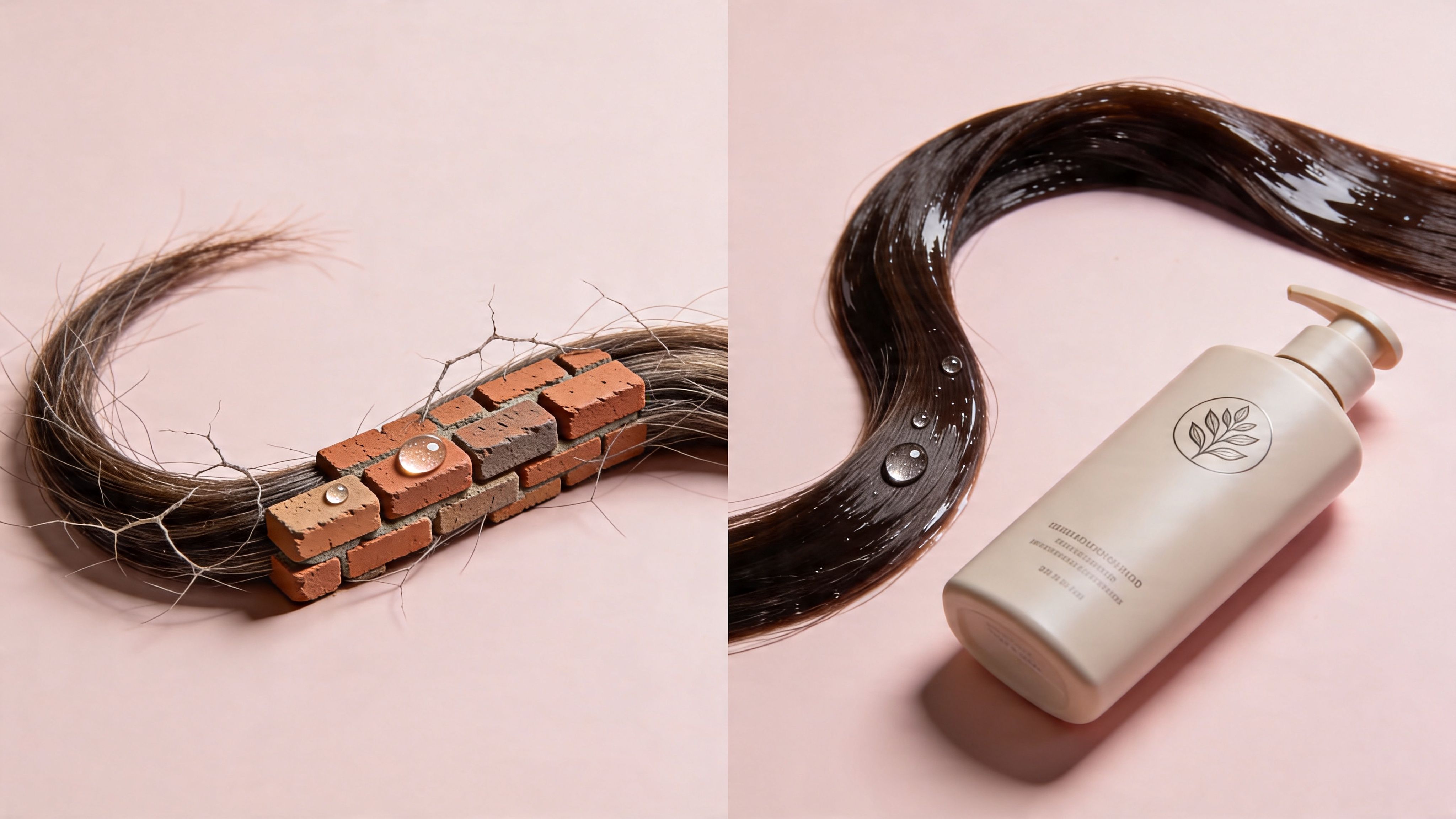
This visual shows exactly how your hair's cuticle—that pinecone we talked about—reacts to different pH levels.

As you can see, alkaline conditions lift the cuticle, inviting damage. Acidic conditions, on the other hand, keep it sealed, smooth, and protected.
Low pH vs High pH Conditioner At A Glance
Here’s a quick comparison of how low pH and high pH conditioners affect your hair cuticle and overall hair health.
| Attribute | Low pH Conditioner (Acidic) | High pH Conditioner (Alkaline) |
|---|---|---|
| Cuticle State | Seals the cuticle flat and tight. | Lifts and opens the cuticle. |
| Appearance | Smooth, shiny, and reflective. | Dull, rough, and frizzy. |
| Moisture | Locks in moisture and hydration. | Allows moisture to escape easily. |
| Strength | Strengthens the hair shaft, reduces breakage. | Weakens the hair, making it prone to damage. |
| Best For | Color-treated, high porosity, damaged hair. | Used professionally to prep for chemical services. |
Essentially, a low pH conditioner helps you maintain that ideal, healthy hair state, while a high pH formula does the opposite.
The Rise of pH-Optimized Hair Care
It's no surprise that the demand for pH-conscious products is surging. The global hair conditioner market, valued at USD 5.04 billion in 2025, is projected to hit an incredible USD 9.62 billion by 2034.
A huge part of that growth comes from the increasing awareness around formulas like the low pH hair conditioner. These products are formulated to mimic the natural acidity of the hair shaft—around a pH of 3.67—to seal the cuticle and lock in vital moisture. For those with high-porosity hair, using a pH-balanced conditioner can even reduce breakage by up to 40%.
Getting these fundamentals right is the first step toward the hair you've always wanted. A great conditioner is a fantastic start, but knowing how to use it correctly within a full routine is what truly delivers results. You can build your personalized hair routine to ensure every product works together for maximum impact.
Who Actually Needs a Low pH Conditioner
While just about anyone can benefit from a low pH conditioner to keep their hair smooth and resilient, some hair types will see a game-changing difference. If your hair is constantly sending out an SOS in the form of frizz, dullness, or breakage, it’s a prime candidate.

Think of it like this: certain hair is just naturally more prone to having that "open pinecone" cuticle we talked about. A low pH conditioner is the most direct way to encourage those cuticles to lie flat again. So, how do you know if your hair falls into this category?
The Top Candidates for a Low pH Regimen
Let's get specific. Some hair types are practically begging for a pH adjustment. If any of these sound familiar, a low pH conditioner isn't just a nice-to-have—it’s a must-have.
Color-Treated or Bleached Hair: Chemical services like dyeing and bleaching are extremely alkaline. They have to be, to force open the hair cuticle and alter the color inside. The aftermath? Damaged, porous hair. A low pH conditioner is your first line of defense, sealing that cuticle to lock in your expensive color, prevent fading, and bring back a smooth, healthy feel.
Curly and Wavy Hair: The beautiful bends and coils in curly hair mean the cuticles are already naturally a bit lifted compared to straight hair. This is why curls are so susceptible to frizz and losing moisture. Using a low pH formula helps smooth that outer layer, leading to better curl definition, less frizz, and a healthy-looking shine. If you're not sure where your waves or coils land, you can take a quick Hair Type Quiz to get clarity.
High Porosity Hair: This hair type has a wide-open cuticle structure. It soaks up water and products instantly but loses that moisture just as fast, leaving it feeling perpetually dry and brittle. A low pH conditioner is critical here. It helps the cuticle contract, which is the key to finally holding onto hydration. If you're not sure, you can easily check your hair porosity with a simple test at home.
Signs Your Hair Needs a pH Adjustment
Your hair is always telling you what it needs; you just have to learn to speak its language. If you're nodding along to any of the following, it’s a huge red flag that your hair's pH is too high and it's time for an acidic conditioner.
Your hair feels dry and straw-like even right after using a deep conditioner. This is the classic sign of a raised cuticle that simply can’t hold onto moisture.
Other tell-tale signs include:
- Excessive tangles and knots right after washing.
- Hair that looks dull and just won't shine, no matter what.
- A constant halo of frizz that shows up in any weather.
- Hair color that seems to wash down the drain way too fast.
If this sounds all too familiar, adding a low pH conditioner to your routine is a direct solution. It gets to the root cause—an imbalanced pH—instead of just putting a band-aid on the symptoms.
Reading the Ingredient List on a Low pH Conditioner
Flipping over a conditioner bottle can feel like you need a chemistry degree just to understand what you're buying. But once you know what to look for, you can spot a truly effective low pH conditioner from a mile away.
The "low pH" claim on the front is a great start, but the real proof is always in the formula.
What to Look For: The pH-Lowering Heroes
To get that cuticle-sealing, shine-boosting effect, formulators need to bring the product's pH down. When you scan the ingredient list, these are the ingredients doing the heavy lifting.
- Citric Acid: You’ll see this one everywhere. Derived from citrus fruits, it’s a go-to for lowering a formula’s pH into that sweet spot that helps smooth down the hair cuticle.
- Lactic Acid: This is an alpha-hydroxy acid (AHA) that does double duty. It helps adjust the pH while also offering a gentle exfoliating effect for your scalp and adding a touch of moisture.
- Aloe Vera Juice: Naturally acidic, aloe is a powerhouse. It helps lower the conditioner's pH while packing in serious hydration and soothing properties for both your hair and scalp.
A great low pH conditioner will balance these acidic ingredients with classic moisturizers like fatty alcohols (think Cetyl or Cetearyl Alcohol) and natural oils. This ensures your hair gets that smooth, sealed finish without sacrificing hydration.
What to Watch Out For
Just as important is knowing what shouldn't be in your low pH conditioner. You don't want ingredients that fight against the benefits you're trying to achieve. The biggest culprits are harsh sulfates, which are notorious for disrupting your hair's pH and stripping away its natural, protective oils.
The science behind this isn't new. A 1985 patent was already talking about using specific ingredients that kept conditioners effective even at a low pH. But today, it's what consumers demand. Clean-label low pH conditioners now capture 18% of U.S. turnover because people want products that are both transparent and deliver real results.
An ingredient list tells you the whole story of a product. To truly understand if a formula will work for you, you need to look past the marketing claims on the bottle. With our handy Ingredient Checker, you can analyze formulations and find products that genuinely support your hair's health.
Integrating a Low pH Conditioner Into Your Hair Routine
So, you’ve picked out a great low pH conditioner—now what? Adding it to your lineup isn't as simple as just swapping bottles. To get the most out of it, you need to be strategic about when you use it. Getting the order right is the key to unlocking its full potential.

The simplest rule of thumb is to always use your low pH conditioner immediately after you shampoo. Even the gentlest cleansers can temporarily raise your hair’s pH. Following up right away with an acidic conditioner brings that pH back down, sealing the cuticle at the perfect moment.
Sequencing Your Treatments for Peak Performance
Things get a little more interesting when you add other treatments like deep conditioners or protein masks into the mix. Using them in the wrong order can make your products less effective, or even cancel out their benefits.
Think of it like this: your protein treatment or deep conditioner is the main course, delivering a powerhouse of nutrients to repair and moisturize the inner core of your hair. Your low pH conditioner is the final sealant that locks all that goodness inside.
Here’s the ideal wash day sequence:
- Shampoo: Cleanse your hair and scalp as you normally would.
- Specialized Treatment (If Using): Apply your deep conditioner or protein mask. Let it work its magic for the recommended time, then rinse it out completely.
- Low pH Conditioner: This is the crucial step. Apply your low pH conditioner from the mid-lengths to the ends to smooth and seal the cuticle, trapping the nutrients from your treatment inside the hair shaft.
- Rinse: Use cool water for your final rinse. This gives the cuticle one last gentle nudge to close up tight.
Optimizing Your Routine
Understanding the science helps. Your hair has what’s called an isoelectric point, which sits around pH 3.67. A conditioner with a pH lower than this gives your hair a positive charge, dramatically improving how well conditioning ingredients adhere to it.
This small adjustment can cut combing friction by up to 50% and give you a serious shine boost. It's a game-changer for the 65% of women with wavy or curly hair who often fight buildup and dullness from products that aren't pH-optimized.
The goal isn't just to add one product—it's to build a smarter, more effective system for your hair. You can use our Routine Analyzer to see how a low pH conditioner can fit into and improve your current lineup.
Building Your Ultimate Low pH Hair Care Routine
Great hair doesn't come from a single magic bottle. It comes from building a smart, consistent system that works with your hair, not against it. We've gone through the science of low pH and figured out who benefits most, so now it's time to put that knowledge into action.
Think of a low pH conditioner as a key player on your team. It’s a powerful tool, but it performs best when it’s part of a bigger game plan designed just for you. This is where you stop guessing and start building a routine that actually gets you the frizz-free, vibrant, and healthy hair you want.
Personalize Your Plan
Your hair has its own personality, and your routine needs to match. The first step is to get real about your hair’s needs. Is it curly or straight? Does it soak up moisture instantly (high porosity) or does water bead up on it (low porosity)? Is it color-treated or virgin? Knowing these details is what separates a generic routine from a truly effective one.
A great routine is more than just shampoo and conditioner. It’s a complete system, from your pre-wash oil to your final styling cream, where every product works together.
The real magic happens with synergy. When your cleanser, conditioner, and treatments all work toward the same goal—like maintaining an acidic pH—you don't just get better results; you stop using products that are secretly undoing each other's work.
This is exactly where a low pH conditioner fits in. It’s the perfect final rinse step that seals the cuticle after cleansing or a deep conditioning treatment. By using it correctly, you lock in all the moisture and nutrients from your other products, making your entire routine more effective. If you're searching for products that fit this philosophy, you can start by exploring our database of clean hair care options.
Build Your Step-by-Step Routine
Ready to build a plan that finally works? The secret is putting the right products in the right order. This ensures you get the maximum benefit from every single step, especially from that all-important low pH conditioner.
This process can feel overwhelming, but you don't have to figure it out alone. It's the perfect time to build your personalized hair routine with our tool, which guides you in picking the perfect products for your hair type and goals, including the ideal low pH conditioner. It helps you organize everything into a simple, step-by-step plan that will get you the healthy, shiny hair you've been working toward.
Common Questions About Low pH Conditioners

Let's cut through the noise and tackle some of the most common questions and myths out there. This is where we get practical, so you can feel 100% confident about adding a low pH conditioner to your routine.
Can I Use a Low pH Conditioner Every Day?
For most people, the answer is a big yes. In fact, daily use is often ideal. Using a low pH hair conditioner every time you wash helps consistently keep your hair cuticle sealed, smooth, and guarded against daily damage.
The only exception? If you have extremely fine hair, you might find that alternating with a standard lightweight conditioner keeps your strands from feeling too soft. It’s all about listening to your hair and finding that perfect balance.
Will a Low pH Conditioner Weigh My Hair Down?
This is a huge myth we need to bust. The idea that acidic products are heavy comes from confusing them with old-school, silicone-heavy formulas that just coat the hair shaft.
A low pH conditioner works differently. It smooths and seals your hair’s own structure, which is an entirely different mechanism. This makes them naturally lightweight and a fantastic choice for all hair types—even fine hair that gets weighed down by almost everything.
How Do I Know if My Conditioner Has a Low pH?
Sometimes, the label will give you clues. Keep an eye out for phrases like "pH balanced" or look for acidic ingredients like Citric Acid or Aloe Vera Juice near the top of the ingredients list.
But labels can be misleading.
For a definitive answer without the guesswork, you can analyze your ingredients using our checker. This tool instantly evaluates the formulation, so you know exactly what you're putting on your hair.
Ready to stop guessing and start building a hair care system that actually delivers? The real magic happens when every product you use works together in harmony. At IsItClean, we make that simple. You can build your personalized hair routine with our Hair Routine Builder, selecting the perfect low pH conditioner and other products to finally achieve your hair goals.