If you have curly hair, you already know the struggle. It can feel like a never-ending quest to tame frizz, banish dryness, and get your curls to cooperate. But the secret isn't piling on more products; it’s using the right ones. And the single most important product in your arsenal is a sulfate-free conditioner.
Think of it as the non-negotiable foundation of your routine. It’s designed to give your curls the one thing they crave most—moisture—without the harsh ingredients that cause damage and strip away natural oils.
Why Your Curls Need a Sulfate-Free Conditioner
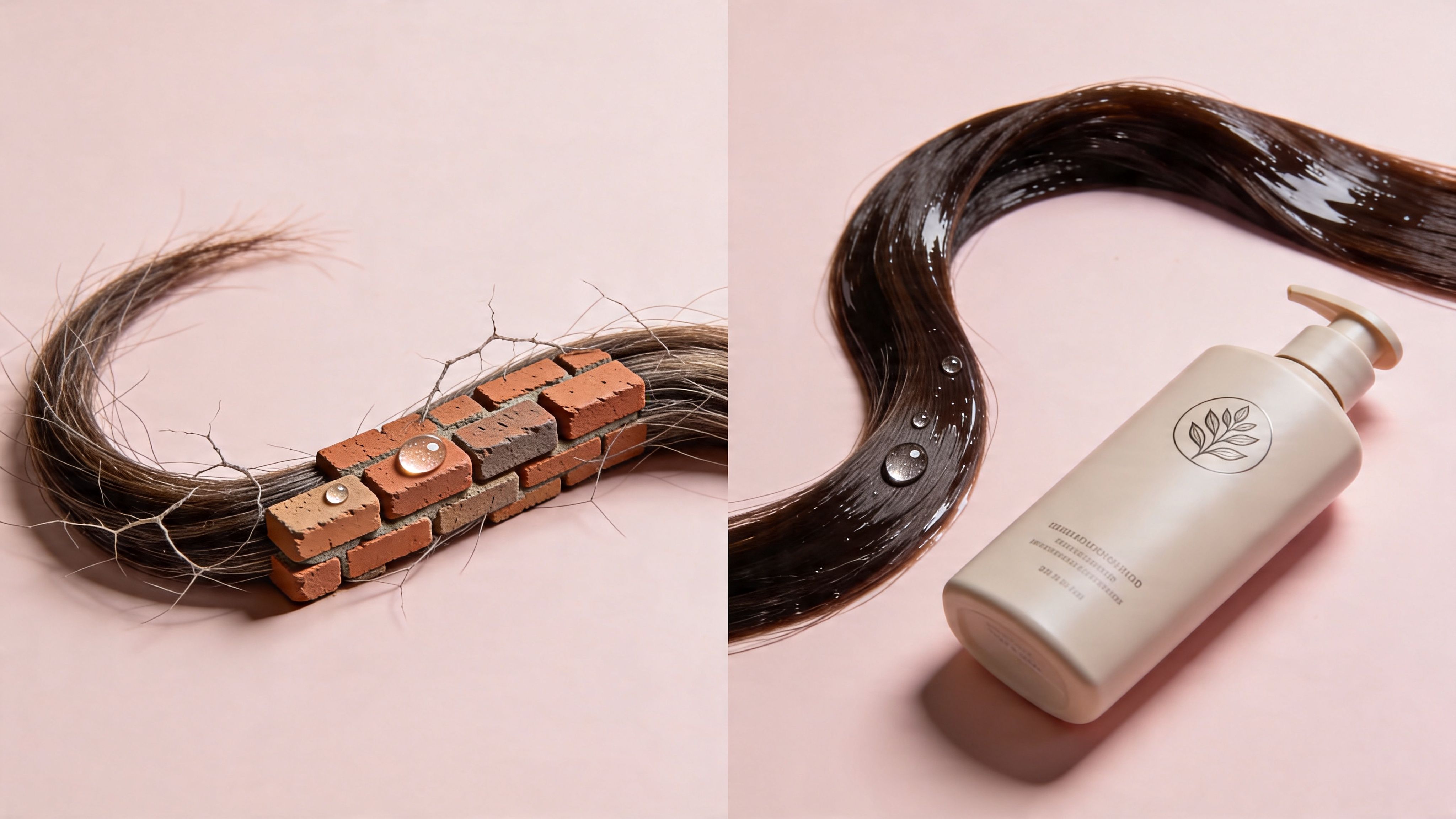
Let's get visual for a second. Imagine your hair's outer layer, the cuticle, as the shingles on a roof. On curly hair, these shingles are naturally more raised and open. This creates tiny gaps that allow the hair's essential moisture to escape, which is the root cause of dryness and frizz.
Now, think about traditional conditioners that contain sulfates. They act like an aggressive detergent, scrubbing away not just dirt but also your hair's natural, protective oils. This process lifts those 'shingles' even further, leaving your curls exposed, vulnerable, and even drier than before.

Making the switch to a sulfate-free formula is one of the biggest upgrades you can make for your hair's health. Instead of stripping moisture, these conditioners are formulated to do the opposite: they replenish it, helping to smooth the cuticle and lock hydration inside the hair shaft.
The benefits are immediate and noticeable:
- Reduces Frizz and Flyaways: By keeping your hair's natural moisture barrier intact, sulfate-free conditioners help the cuticle lie flat. A smooth cuticle is the key to fighting frizz.
- Enhances Curl Definition: Hydrated hair is happy hair. When your curls have enough moisture, they clump together into more defined, bouncy, and consistent patterns.
- Improves Hair Health: Without harsh sulfates causing constant dryness and breakage, your hair becomes stronger, more elastic, and less prone to split ends over time.
- Soothes the Scalp: Sulfates can be irritating, leading to a dry, itchy scalp for many people. A gentler, sulfate-free approach creates a healthier and more comfortable scalp environment.
The Science of Gentle Conditioning
This isn't just about trends; it's about smart science. Consumers are demanding hair products that cater to specific needs, and the industry is listening. The global hair conditioner market is on track to hit USD 9.62 billion by 2034, largely because people are moving away from one-size-fits-all formulas.
For anyone with textured hair, this shift is a game-changer. Studies show that sulfates can be responsible for 40-50% more frizz and breakage in curly hair types. Sulfate-free conditioners, on the other hand, work with your hair's natural biology to restore its moisture barrier, leading to a healthier scalp and a visible reduction in dryness. You can see the full market analysis on Fortune Business Insights to understand how this consumer-led movement is shaping product innovation.
This is why a sulfate-free conditioner for curly hair isn't just a preference—it’s a necessity for achieving vibrant, healthy curls.
Sulfate vs Sulfate-Free Conditioner Effects on Curly Hair
Here’s a direct comparison of how conditioners with and without sulfates impact the most common curly hair concerns.
| Hair Concern | Traditional Conditioner with Sulfates | Sulfate-Free Conditioner |
|---|---|---|
| Moisture Levels | Strips natural oils, leading to chronic dryness and a "straw-like" feel. | Replenishes moisture and helps seal the hair cuticle to prevent moisture loss. |
| Frizz & Flyaways | Can worsen frizz by raising the hair cuticle and disrupting the moisture balance. | Smooths the hair cuticle, significantly reducing frizz and promoting a sleeker finish. |
| Curl Definition | Dehydrated curls go limp and lose their pattern, appearing undefined and frizzy. | Properly hydrated curls clump together, creating bouncy, well-defined ringlets and waves. |
| Hair Strength | Leads to brittleness, increased breakage, and more split ends over time. | Improves hair elasticity and strength, making it more resilient to damage. |
| Scalp Health | Can cause irritation, itchiness, and dryness, disrupting the scalp's natural biome. | Gentle on the scalp, helping to maintain a balanced and healthy environment for hair growth. |
The difference is clear. While traditional conditioners might provide a temporary-feeling slip, they often create a cycle of dryness and damage. Sulfate-free formulas work to break that cycle by nourishing your hair from the inside out.
The next step, of course, is finding the right conditioner for your specific hair. Factors like your curl pattern and especially your hair's porosity play a massive role in what your hair needs.
Not sure where to start? We've made it easy. You can discover your unique hair type with our quick quiz to get personalized insights and product recommendations. Knowing your hair's characteristics empowers you to choose a conditioner that truly works for you, not against you.
Understanding How Sulfates Disrupt Your Curls
Have you ever felt like your curls have a mind of their own? Amazing one day, a frizzy, unpredictable mess the next. You're not imagining things. The reason is baked right into the science of how your hair grows, and understanding it is the key to finally getting the consistent, beautiful curls you want.
It all starts at the scalp. Curly hair grows from an oval-shaped follicle, which is what forces the hair strand to twist and curve as it emerges. This is what creates your beautiful coils and waves. But this unique structure has a major downside.
Those twists and turns create a difficult path for the natural oils from your scalp, known as sebum, to travel down the hair. While straight hair gets a free pass for this natural conditioner, curly hair is often left high and dry, especially from the mid-lengths to the ends.
The Porosity Problem
The shape of curly hair also means its protective outer layer—the cuticle—doesn't lie flat. Think of the cuticle as overlapping shingles on a roof. On straight hair, they're smooth and tight. On curly hair, those shingles are naturally more raised, creating a more porous surface.
This built-in high porosity is a double-edged sword:
- It lets moisture in very easily.
- But it also lets moisture escape just as fast, leading to a constant state of dryness.
This is exactly why so many people with curly hair feel like they're in a never-ending battle with dryness, no matter how many products they pile on. If you aren't sure where your hair lands, you can easily check your hair porosity with a simple test at home. Knowing your porosity is non-negotiable because it determines which products will actually help, not hurt.
So, What Are Sulfates and Why Are They So Bad for Curls?
This brings us to sulfates, the heavy-duty cleansing agents in most traditional shampoos and even some conditioners. The most common culprits you'll see on an ingredient list are Sodium Lauryl Sulfate (SLS) and Sodium Laureth Sulfate (SLES).
Sulfates are powerful surfactants. Think of them as the industrial-strength degreaser you use on a greasy frying pan—they're designed to grab onto oil and water and strip away everything in their path.
While that aggressive cleaning power is great for dishes, it's a total disaster for delicate curls.
When you use a product loaded with sulfates, it doesn't just remove dirt and buildup. It obliterates the tiny amount of precious sebum that managed to make its way down your hair shaft, leaving your curls completely bare and unprotected.
This stripping action creates a cycle of damage:
- Intensifies Dryness: It vacuums out your hair's natural moisture, making already-dry curls even more parched and brittle.
- Creates Frizz: By roughing up the already-raised cuticle layer, sulfates create friction between strands—the number one cause of frizz.
- Causes Irritation: For many, sulfates leave the scalp feeling tight, dry, and itchy, disrupting the healthy foundation your hair needs to grow.
Choosing a sulfate-free conditioner for curly hair isn’t just about following a trend. It's a strategic, science-backed move to break this cycle of dryness and damage. By ditching these harsh detergents, you finally give your hair a chance to hold onto its own moisture—the foundation for defined, healthy, and frizz-free curls. It’s time to stop fighting your hair and start working with it.
Ready to build a routine that actually supports your hair's unique structure? You can build your personalized hair routine with our guided tool. It helps you hand-pick products that solve your biggest challenges, from dryness to frizz.
How to Read a Conditioner Label Like an Expert
Walking down the hair care aisle can feel like a pop quiz you didn't study for. Walls of colorful bottles all promise perfect curls, but when you flip them over, you’re faced with a laundry list of unpronounceable chemical names. Let’s be honest, it’s overwhelming.
But it doesn't have to be. Think of it like learning to read a food label. At first, it’s just a block of text. Once you know what to look for, you can instantly spot the good stuff and avoid the junk. We're going to do the same for your sulfate-free conditioner for curly hair.

Learning to decode that label is the single biggest step you can take to get consistent, healthy results. When you know how to spot the heroes from the villains, you take back control.
The 'Hero' Ingredients Your Curls Crave
Here’s the first rule of label reading: ingredients are listed by concentration. The first five or six ingredients make up the vast majority of what’s in the bottle. You want to see these curl-friendly champions right at the top.
Moisturizing Fatty Alcohols: Don't let the word "alcohol" scare you off. We're not talking about the harsh, drying kind. Fatty alcohols like Cetyl Alcohol, Cetearyl Alcohol, and Stearyl Alcohol are your friends. They’re derived from fats and oils, and they give your conditioner that rich, creamy feel and the "slip" you need to detangle without breakage.
Hydrating Humectants: Think of these as moisture magnets for your hair. Ingredients like Glycerin, Sorbitol, and Panthenol (Pro-Vitamin B5) literally pull water from the air into your hair shaft. This is what gives you that deep, lasting hydration that makes curls plump and juicy.
Nourishing Oils and Butters: These are your sealers. Once humectants draw moisture in, rich emollients like Shea Butter (Butyrospermum Parkii), Coconut Oil (Cocos Nucifera Oil), and Jojoba Oil (Simmondsia Chinensis Seed Oil) lock it all down. They smooth the hair's outer layer, or cuticle, preventing that precious moisture from escaping.
Mastering this skill is a game-changer. For a deeper dive, learning how to read organic bath and body product labels can give you even more confidence, as many of the principles for spotting quality ingredients are the same.
The 'Villains' to Watch Out For
Just as important as knowing what to look for is knowing what to avoid. Beyond sulfates, a few other common ingredients can seriously sabotage your curls.
Key Takeaway: The wrong ingredients don't just fail to help; they can actively cause buildup, dryness, and breakage, working against all the effort you put into your routine.
Keep an eye out for these culprits lurking on the label:
- Certain Silicones: Not all silicones are evil, but many, like Dimethicone, are not water-soluble. They create a plastic-like film that gives you that initial silky, shiny feeling. The problem? That coating also blocks moisture from getting in, leading to hair that becomes progressively drier and more brittle underneath.
- Drying Alcohols: These are the polar opposite of the fatty alcohols we love. If you see Alcohol Denat, Isopropyl Alcohol, or SD Alcohol 40 high up on the list, put the bottle down. These are notorious for stripping moisture from curls, leading directly to frizz, brittleness, and breakage.
There’s a reason the natural hair care market is projected to hit USD 14.5 billion by 2026. We’re all getting smarter about ingredients. For those with high-porosity curls, formulas with drying alcohols can increase breakage by a staggering 30-40%. On the flip side, just switching to a gentler conditioner can improve scalp health by up to 34%. The numbers don't lie.
Putting It All Together
Feeling more confident? You should be. Instead of trying to memorize a massive list, you can now focus on the core principles. Is the formula packed with moisturizing alcohols, humectants, and natural oils? Is it free from sneaky silicones and harsh, drying alcohols?
If you're standing in the aisle and still feel a little unsure, you don’t have to guess. Use an ingredient checker to snap a picture of the label and get an instant analysis. For those with tricky low-porosity hair, our guide on building a low porosity hair routine offers more specific advice.
Finding the right products isn't about luck; it's about having a system. Stop the frustrating guessing game and start building a routine that gives you predictable, amazing results, every single time.
Find the Perfect Conditioner for Your Hair Type
When it comes to curls, there's no such thing as a "one-size-fits-all" conditioner. The right sulfate-free conditioner for curly hair is deeply personal and depends entirely on your hair's unique blueprint. It's just like skincare—you wouldn't use a heavy cream on oily skin, and the same logic applies to your hair.
To find your holy grail, you need to look at three things: your hair's porosity, your curl pattern, and any specific struggles like damage or protein sensitivity. Nailing this is the difference between fighting your hair every day and finally working with it.
The demand for gentle hair care is bigger than ever, with the global market for sulfate-free products expected to reach USD 1,095.9 million by 2033. This isn't just a trend; it's a response to what our hair actually needs. With studies showing that going sulfate-free can cut down scalp irritation by 27%, it's no surprise that 55% of people now seek out gentler options—a game-changer for curls that get dehydrated so easily. Find out more about this growing market trend.
Match Conditioner Weight to Your Hair Porosity
If you only pay attention to one thing, make it porosity. It’s the single most important factor for picking your conditioner's texture because it determines how your hair absorbs and holds onto moisture. Porosity is your hair’s way of telling you exactly what it needs.
Low Porosity Hair: These strands have a tightly sealed cuticle, which makes it tough for moisture to get in. Slathering on heavy butters and oils is a recipe for disaster—they'll just sit on top, leaving your curls greasy and weighed down. The secret is lightweight hydration. Look for watery, lotion-like conditioners with humectants like glycerin that pull moisture into the hair without causing buildup.
High Porosity Hair: This hair has gaps and openings in its cuticle, so it soaks up water easily but loses it just as quickly. It craves rich, creamy conditioners loaded with butters (like shea) and sealing oils (like coconut or argan). These ingredients lock in the hydration and smooth the cuticle down. For a complete guide on this hair type, check out our high porosity hair routine.
Not sure where your hair lands? Don't guess. You can easily check your hair porosity with a simple test at home. It’s a quick way to get answers and stop wasting money on products that aren't right for you.
Consider Your Curl Pattern and Density
While porosity is king, your curl pattern (from loose waves to tight coils) and density (fine vs. coarse strands) are the next pieces of the puzzle. Someone with fine, wavy hair will need a much lighter product than a person with coarse, coily hair, even if their porosity is the same.
- Wavy and Loose Curls (Type 2-3a): These curls are easily weighed down, so they usually do best with lightweight conditioners.
- Curly and Coily Hair (Type 3b-4c): This hair type generally thrives with richer formulas packed with emollients to keep it moisturized and defined.
Address Specific Hair Concerns
Finally, you can fine-tune your choice based on any other issues you're dealing with.
- Color-Treated or Damaged Hair: Your hair needs repair work. Look for conditioners with strengthening ingredients like hydrolyzed proteins (think rice, wheat, or silk) and amino acids to help patch up the hair's structure.
- Protein-Sensitive Hair: Does your hair feel weirdly stiff or brittle after using certain products? You might have protein overload. If so, skip the strengthening formulas and reach for a protein-free moisturizing conditioner instead.
Putting these pieces together makes you a smart shopper, not a hopeful one. You'll be able to walk past the endless aisles of products and confidently pick one that's made for your hair's biology. When you're ready to end the cycle of trial and error for good, the next step is to build your personalized hair routine with our tool. It matches your unique hair profile to the right products for beautiful, consistent results.
Mastering Your Conditioner Application Technique
You could have the best sulfate-free conditioner for curly hair on the planet, but if you're not applying it the right way, you’re leaving most of its benefits in the bottle. The right technique is what truly activates a conditioner's power, taking your results from just "good" to absolutely incredible.
It’s the difference between conditioner simply sitting on top of your hair and actually getting inside the cuticle for deep, lasting moisture. This hands-on guide will walk you through the expert-approved methods that encourage your curls to clump, soak up maximum hydration, and form with stunning definition.
The Praying Hands Method for Even Distribution
Stop raking conditioner through your curls with your fingers. This common habit is a fast track to disrupting your delicate curl clumps before they even have a chance to form, creating frizz where you want definition.
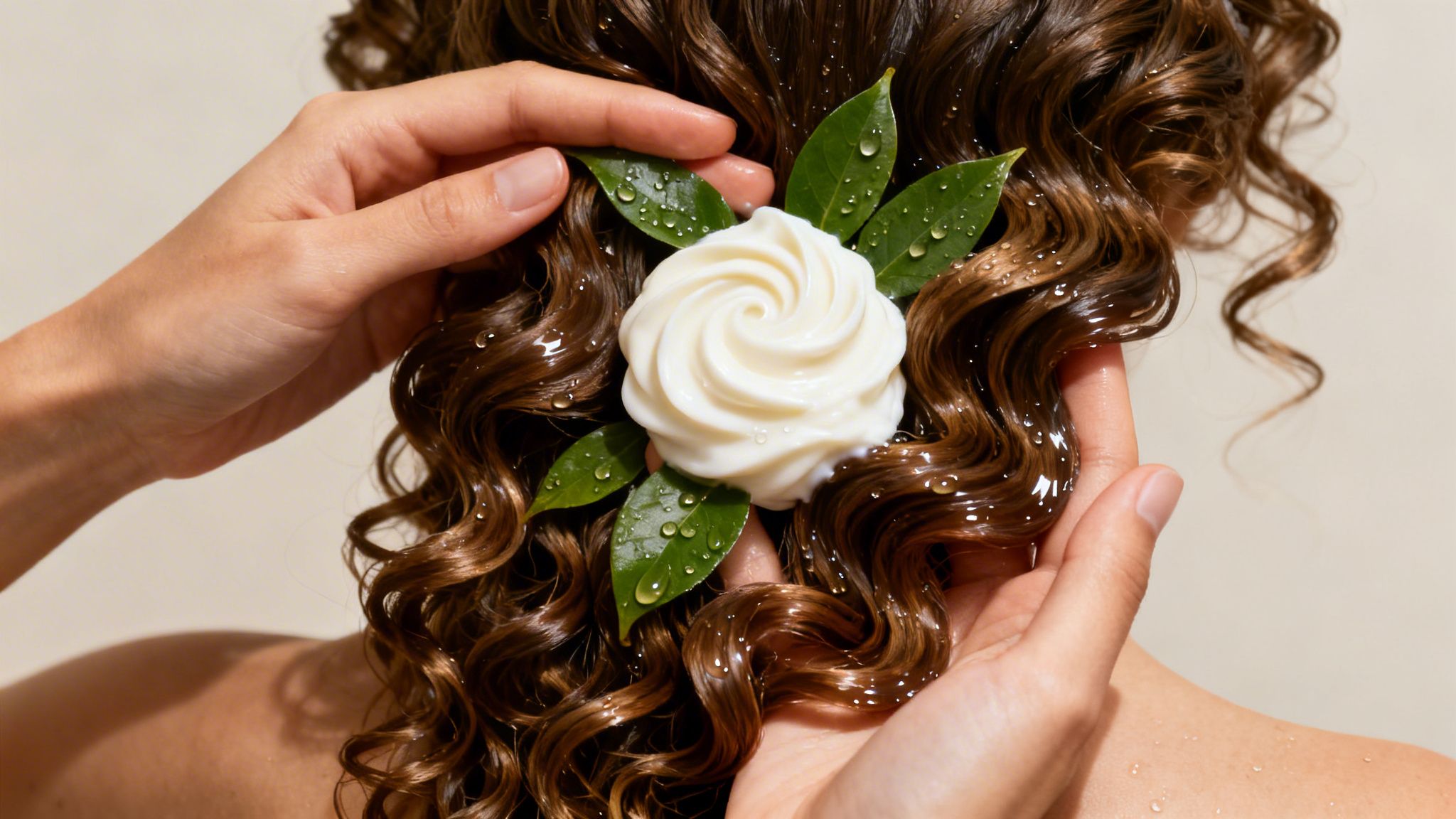
Instead, embrace the "praying hands" method. Start by rubbing the conditioner between your wet palms to emulsify it. Take a section of hair, place it between your flat palms, and glide them down from the mid-lengths to the ends. This technique smoothes the hair cuticle and ensures every single strand gets an even coat of product without causing frizz.
Squish to Condish for Maximum Hydration
If there's one technique that can completely change your curly hair game, this is it. "Squish to Condish" is a method for rinsing your conditioner that helps your hair absorb significantly more water and product, leading to plump, juicy, and perfectly formed curl clumps.
Here’s how it works:
- After applying conditioner with the praying hands method, tip your head to one side.
- Cup a handful of water from the shower stream and bring it up to your ends.
- Gently squeeze or "squish" that water upward into your hair. You're looking for a distinct squelching sound—that's the signal you're doing it right!
- This simple motion manually forces water and conditioner into the hair shaft.
- Repeat this all over your head until most of the conditioner is rinsed, but a little bit of that slippery feeling remains. Your curls should feel like smooth, hydrated seaweed.
Making this one change encourages curl clumping and dramatically cuts down on frizz, ensuring your hair is fully hydrated before you even grab a towel.
This decision tree infographic helps you find the right conditioner by starting with your hair's porosity, then considering your curl pattern and specific concerns.
 As you can see, porosity is the most critical first step. It dictates whether you need a lightweight or rich formula long before you even think about your curl type.
Common Application Questions Answered
- How much conditioner should I use? Start with a quarter-sized amount and add more if you need it. Your hair should feel slippery and fully saturated from the mid-lengths to the ends, but not so goopy that it feels weighed down.
- How long should I leave it in? For a regular rinse-out conditioner, 3-5 minutes is plenty. That’s enough time for it to work its magic while you finish up your shower. If you're doing a deep conditioning treatment, aim for 15-30 minutes.
- Should I rinse it all out? For most curly types, the answer is a firm no. Leaving a small amount of conditioner in your hair (it should feel slick, not slimy) acts as a perfect primer for your styling products and is a secret weapon against frizz.
Combining these techniques is a game-changer, but it's just one piece of the puzzle. If you're still struggling to find products that play well together, it might be time to get more strategic. You can easily build your personalized hair routine with our tool to find a compatible shampoo, conditioner, and styler that match your hair’s unique needs for consistent, beautiful results.
Build Your Ultimate Curly Hair Routine
Finding a great sulfate-free conditioner for curly hair is a huge win, but it’s only one piece of the puzzle. To get those consistently amazing curls you’re after, you need a complete routine where every single product works together like a well-rehearsed team. This is how you finally get off the rollercoaster of good and bad hair days and start building predictable, long-term hair health.
Instead of just crossing your fingers on wash day and hoping for the best, it’s time to build a system designed specifically for your hair's unique profile. A solid routine means no more guesswork—just reliable results.
From Individual Products to a Cohesive System
Think of your routine like a recipe. The conditioner might be a key ingredient, but it can't create the final dish on its own. You need the right cleanser, leave-in, and styler all working toward the same goal—whether that's taming frizz, creating volume, or making your definition pop.
When products are chosen to work together, they build on each other's success. A gentle co-wash perfectly preps your hair for a moisturizing conditioner, which in turn primes your curls for a gel that locks in hold without flaking. It's this smart combination that unlocks what your hair can really do. For a deep dive into this strategy, our guide to building a curly hair routine is the perfect place to start.
For an extra boost from the inside, supplements like Hair Skin Nails Gummies can be a great addition to your overall wellness plan, supporting your hair’s foundation.
Take Control with the Hair Routine Builder
Ready to finally stop the frustrating cycle of trial and error? Now that you know what your curls need from a conditioner, the next step is building the rest of your routine around it. This is where you get to take back control.
Here’s a quick look at how our Hair Routine Builder walks you through creating a personalized regimen from scratch. The tool starts by asking about your hair’s unique needs, so every recommendation is truly a perfect match.
You can build your personalized hair routine with our IsItClean Hair Routine Builder. It intelligently uses your hair type, porosity, and main concerns to recommend a full lineup—shampoo, conditioner, and stylers—that are all designed to work in harmony. It’s time to stop guessing and start building a routine that delivers incredible, predictable results every single wash day.
Your Questions About Sulfate-Free Conditioners, Answered
Switching to a sulfate-free conditioner can feel like a leap of faith. We get it. To help you feel confident about making the change, we’ve put together answers to the most common questions we hear from the curly community.
Will a Sulfate-Free Conditioner Actually Detangle My Knots?
Oh, absolutely. The secret to great detangling isn't harsh detergents—it's slip.
A well-formulated sulfate-free conditioner for curly hair is loaded with ingredients designed for this exact purpose. Think moisturizing fatty alcohols like Cetearyl Alcohol and nourishing oils. These ingredients create a silky coating on the hair shaft, allowing tangles and knots to melt away without a fight. No more tugging, no more breakage.
How Often Should I Use It?
The simple answer? Every single time your hair gets wet. For most curlies, that's about two to four times a week.
Many of us also use our conditioner to "co-wash" on days we don't use shampoo. This is a fantastic way to refresh your curls and add moisture without stripping away your hair's natural oils. It’s a lifesaver for anyone with high-porosity or very dry hair.
Pro Tip: Think of conditioner as more than just a post-shampoo step. Co-washing can be a game-changer for keeping your hair hydrated between washes, locking out frizz, and keeping your curls defined and happy.
If you’re not sure what your wash schedule should be, start by figuring out what your hair really needs. A quick hair type quiz can give you the clarity you need to build the perfect routine for your curls.
My Hair Feels Greasy After Using a Sulfate-Free Conditioner. What Am I Doing Wrong?
This is a super common issue, and luckily, it’s usually an easy fix. If your hair feels greasy, it's almost always one of two things: the conditioner is too heavy for your hair type, or you're applying it too close to your scalp.
If you have fine or low-porosity hair, look for a more lightweight, lotion-like formula instead of a thick, buttery cream. And always concentrate your conditioner on the mid-lengths and ends—that’s where your hair is the oldest and needs the most love. Your roots don't need it.
If the problem persists, you can analyze your ingredients with our tool to pinpoint any products that might be causing buildup.
Can I Use a Sulfate-Free Conditioner with a Sensitive Scalp?
Yes, and your scalp will probably thank you for it! Sulfate-free formulas are often the best choice for sensitive scalps. They skip the aggressive detergents that can lead to dryness, itching, and irritation.
Instead, they gently cleanse while respecting your scalp’s natural moisture barrier. If you're constantly dealing with scalp issues, taking our quick scalp sensitivity quiz can provide more personalized advice to help you find some relief.
Now that you've got the answers, you have the knowledge to build a routine that gives you healthy, defined curls every single time. Here at IsItClean, we believe that understanding your hair is the first step toward loving it. It's time to stop the cycle of trial and error and start building a routine that actually works for you.
Ready to put it all together? Use our Hair Routine Builder to get a complete, personalized product lineup based on your unique hair profile.