Figuring out your curl type is the first real lightbulb moment in any hair care journey. It's the key that unlocks why some products give you the best hair of your life, while others leave you with a frizzy, undefined mess.
Your Guide to the Curl Typing System
The most common way to talk about curls is the Andre Walker Hair Typing System. It’s not perfect, but it gives us a fantastic starting point. This system breaks hair down into four families: Type 1 (Straight), Type 2 (Wavy), Type 3 (Curly), and Type 4 (Coily).
Within those families, subcategories from A to C describe how tight or loose the pattern is. Think of it as a visual guide that helps you tell a gentle “S” wave from a springy corkscrew or a tight, zig-zag coil. Knowing where you fit on this spectrum is the foundation for building a routine that actually works.
The Three Families of Curls
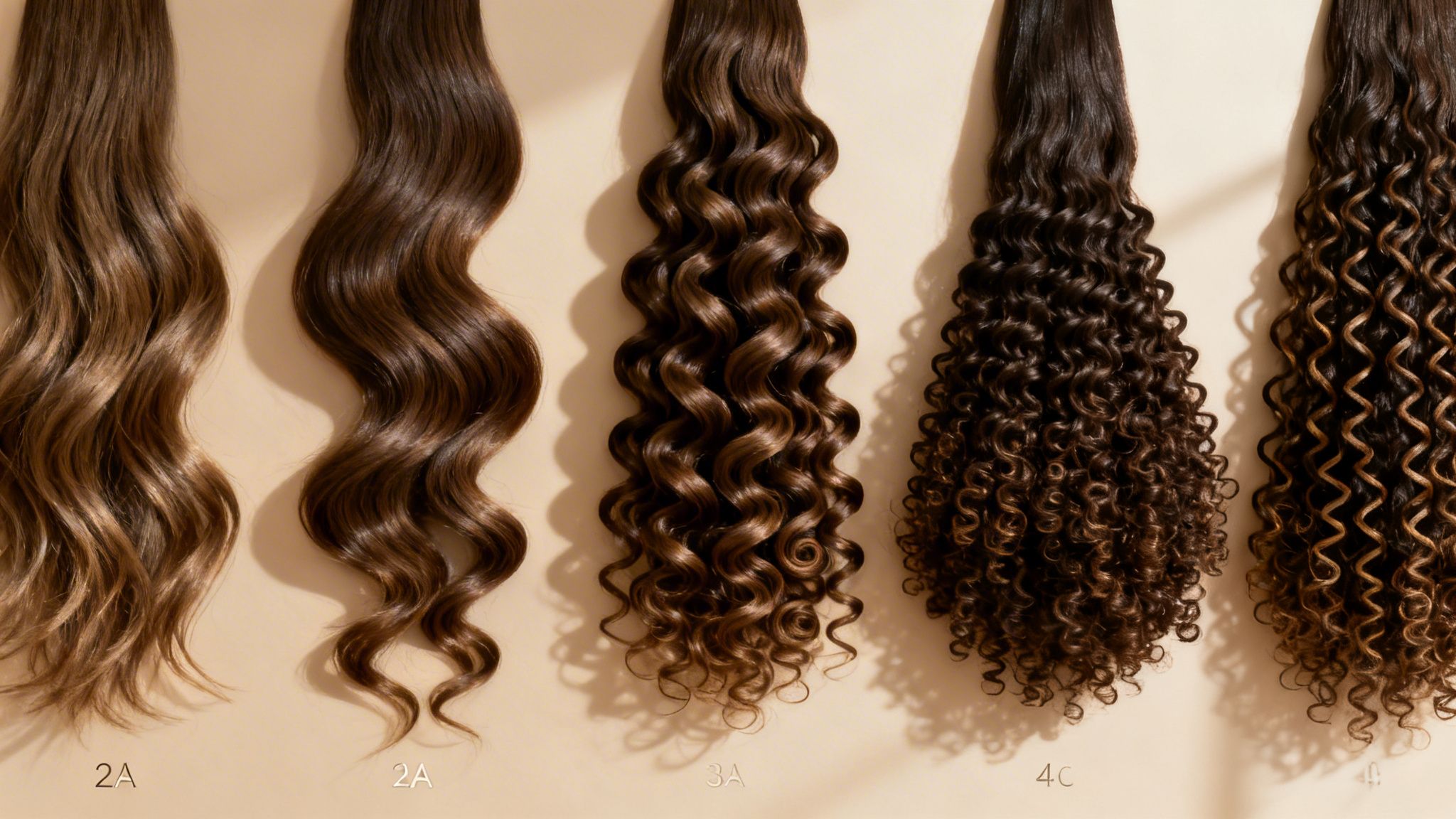
Textured hair fits into three main groups. Generally, as you go up the scale from Type 2 to Type 4, the curl pattern gets tighter, and the hair tends to be more prone to dryness. It's all about the shape of the strand.
This simple chart shows how the pattern progresses from Wavy to Curly to Coily.

You can see how the pattern becomes more compact and defined with each type. Here’s a quick breakdown of what that means for your hair:
- Type 2 (Wavy): Your hair forms a distinct “S” shape and usually lies flatter at the root. The biggest challenges are often fighting frizz and avoiding heavy products that can weigh your waves down.
- Type 3 (Curly): This is where you’ll find everything from loose, loopy ringlets to tight, bouncy corkscrews. The name of the game here is usually maintaining definition and keeping dryness at bay.
- Type 4 (Coily): These are tightly packed curls, coils, or even “Z”-shaped patterns. This hair type experiences the most shrinkage and needs a serious commitment to moisture to stay healthy and prevent breakage.
To make it even clearer, this table breaks down the visual cues and common struggles for each curl type.
The Curl Type Chart at a Glance
| Curl Type | Visual Description | Common Challenges |
|---|---|---|
| Type 2: Wavy | Loose "S" shapes, can be fine to coarse. | Gets weighed down easily, prone to frizz. |
| Type 3: Curly | Defined spirals, from loose loops to tight corkscrews. | Dryness, losing definition, frizz. |
| Type 4: Coily | Tightly packed coils, zig-zags, or no visible pattern. | Extreme dryness, shrinkage, prone to breakage. |
Seeing it laid out like this really helps connect the visual pattern of your hair to the problems you're likely trying to solve.
Your curl pattern is your hair’s blueprint. Identifying it is the first step, but understanding its properties—like porosity and density—is what allows you to build a structure of care that truly works.
But here’s the thing: your curl type is just one piece of the puzzle. Your hair's porosity (its ability to absorb and hold on to moisture) is just as important. For example, two people can have 3B curls, but if one has high-porosity hair that drinks up moisture and the other has low-porosity hair where products sit on top, they'll need completely different routines.
If you’re feeling a bit lost, taking an interactive Hair Type Quiz is a great next step. It looks beyond just the visual pattern to give you a much more complete picture of what your hair needs.
At the end of the day, knowing your curl type stops the guesswork. You can finally ditch the random product-hopping and start choosing ingredients and techniques that will make your hair thrive.
How to Find Your True Curl Type at Home

So, you’re ready to play hair detective? Figuring out your true curl type doesn’t involve a science lab—just a good, honest look at your hair in its most natural state.
The secret is to wash, condition, and let your hair air-dry without any styling products. This is your hair’s reset button, revealing the pattern it was born with. Gels, creams, and mousses are all designed to alter or enhance your curls, so skipping them for one wash day gives you a clear, unfiltered baseline.
The Wash Day Test
To get an accurate read on your curl pattern, you need a clean slate. This simple process strips away any product buildup or styling manipulation that might be hiding your hair’s true texture. It’s the single best way to get a clear diagnosis.
Here’s how to get the most reliable results:
- Cleanse Thoroughly: Start by washing with a clarifying or sulfate-free shampoo to get rid of every last trace of product residue.
- Condition and Detangle: Slather on your usual conditioner, gently detangle your hair, and then rinse it all out completely.
- Do Not Apply Products: This is the most crucial step. After rinsing, don’t apply any leave-in conditioners, oils, creams, or gels. Nothing.
- Air-Dry and Observe: Let your hair air-dry 100% without touching it. No scrunching, no diffusing, no towel-turban. Once it’s fully dry, you can examine the patterns that have formed naturally.
Now that your hair is dry, gently separate a few sections from different parts of your head—the nape of your neck, your crown, and the hair framing your face. Look closely at the shape of an individual strand or a small clump of hair.
- Does it create a loose, stretched-out "S" shape? You’re likely in the Type 2 Wavy family.
- Is it a defined, springy spiral or a perfect little corkscrew? That points straight to the Type 3 Curly category.
- Is the pattern a very tight, tiny coil or even a "Z"-shaped bend? You’re probably looking at Type 4 Coily hair.
What If I Have Multiple Curl Types?
Don't panic if you find a mix of patterns co-existing on your head—it’s incredibly common. So many people have looser waves at the nape of their neck and tighter curls at the crown. This isn’t a problem; it’s just part of your hair’s unique map.
When you're dealing with mixed patterns, the rule of thumb is to care for your hair based on the dominant texture—the one that covers most of your head. You can then make small tweaks in your styling for the other sections.
For example, you could use a lightweight cream all over but add a bit of a stronger hold gel just to the sections with tighter curls to encourage more uniform definition. Understanding these variations is a massive step toward mastering your routine.
Knowing your pattern is a huge piece of the puzzle, but there's more to learn. If you want to explore other properties like porosity and thickness, there are many excellent hair care tools you can check out to go deeper.
The Science Behind Your Curls: Why Structure is Everything
Ever feel like your curls have a mind of their own, constantly battling dryness or exploding into frizz no matter what you do? The secret isn't in your product graveyard (at least, not entirely). It’s written into the very biology of your hair follicles.
To finally get a handle on your hair’s unique personality, you have to go back to the beginning—back to the science of how it grows.

Straight hair grows out of a perfectly round follicle. But curly hair? It emerges from an oval or elliptical-shaped follicle.
Think about curling a ribbon with scissors. When you pull the flat ribbon straight through your fingers, it stays flat. But when you create tension by pulling it over the sharp edge of the blade, it springs into a perfect spiral. Your hair follicle does the exact same thing, forcing the strand to curve and bend as it grows.
This unique shape is behind every gorgeous coil and wave. But it also comes with a few built-in challenges that are fundamental to curly hair care.
How Shape Affects Hair Health
The twists and turns along a curly strand aren't perfectly smooth. They create raised points along the cuticle, which is your hair's protective outer layer. Imagine a winding, hilly road versus a straight, flat highway.
This uneven surface makes it much harder for your scalp's natural oils (sebum) to travel down the hair shaft. This is the root cause of one of the biggest complaints from the curly community: natural dryness.
This simple structural fact has a few major consequences:
- More Fragile: Every single bend in a curl is a potential weak point where the hair can snap or break.
- Prone to Frizz: That raised, uneven cuticle is like an open door for humidity, which causes the hair shaft to swell up and create frizz.
- Struggles with Moisture: The very structure that makes your hair curly also makes it harder for it to hold onto the moisture it desperately needs.
This isn't just a science lesson—it's validation. Your hair isn’t “difficult” for no reason. It’s built differently, and that structure simply demands a different kind of care.
How Structure Dictates Your Product Choices
This is where the science hits your shower shelf. The unique geometry of a curl directly changes how products interact with it. Research confirms that curly hair fibers have a smaller cross-sectional area compared to the rounder profile of straight hair, which is a key reason they dry out faster.
This is especially true for Type 3 (curly) and Type 4 (coily) hair, which is the most common type of curls for over 50% of individuals in Black communities. While this hair often has higher lipid levels for natural protection, that protection is easily stripped away by harsh cleansers. You can explore more about these findings on hair structure.
Knowing this gives you the power to choose smarter. Heavy, non-soluble silicones might give you a temporary smooth feeling, but they quickly build up on a curl's unique structure, suffocating the strand and blocking out moisture. On the other hand, lightweight, water-based hydrators and natural oils can more easily navigate past the raised cuticles to deliver real moisture.
To make sure your products are helping, not hurting, you can analyze your ingredients with a tool designed for the job. Matching your product choices to your hair's fundamental biology is the most direct path to consistently healthy, happy curls.
Alright, you've figured out your curl pattern. Now what? This is where the fun really begins—turning that knowledge into a routine that finally gets you the healthy, defined hair you're after.
It's time to stop the guesswork. What makes a loose wave look amazing can leave tight coils feeling dry and brittle, and vice versa. Let's break down exactly what your hair needs based on its curl family: Wavy, Curly, or Coily.
Strategies for Wavy Hair (Type 2)
If you have Type 2 waves, your biggest challenge is likely fighting off frizz without weighing your hair down. The goal is to encourage those beautiful S-patterns to pop, but heavy products will just pull them flat. Your new motto? Lightweight hydration and gentle hold.
- Cleansing: Stick with sulfate-free shampoos that clean without stripping your hair's natural oils. Co-washing (using only conditioner to wash) is usually too heavy for waves and can lead to greasy roots and buildup.
- Conditioning: A lightweight conditioner is your best friend. Focus on applying it from the mid-lengths to the ends, and keep it away from your roots to preserve that precious volume.
- Styling: Reach for mousses, light curl creams, and foams. Apply them to damp hair (not soaking wet!) and give it a good scrunch to encourage definition. Air-drying or using a diffuser on a low setting will help lock in your waves without creating a halo of frizz.
Mastering Moisture for Curly Hair (Type 3)
Type 3 curls, whether they're loose spirals or tight corkscrews, are thirsty for moisture. Your primary mission is to pack in hydration and lock it down to get those bouncy, well-defined ringlets and keep frizz at bay. This hair type can handle more substantial products than wavy hair but needs less richness than coily hair.
You’ll want to embrace techniques like the "squish to condish" method—where you literally squish water and conditioner into your hair to boost hydration. Layering products is also a game-changer. Try the LOC (Leave-in, Oil, Cream) or LCO (Leave-in, Cream, Oil) method to seal in all that good moisture.
For Type 3 curls, it’s all about creating a moisture-retaining shield. Gels and creams are your styling superheroes. They create a "cast" that holds your curl clumps together while they dry. Once fully dry, you just gently "scrunch out the crunch" for soft, defined results that last.
Intensive Care for Coily Hair (Type 4)
Because of its tight Z-pattern, Type 4 coily hair is the most fragile and driest of all the curl types. For you, intensive hydration isn't just a good idea—it's absolutely essential. Your routine should revolve around rich, moisturizing ingredients, frequent deep conditioning, and methods that protect your delicate strands from breakage.
This is where rich butters like shea and mango, plus thick, creamy leave-ins, become your holy grails. The unique structure of coily hair is a fascinating example of genetic adaptation. Type 4 hair is most common in African diaspora communities, a trait that evolved to provide protection from the sun's intense UV rays. While North America has a diverse mix of hair types—around 44% wavy and 36% curly/coily—studies show that only about 13.9% of European populations have naturally curly hair, many of whom struggle with finding the right care routine.
Here are your key strategies for Type 4 hair:
- Deep Conditioning: Make weekly deep conditioning or hair mask treatments a non-negotiable part of your schedule.
- Protective Styling: Styles like twists, braids, and buns are your best defense. They protect your ends from friction, reduce daily manipulation, and are crucial for retaining length.
- Sealing: After applying a water-based moisturizer or leave-in, always seal that moisture in with a heavier oil or butter. This creates a barrier that stops the moisture from escaping.
Figuring all this out can feel like a lot, but you don't have to go it alone. Instead of trying to patch together a routine from random tutorials, you can build your personalized hair routine with our smart tool. It takes your specific type of curls, porosity, and goals into account to recommend the right products and a step-by-step plan.
For more expert tips on what to do (and what to avoid), check out our guide on common hair care mistakes.
Building Your Ultimate Curl Care Routine
Alright, you’ve put in the work. You know your curl pattern and you’re starting to get the science behind why your hair does what it does. Now for the fun part: putting it all together to build a routine that actually works, day in and day out. This is where all that learning pays off.

Let’s be real—mastering your curls isn’t about hunting for one miracle product. It's about building a smart, consistent system of care that’s based on what your hair fundamentally needs. The biggest lesson you can learn is that a personalized routine isn't just a nice-to-have; it's everything for anyone with any type of curls.
Core Principles for Curl Success
Your whole journey really comes down to three key things. Get these right, and you’ll finally end the cycle of frustrating, hit-or-miss hair days.
Know Your Pattern: Figuring out if you have Type 2, 3, or 4 hair is your starting block. It gives you a general idea of how much weight your hair can handle from products.
Understand Your Properties: Don't stop at the visual pattern. Things like your hair’s porosity are just as important. A quick hair porosity test reveals how your hair absorbs and holds onto moisture—a critical clue for choosing the right ingredients.
Choose the Right Products: Once you have this info, you can stop guessing in the hair care aisle. You’ll be able to pick cleansers, conditioners, and stylers that actually work with your hair’s unique biology, not against it.
Once you understand your hair’s blueprint—its pattern, its porosity, its needs—you can stop throwing products at the wall to see what sticks. You can finally build a routine that works with your hair, not against it.
Tired of the endless trial and error? The guesswork can stop right now. Instead of trying to patch together advice from a dozen different places, it's time for a plan that's truly yours.
The IsItClean Hair Routine Builder is the most direct way to get the healthy hair you've been working towards. It takes your unique hair profile—including your specific type of curls and porosity—and builds a complete, ingredient-safe routine just for you. Let's get you on the path to beautiful, healthy curls, starting today.
Common Questions About Curl Types
So you’ve figured out your curl type. Awesome! But if you’re like most people, that discovery probably just opened up a whole new can of worms.
Identifying your curl pattern is a huge first step, but it's rarely the final one. Let's tackle some of the most common questions that pop up on the journey to amazing curls, so you can move forward with total confidence.
Can My Curl Type Change Over Time?
Absolutely, and it happens more often than you'd think. Your curl pattern isn't permanently locked in from birth.
Big hormonal shifts—think pregnancy, postpartum, or menopause—are notorious for changing hair texture. The same goes for aging, certain medications, and long-term damage from things like bleach or chemical relaxers. You might notice your curls getting looser, tighter, or behaving in a completely new way.
If your hair suddenly isn't responding to your old routine, that's your cue. Your hair's needs have likely changed. It's the perfect time to reassess your pattern by retaking our Hair Type Quiz and tweaking your routine to match.
Is Hair Porosity More Important Than My Curl Type?
This is a classic chicken-or-the-egg question in the hair world. The real answer? They are equally important partners. You can't focus on one and ignore the other.
Your curl type is about the physical shape of your hair, which guides your styling techniques and how heavy your products should be. Porosity, on the other hand, is all about how your hair behaves—specifically, how it absorbs and holds onto moisture.
For example, a 3B curl with high porosity will drink up moisture but lose it just as fast. It needs a routine packed with sealants. A low-porosity 3B curl will have products sitting on top of the hair shaft, requiring lighter formulas and heat to help them sink in. Same curl pattern, totally different needs.
The magic really happens when you cater to both your curl pattern and its porosity. This two-pronged approach is the secret to a routine that finally works.
To get the complete picture, you need to check your hair porosity and combine that knowledge with your curl type.
What If I Have Multiple Types of Curls?
Welcome to the club! Having a mix of curl patterns on one head is completely normal—in fact, it's probably more common than having a perfectly uniform texture. It's very typical to have looser 2C waves at the nape of your neck and tighter 3B spirals at the crown.
The best strategy is to build your core routine around whichever curl type is most dominant on your head.
When it comes to styling, however, you can get specific. Try applying a lighter leave-in to your wavier sections to avoid weighing them down, then use a gel with more hold on the tighter curls to encourage uniform definition. This spot-treating approach can be a game-changer.
We're always looking for new voices to share their experiences. If you have a story about navigating your unique hair journey, we'd love to hear it. You can learn more about writing for our blog.
Trying to balance curl types, porosity levels, and confusing ingredient lists can feel like a full-time job. At IsItClean, our mission is to cut through the noise and make it simple. It's time to stop the cycle of buying and trying, and let our tools do the heavy lifting. The next step is turning all this knowledge into an actual plan, so let us build your personalized hair routine and get a step-by-step guide with product recommendations picked specifically for your unique hair.