If you’ve ever found yourself saying your hair is “mostly straight, but with a mind of its own,” or “kinda curly, but not really,” then welcome. You’re in the right place.
Wavy hair lives in that beautiful, but often confusing, space between straight and curly. This versatility is amazing, but it's also why so many people never unlock their hair's true potential. You might be fighting frizz by treating it like straight hair, or wondering why it looks limp and greasy after using products made for super curly textures.
The secret? It’s all about getting to know your specific wave pattern. This isn’t about getting hung up on labels. It’s about understanding how your hair actually behaves so you can give it what it needs. If you're not sure where to begin, you can take a quick Hair Type Quiz to get a better starting point.
The Wavy Hair Spectrum: 2A, 2B, and 2C
The hair typing system gives us a helpful roadmap. While hair is broadly grouped into four main categories (Type 1 for straight, Type 2 for wavy, Type 3 for curly, and Type 4 for coily), our focus is squarely on Type 2.
This single category covers a lot of ground, which is why it’s broken down into three distinct subtypes: 2A, 2B, and 2C.
- Type 2A: Think of these as soft, gentle "S" waves that lie fairly close to the head. This hair is often fine and can be easily weighed down.
- Type 2B: The S-shaped waves are more defined here, starting around the mid-lengths. This type is more prone to frizz, especially at the crown.
- Type 2C: These are deep, well-defined S-waves that start right from the root. The texture is often thicker and coarser, and some strands might even form loose spirals, bordering on curly.
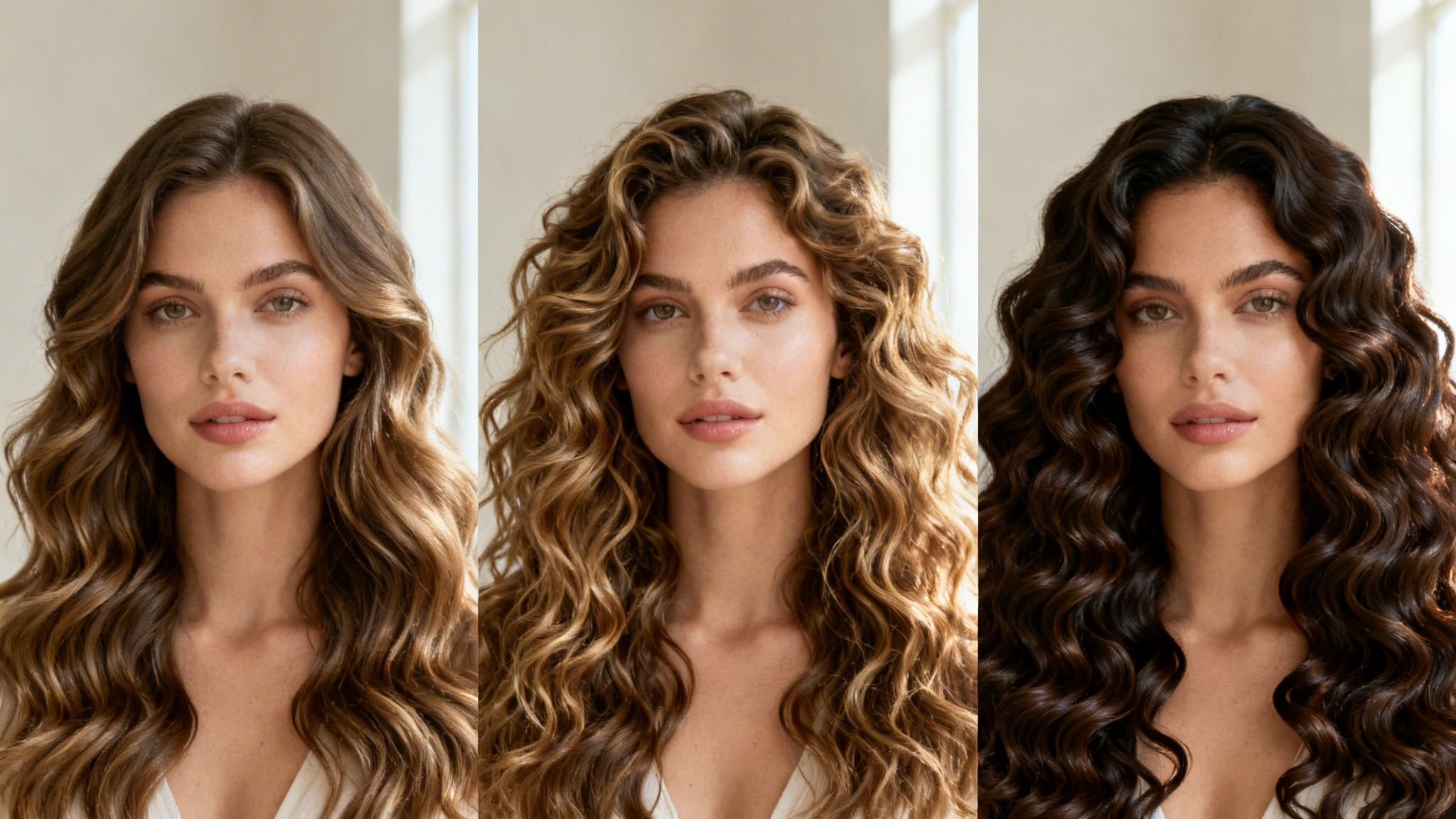
This quick visual guide really helps put the different patterns into perspective.

As you can see, the wave pattern gets more intense and defined as you move from 2A to 2C. You might even have a mix of two types on your head—that's totally normal!
Wavy Hair Types at a Glance
For a quick reference, here’s a breakdown of the key differences you can see and feel in each wavy hair type.
| Hair Type | Wave Pattern | Common Traits | Key Challenge |
|---|---|---|---|
| Type 2A | Loose, tousled "S" shape | Fine texture, lies flat at the root, easily straightened | Lacks volume, easily weighed down by products |
| Type 2B | Defined "S" shape from mid-lengths down | Medium texture, more prone to frizz than 2A | Frizz at the crown, undefined roots |
| Type 2C | Strong, defined "S" waves from the root | Can be coarse, thick, and voluminous; some spiral curls | Prone to frizz, can feel dry or unruly |
This table helps you quickly pinpoint which category sounds most like your own hair, but remember it’s just a starting point.
If you’re a wavy, you're in good company. Research shows that wavy hair is incredibly common, making up about 42.9% of the population across many parts of the world. This texture shows up in many forms, like the highly sought-after Raw Indian Wavy hair, which is prized for its natural body and versatility.
Identifying your hair is the first step, but the condition of your hair is just as crucial. A strand of 2B hair that's highly porous will act completely differently than one with low porosity, absorbing and losing moisture much faster. This is why a one-size-fits-all approach to wavy hair care so often fails.
Before you start building your routine, it helps to know what you’re actually putting on your hair. You can quickly analyze your ingredients with a checker tool or learn more about clean ingredients on our blog to see why making smart choices matters so much.
Caring for Fine Type 2A Waves

Type 2A hair is the most delicate of the wavy crew. It's known for that loose, tousled "S" shape that often doesn’t even start until a few inches down from the root. Because this hair type is usually fine, its biggest challenge is simple: it gets weighed down by almost everything.
If you have 2A waves, you know the struggle for volume is real. The roots want to lie flat against your scalp, and that gentle wave pattern can completely disappear under the weight of heavy products. Use the wrong styler, and your hair can go from wavy to limp, greasy, or even straighter than when you started.
Lightweight Products Are Your Best Friend
To get the most out of your delicate texture, you have to steer clear of the heavy butters, thick creams, and rich oils made for much curlier hair. Instead, your mission is to find products that give you hold and volume without the weight.
Your ideal product lineup is all about being light and airy:
- Volumizing Mousses: These are a 2A wavy’s secret weapon. They’re incredible for adding body and encouraging your waves to form, all without that sticky or heavy feeling. Look for formulas made specifically for fine hair.
- Water-Based Gels: A light-hold, water-based gel can give you just enough definition and frizz control without creating that dreaded greasy film.
- Sea Salt or Texturizing Sprays: Perfect for enhancing your natural pattern and getting that effortless, beachy vibe. Just use them in moderation, as they can be a bit drying.
Trying to decipher ingredient lists can feel like a full-time job. A much smarter approach is to build your personalized hair routine with a tool that already knows what fine, wavy hair needs. It takes all the guesswork out of finding products that will enhance your waves, not smother them.
Smart Styling Techniques for 2A Waves
How you style your hair matters just as much as the products you use. For Type 2A, the entire goal is to gently coax out your natural pattern while pumping up the volume at the root.
Plopping is a total game-changer for fine waves. After you apply a lightweight styler to sopping wet hair, you just gently scrunch your hair up into an old cotton t-shirt or a microfiber towel and tie it on your head. This soaks up excess water without causing frizz and helps your waves set without gravity pulling them straight.
Your blow dryer is your other key player. Instead of letting your hair air-dry completely flat, flip your head over and use a diffuser on a low-speed, low-heat setting. Focus the airflow right at your roots, using your fingers to lift them as you dry. This one simple step can be the difference between flat waves and full, bouncy ones.
Defining Your Classic 2B Beach Waves
When you picture those perfect, effortless beach waves, you're almost certainly thinking of Type 2B hair. This is where waves start to get serious, with a distinct "S" shape that usually kicks in around the mid-lengths and continues to the ends. While the hair at your roots tends to lie flatter, the rest of your hair has a consistent, defined wave pattern.
The number one enemy for 2B waves? One word: frizz. Because the wave pattern is more defined, the hair's cuticle is naturally a bit more raised than on 2A or straight hair. This makes it a prime target for humidity, which can quickly turn those beautiful waves into a poofy, undefined halo, especially around the crown.
Balancing Hydration and Weight
The real secret to making 2B hair look amazing is all about finding that perfect product balance. Your waves crave enough moisture to fight off frizz and help them clump together, but even a little too much can weigh them down and flatten them out. It's a classic struggle for anyone with wavy hair.
And a lot of us have it. Wavy hair is incredibly common, with some large-scale surveys showing that a whopping 42.4% of people have wavy hair globally. What's interesting is how this changes with age. While the rate of wavy or curly hair can peak at 28% for young adults (20-29), it often drops to 18% by age 50, thanks to shifts in hormones and other factors. You can dive deeper into these findings over at Power Your Curls.
Because of the "S" shape, your scalp’s natural oils have a harder time traveling down the hair shaft, which is why dryness and frizz are always knocking at the door.
The perfect 2B routine gives your hair targeted hydration to shut down frizz, but without stealing your volume. It’s all about finding products that are nourishing but won’t weigh down your waves.
To nail this balance, you'll want to focus on products specifically made to hydrate without being heavy.
- Light Leave-In Conditioners: A spray or a lightweight lotion is perfect for adding that first layer of moisture and frizz control.
- Anti-Frizz Serums: Look for lightweight, silicone-free serums that smooth the hair cuticle without causing greasy buildup.
- Gels or Creams with Medium Hold: These are your best friends for helping waves clump together and hold their shape, even when it's humid.
Knowing how your hair absorbs moisture is a total game-changer here. To stop the frustrating cycle of trial and error, it's essential to check your hair porosity. This simple test will tell you if your hair needs more or less moisture, pointing you toward the perfect products for your classic beach waves.
Mastering Thick and Defined 2C Waves

If your hair is the life of the party, you probably have Type 2C. This is the boldest, most voluminous of the wavy hair family, often blurring the line into true curls. You'll see well-defined "S" shaped waves that start right up at the root, giving your hair instant body and texture from top to bottom.
The individual strands tend to be thick and can feel a bit coarse, which is where all that amazing fullness comes from.
But with great volume comes great responsibility. Type 2C hair actually has more in common with its curly cousins than its wavy ones. This means you're likely no stranger to significant frizz and a constant battle against dryness. Simply put, your waves are thirsty, and they need a lot more moisture and stronger-hold products to truly thrive.
Taming Frizz with Moisture and Hold
For 2C waves, lightweight lotions and airy mousses just aren't going to cut it. You need to shift your focus to deep hydration and products that create a strong "cast" to lock in your wave pattern and seal out frizz-inducing humidity. This is where curl-focused products become your new best friend.
Your go-to product arsenal should include:
- Hydrating Curl Creams: These are your foundation. They give your waves the moisture they desperately crave, helping them clump together into juicy, defined sections instead of separating into frizz.
- Powerful Gels: A strong-hold gel is completely non-negotiable for 2C hair. It creates that protective cast around your waves while they dry. You'll gently scrunch this "crunch" out later to reveal soft, perfectly defined waves that last for days.
- Weekly Deep Conditioning: Make it a ritual. Treat your hair to a rich deep conditioner or a moisturizing mask at least once a week. This is essential for replenishing lost moisture and keeping your hair feeling soft and elastic.
The signature S-shape of wavy hair is formed by an elliptical follicle. This shape makes it harder for the natural oils from your scalp to travel down the hair shaft, which is why your ends get dry and frizz takes over. In fact, studies show that wavy and curly types can have up to 21% more split ends than straight hair.
Finding the right protein-moisture balance is crucial for 2C hair. While protein provides essential structure and strength, too much can lead to brittle, straw-like hair.
If your normally bouncy waves suddenly feel stiff, rough, and snap easily, you could be dealing with protein overload. You can quickly check your symptoms with a Protein Overload Test to figure out what's going on and get your hair back on track.
For a deeper look into your hair’s unique personality, check out the full suite of IsItClean tools and start building a routine that finally works.
Building Your Ideal Wavy Hair Routine
Alright, you've figured out your wave type. Now for the fun part: building a routine that actually works for your hair.

A great wavy hair routine isn’t about having a hundred products. It's about using the right ones in the right order. We'll stick to the essentials: Cleanse, Condition, Style, and Protect. The real magic comes from tweaking each of these steps to match your specific wave pattern.
Wavy and textured hair is far from a niche category; it’s the global norm. In fact, some studies show it accounts for up to 86% of the world's population. This is exactly why a one-size-fits-all approach just doesn't cut it. Your waves have unique needs, and a targeted routine is the only way to keep them healthy, defined, and frizz-free.
Cleanse and Condition for Your Waves
It all starts in the shower. The goal here is simple: get your scalp and hair clean without stripping away the natural oils that give your waves life and prevent frizz.
For 2A/2B Waves: You'll likely do best with a gentle, sulfate-free low-poo. These shampoos clean perfectly without being harsh. Pair it with a lightweight conditioner, focusing only on your mid-lengths and ends to keep your roots from getting weighed down.
For 2C Waves: Your hair is probably a lot thirstier. You might fall in love with co-washing (using only conditioner to wash your hair). Many 2Cs alternate between a co-wash and a low-poo. No matter what, always follow up with a rich, deeply hydrating conditioner to give your waves the moisture they crave.
Style and Protect Your Pattern
Styling is where you get to define your waves and make them last. The products you choose will make or break your results, and it all comes down to what your specific wave pattern needs.
A lightweight mousse, for example, can give Type 2A hair that boost of volume it needs without the heaviness. For Types 2B and 2C, a cream-gel combo is often the holy grail—it offers the perfect mix of moisture from the cream and the serious hold from the gel needed to lock in definition and fight off frizz all day.
Learning the right application methods is just as important as the products themselves. For a deep dive, check out this guide on how to style wavy hair for effortless, frizz-free results.
These guidelines are an amazing starting point. But the real secret to unlocking your best-ever waves? Personalization. Generic advice can only get you so far.
You can finally stop the expensive cycle of buying and trying products that just don't deliver. Instead of guessing, it's time to build your personalized hair routine with our AI-powered tool. We analyze your unique hair type, porosity, and concerns to create a step-by-step plan with product recommendations made just for you.
It's the smartest way to find the perfect products for your wavy hair and get the consistent, beautiful results you've been looking for.
Common Wavy Hair Questions Answered
Once you dive into the world of wavy hair, you'll find that a lot of questions pop up. Let's tackle some of the most common ones to help you troubleshoot your routine and get the most out of your natural texture.
Can I Make My Wavy Hair Curlier?
While you can’t change your hair's DNA, the right routine can absolutely make your waves more defined and springy. Think of it less as changing your hair and more as encouraging it to reach its full potential.
Proper care with hydrating, lightweight products and styling techniques like scrunching can coax waves into forming tighter, more uniform clumps. For many 2C wavies, a great routine can even push their pattern into what looks like beautiful, loose curls.
If your stylers are leaving your hair limp and undefined, it's a huge clue that they might be weighing your waves down. You can analyze your hair care routine to see if your products are helping or hurting your definition.
How Often Should I Wash My Wavy Hair?
This one truly depends on your specific wave type and scalp. There's no single right answer.
Finer 2A hair tends to get oily faster, which can weigh down those delicate waves. Washing every 2-3 days often helps maintain volume and prevent hair from going flat.
On the other hand, thicker 2B and 2C types usually do better with less frequent washing. Many people with these patterns find success with co-washing (using conditioner to wash) between shampoo days to keep moisture locked in and frizz locked out. A sensitive scalp can also affect wash frequency; you can take a Scalp Sensitivity Quiz to see if this is a factor for you.
Why Is My Hair Wavy and Straight In Different Places?
First off, know that this is completely normal. In fact, it's incredibly common to have multiple wave patterns on the same head of hair!
There are a few reasons this happens. Heat or chemical damage can permanently straighten sections of hair, while the sheer weight of your hair can pull the underlayers or crown straighter than the rest.
A simple trick is to give those straighter pieces a little extra TLC during styling. Try finger-coiling them with your gel or cream to help them clump up and better match the rest of your wave pattern.
Put Your Wavy Hair Plan into Action
You now have the playbook for your specific wave pattern. You know how to spot your hair type, understand its unique quirks, and what it needs to look its best. But knowing is only half the battle.
The real magic happens when you turn that knowledge into a consistent routine that’s built just for you. It's time to move past the endless product guesswork and finally get the defined, healthy waves you've been aiming for.
Stop wasting money and time on products that aren't right for your waves. Instead, let our AI-powered tool build your personalized hair routine in just a few clicks. It takes everything you've learned here—your hair type, porosity, and goals—and creates a simple, step-by-step plan with product recommendations tailored just for you. This is the fastest way to get the frizz-free, beautiful hair you've always wanted. Let's get started.