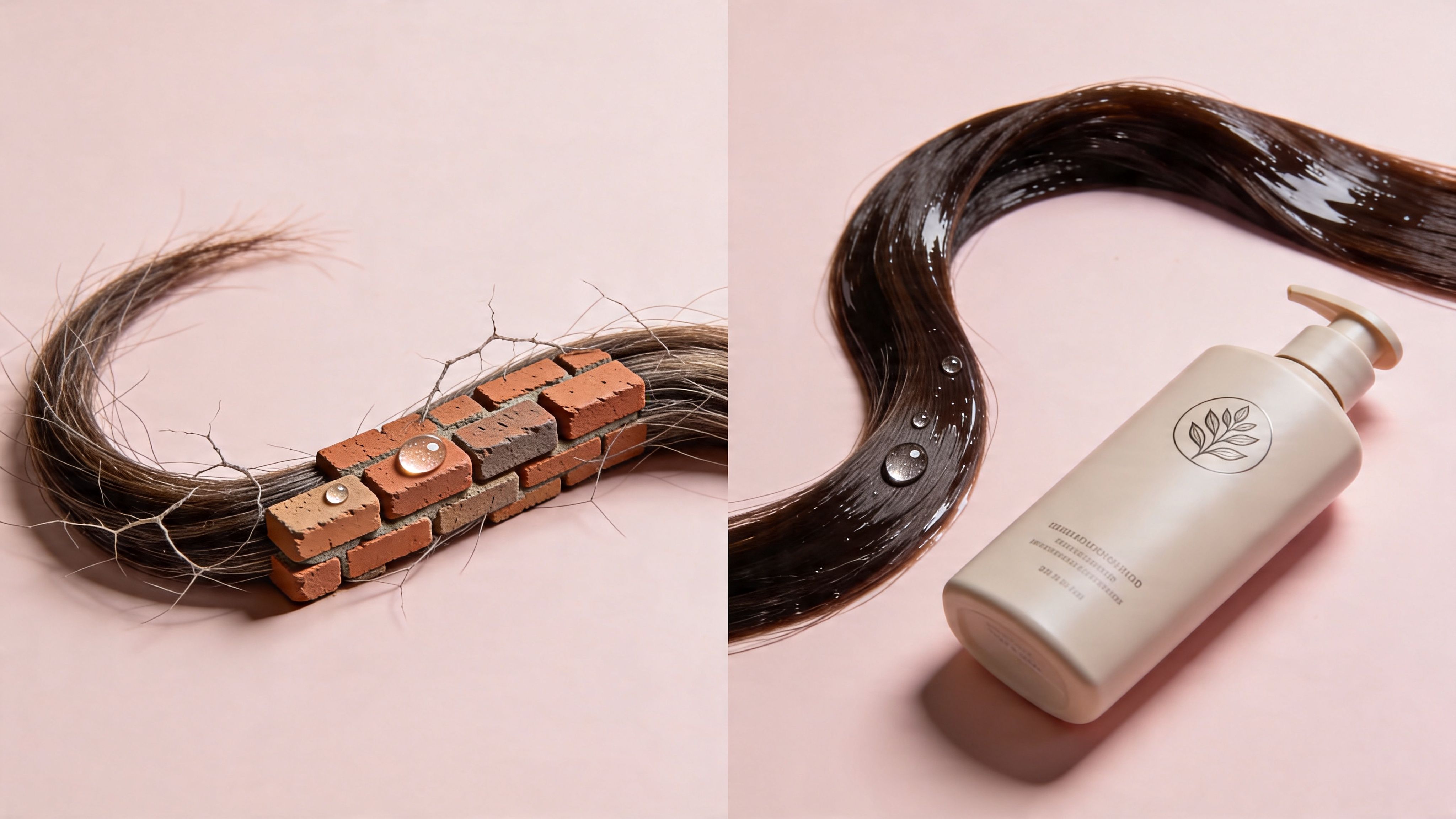

If you’ve ever found yourself standing in the hair care aisle, completely bewildered by the word “silicone,” you are definitely not alone. The easiest way to think about them is as a temporary raincoat for your hair. They wrap each strand in a thin, waterproof layer that creates that smooth, shiny, and frizz-free finish we all crave.
The Great Silicone Debate: What Are They Really Doing to Your Hair?
Silicones have become a staple in modern hair care for one simple reason: they deliver that instant, silky-smooth feeling everyone loves. These synthetic compounds form a thin, protective film around the hair shaft, much like a makeup primer smooths out skin before you apply foundation. It creates a flawless canvas.
This coating is what gives you that immediate "wow" factor from so many products:
- Instant Shine: The slick surface reflects light beautifully, making your hair look incredibly glossy and healthy.
- Frizz Control: By sealing the hair’s outer layer (the cuticle), silicones create a barrier that blocks out humidity—the main culprit behind frizz.
- Effortless Detangling: They provide incredible "slip," which is just a fancy way of saying your comb or brush will glide right through without snagging or pulling.
- Heat Protection: That same film acts as a protective shield against damage from hot tools like flat irons and curling wands.
There’s no denying how widespread these ingredients are. In fact, the haircare segment took up a massive 45.50% of the global silicone market in the personal care industry back in 2023. The most common type, silicone fluids, accounted for over 32% of that revenue thanks to how well they perform. If you want to dive deeper, you can explore more data on the silicone market to see just how dominant they are.
But this quick cosmetic fix is also at the heart of the "great silicone debate." While the immediate results are impressive, the long-term effects can be a real problem for certain hair types. That same film that creates amazing shine can also prevent moisture and essential nutrients from getting into the hair shaft, potentially leading to dryness and buildup over time.
So, are silicones a friend or foe? The truth is, it depends entirely on your hair. Things like your hair’s natural texture, its condition, and how porous it is play a huge role. Instead of just guessing, it's better to get a clear picture of your hair's unique needs first. From there, you can build a personalized hair routine that truly works for you. This guide is here to move beyond the simple 'good vs. bad' fight and give you the knowledge to decide what's actually best for your hair.
Decoding the Silicone Family: Soluble vs. Insoluble
Not all silicones are created equal. Far from it, in fact. Getting a handle on the different types is the first real step toward picking products that make your hair happy, not weighed down or greasy.
Think of it like this: the silicone family has a few different branches, and each one has its own distinct personality. Knowing which one is in your conditioner or styling cream lets you predict how it will feel, how it will perform, and whether it’s going to cause that dreaded buildup over time.
The Three Main Silicone Groups
To keep things simple, we can sort the silicones you'll find in most hair products into three main camps. Their grouping all comes down to how they interact with water and air.
Water-Soluble Silicones: These are the most low-maintenance of the bunch. Because they dissolve in water, they rinse away easily with a gentle shampoo or even just a good rinse, which means buildup is rarely a concern. They offer light conditioning and a touch of shine without weighing your hair down.
Non-Soluble Silicones: This is the most common group and the one that’s usually responsible for buildup. They don't dissolve in water, so they cling to the hair and require a stronger, sulfate-based clarifying shampoo to fully remove. While they provide powerful frizz control and heat protection, they can also block moisture from getting into the hair shaft if they're not washed out properly.
Volatile (or Evaporating) Silicones: These are the "get the job done and disappear" types. They are fantastic for helping to spread other ingredients evenly throughout your hair, giving you that initial silky, smooth feeling. But then, they simply evaporate into the air shortly after you apply them. This means they leave behind little to no residue, making them a great choice for lightweight styling products.
As you can imagine, silicones are a massive part of the personal care industry, especially in hair care. This market diagram shows just how big of a role they play.

Both the general "Haircare" category and specific "Fluids" (which includes many silicones) are major segments, underscoring just how common these ingredients are in the products on our shelves.
How to Spot Silicones on Your Product Labels
Trying to figure out what’s in your bottle can feel like you’re trying to crack a secret code. But once you know what to look for, it gets a lot easier. A few common endings (like -cone, -conol, or -xane) are dead giveaways.
Still confused about an ingredient? You can always use the IsItClean Ingredient Checker to analyze your ingredients and see exactly what you're putting on your hair.
To make things even easier, here’s a quick-reference guide to identifying different types of silicones on your hair product labels, what they do, and how to get them out.
Common Silicones and How to Spot Them
| Silicone Type | Common INCI Names (What to look for) | How It Behaves | Washout Method |
|---|---|---|---|
| Water-Soluble | Dimethicone Copolyol, Lauryl Methicone Copolyol, or any silicone with "PEG" or "PPG" as a prefix. | Rinses out easily with water, so no buildup. | Washes out with gentle shampoos, co-washes, or even just water. |
| Non-Soluble | Dimethicone, Amodimethicone, Cetyl Dimethicone, Cyclomethicone. | Sticks to the hair shaft and can cause heavy buildup over time. | Requires a clarifying shampoo, often one containing sulfates, for full removal. |
| Volatile | Cyclopentasiloxane, Disiloxane, Trisiloxane. | Evaporates quickly after application, leaving almost no residue behind. | Disappears on its own. No special removal needed. |
Knowing the difference between a Dimethicone and a PEG-8 Dimethicone can completely change your hair routine. One might lead to limp, heavy hair, while the other gives you slip and shine without any of the baggage. It’s all about finding what works for your hair.
The Upside vs. The Downside: What Silicones Really Do for Your Hair
When it comes to silicones, it’s easy to get caught up in the "good vs. bad" debate. But the truth is, they're just a tool. A tool with some seriously impressive cosmetic benefits, but also one that isn't right for everyone. That’s why you’ll find them everywhere—from serums and conditioners to heat protectants. The instant gratification is hard to ignore.
But those same slick, coating properties can cause real headaches for certain hair types and routines. The trick is understanding this trade-off so you can decide if they have a place in your routine.

The Upside: Instant-Gratification Hair
Let's be honest, the main reason silicones are so popular is that they work—and they work fast. They act like a real-life filter for your hair, smoothing and protecting to give you visible results from the very first use.
- Effortless Detangling: Silicones give hair that amazing "slip," coating each strand so your comb glides right through. No more fighting with knots or hearing that dreaded snapping sound.
- Brilliant Shine: By smoothing down the hair's cuticle (its outer layer), silicones create a perfectly even surface. This surface reflects light like a mirror, giving you that high-gloss, super healthy-looking sheen.
- Frizz and Humidity Control: That film we talked about acts like a raincoat for your hair. It blocks out environmental moisture, stopping humidity from getting in and puffing up the hair shaft. Say goodbye to frizz and flyaways.
- Heat Styling Protection: This protective layer also acts as a buffer against the intense heat from your flat iron, curling wand, or blow dryer, helping to minimize thermal damage.
The Downside: The Risk of Buildup
Here's the catch. The biggest problem with silicones—especially the non-soluble ones—is buildup. Because they're designed to stick to hair and repel water, they can accumulate over time if you aren't washing them out properly.
This buildup creates a plastic-like film that, while great for shine, can eventually suffocate your hair. It’s like wearing a raincoat in the shower—nothing good can get in.
After a while, this barrier can lead to some frustrating issues:
- Dryness and Brittleness: If your moisturizing conditioners and deep treatments can't penetrate that silicone layer, your hair can start to dehydrate from the inside out, becoming dry and brittle.
- Limp, Weighed-Down Hair: For those with fine or low-density hair, the weight of that silicone film can be too much. It can pull your hair down, making it look flat, greasy, and lifeless.
- Loss of Curl Definition: If you have curls or waves, buildup is your enemy. It weighs down your curl pattern, stretching out your beautiful spirals until they become limp and undefined.
One of the biggest factors in how your hair handles silicones is its porosity. Hair with higher porosity has a more open cuticle, so it's more vulnerable to both losing moisture and grabbing onto product. If you're not sure where your hair stands, you can easily check your hair porosity with a simple test. Knowing this will give you a huge clue as to whether silicones are likely to be a friend or foe.
Going Silicone-Free and Removing Product Buildup
Ready for a fresh start? Going silicone-free is a bit like a detox for your hair. It’s your chance to peel back the synthetic layers and see what your hair’s true texture and health are really like.
The very first step—and honestly, the most important one—is to get rid of all that stubborn, water-insoluble gunk that’s been camping out on your hair strands.

You’ll need a clarifying shampoo for this. These are powerhouse cleansers formulated with strong surfactants that are tough enough to break down and wash away that clingy film from non-soluble silicones.
Because they are so effective, you don't want to overdo it. Think of it as a deep clean, not an everyday wash. Using it about once a week or even just a couple of times a month is plenty to keep buildup at bay without stripping away all your hair's natural, protective oils.
The Adjustment Period and Finding Alternatives
After that first clarifying wash, your hair might feel… different. Maybe a little rough, or not as smooth and manageable as you’re used to. Don’t panic! This isn't damage. It’s just your hair's natural state without its synthetic "raincoat."
Now comes the good part: replacing that temporary fix with real, genuine nourishment.
Without their synthetic coating, your strands are finally ready to absorb real moisture and nutrients. This is your opportunity to rebuild hair health from the inside out.
It's time to start looking for products packed with ingredients that truly moisturize, strengthen, and protect the hair. Here’s what to look for:
- Plant-Based Oils & Butters: Things like argan oil, jojoba oil, shea butter, and mango butter are fantastic. They do a great job of sealing moisture into the hair shaft and giving it that natural, touchable softness.
- Hydrolyzed Proteins: These are tiny protein fragments (like keratin or silk) small enough to get inside the hair cuticle to repair and reinforce it. Just be mindful not to go overboard here—you want to avoid the stiff, brittle feeling that can come with protein overload in your hair.
- Natural Humectants: Glycerin, honey, and aloe vera are amazing moisture magnets. They literally pull hydration from the air right into your hair, giving you a deep, lasting dose of moisture.
Switching to cleaner ingredients is more than just a niche trend; it's a huge movement. The market for vegan silicone alternatives is projected to hit USD 1.6 billion in 2026 and skyrocket to USD 3.7 billion by 2036. Consumers are voting with their wallets for ingredients that work with their hair, not just sit on top of it.
To make sure your new routine is actually silicone-free, a quick scan with an ingredient checker can be a lifesaver. It’s the easiest way to spot any hidden silicones before you buy.
Building Your Ideal Hair Care Routine
Alright, let's put all this theory into practice. Now that you have a solid grasp on what silicones are and how they work, it's time to decide how they fit into your life.
The big question—go all-in with silicones, use them strategically, or ditch them completely—doesn't have a single right answer. It’s all about building a routine that actually serves your hair, your lifestyle, and your goals. What makes one person’s hair look like a shampoo commercial could be a total disaster for someone else.
For High Porosity or Color-Treated Hair
Let’s paint a picture. Say you have high porosity, color-treated hair that sees a lot of heat styling. In this case, that protective film from a non-soluble silicone like Dimethicone could be a total game-changer. It acts like a shield, protecting your fragile, porous strands from heat damage while locking in that expensive hair color you paid for.
The secret to making this work is all about balance. To head off the inevitable buildup, you'll need to work a good clarifying shampoo into your routine every 1-2 weeks. This lets you get all those protective benefits without your hair becoming limp, dry, or weighed down. Your weekly plan might involve a hydrating, silicone-based conditioner for daily slip and protection, with a clarifying session on Sunday to give your hair a fresh start.
For Fine, Low-Porosity Hair
Now, let's flip the script. If you have fine, low-porosity hair, your relationship with silicones is probably going to look very different. Your hair cuticles are naturally smooth and tightly packed, which already makes it tough for moisture to get inside. Slapping a layer of non-soluble silicone on top can feel like wrapping your strands in plastic.
For this hair type, going completely silicone-free is often the ticket to getting real volume and hydration. Your hair is begging for lightweight products that can actually sink in. Look for conditioners with natural oils and styling creams with humectants like glycerin. These will give you moisture that absorbs, delivering bounce and body instead of that flat, greasy look. You might just find your hair has never felt cleaner or looked so full.
Instead of guessing which path is right for you, the most effective strategy is to get a plan designed specifically for your hair. A cookie-cutter approach rarely delivers the results you want.
Understanding your hair is the first step, but taking action on that knowledge is what creates real change. If your current products just aren't cutting it, it might be time for a second opinion. You can get a detailed analysis of your current hair care routine to see exactly where silicones might be causing problems.
Ultimately, navigating the world of silicones is about making smart, personal choices. But you don't have to figure it all out alone. To take the guesswork out of the equation and build a truly effective plan, check out IsItClean. It analyzes your unique hair profile and goals to recommend the perfect products and steps, ensuring your hair gets exactly what it needs to thrive.
Frequently Asked Questions About Silicones in Hair Care
Even after diving deep into the science, you probably still have a few questions buzzing around. Let's clear up the most common ones so you can feel 100% confident reading labels and picking the perfect products for your hair.
Are All Silicones Bad for Curly Hair?
Not at all. This is one of the biggest myths out there. While heavy, non-soluble silicones like Dimethicone are notorious for weighing down curls and leaving them lifeless, that’s not the whole story.
Lighter, water-soluble options (look for anything with a "PEG" prefix) can actually be a curly person's best friend. They provide incredible slip for detangling and taming frizz, all without causing that dreaded buildup.
Many people following strict routines like the Curly Girl Method go completely silicone-free to maximize moisture absorption, and that's a fantastic approach if it works for you. But if you’re constantly battling knots and frizz, experimenting with water-soluble types might just be the perfect middle ground. Not sure which kind is in your conditioner? The easiest way to know for sure is to analyze the ingredients with the IsItClean checker to see if they’re buildup-prone.
How Can I Tell If My Hair Has Silicone Buildup?
Your hair is pretty good at telling you when something's wrong. The trick is learning to read the signals, because silicone buildup can often look a lot like dryness or even greasiness, which might tempt you to pile on more of the very products causing the problem.
Here are the most common tell-tale signs:
- Hair that feels dull, greasy, or weighed down, even right after washing.
- A noticeable loss of your natural curl pattern or volume.
- Products that feel like they're just sitting on top of your hair instead of soaking in.
- Increasing dryness and brittleness, a classic sign that moisture can no longer get past the silicone coating.
If you suspect buildup, a single wash with a good clarifying shampoo is the ultimate test. It will strip away that suffocating film and show you what your hair really feels like underneath.
Will My Hair Be Damaged If I Stop Using Silicones?
Absolutely not. In fact, it's the total opposite. Quitting silicones doesn’t damage your hair—it reveals its true condition.
Think of silicones as the ultimate cosmetic cover-up. They are masters of illusion, creating a shiny, smooth facade by plastering over underlying issues like dryness or cuticle damage.
When you wash that coating away, you’re finally seeing your hair in its natural state. It might feel a bit rougher or more unmanageable at first, but don't panic! This is a good thing. It’s your hair's way of showing you what it actually needs, giving you a clean slate to provide real, penetrating moisture and protein instead of a temporary, superficial fix.
Do I Need Sulfates to Remove Silicones?
This is a fantastic question, especially for anyone committed to a gentler, sulfate-free routine. The answer really depends on which type of silicone you're dealing with.
To effectively break down and wash away those heavy, non-soluble silicones (like Dimethicone), you often need a shampoo with stronger surfactants like sulfates. They are powerful cleansers designed for exactly this kind of job. That said, if you're living a dedicated sulfate-free life, many brands now offer amazing "clarifying" shampoos that use other potent cleansing agents to get the same result.
For the lighter, water-soluble silicones, you can put the heavy-duty cleansers away. A gentle, sulfate-free shampoo—or even a co-wash—is more than enough to rinse them away completely, leaving zero residue behind.
The best way to manage silicones, or skip them entirely, is to have a routine built just for you. Instead of guessing your way through the hair care aisle, let IsItClean do the heavy lifting. You can build your personalized hair routine with our AI-powered tool, which analyzes your hair type, porosity, and goals to recommend the perfect products and steps. It's the smartest way to ensure your hair gets exactly what it needs to look and feel its absolute best.