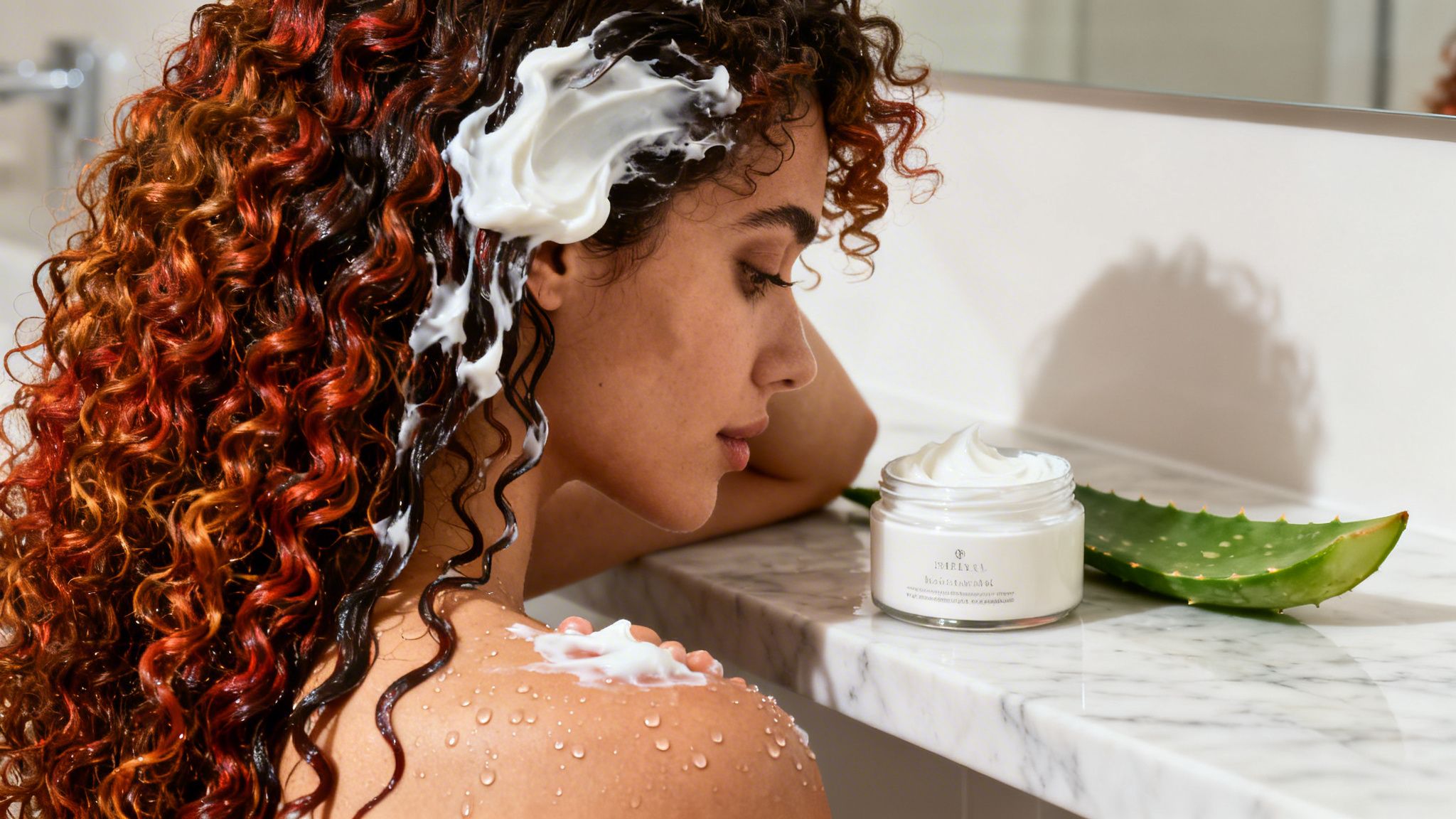
To deep condition your curls, you work a rich, moisturizing treatment through clean, damp hair, let it sit for 15-30 minutes (sometimes with a little heat), and rinse it out. Simple, right? But this single process is the most effective way to give dry curls deep, lasting moisture, finally get a handle on frizz, and bring back the bounce and definition you’ve been missing.
Why Deep Conditioning Is a Game Changer for Curls

If you have curly hair, you’re already familiar with the ongoing fight against dryness. It’s not your fault—it’s physics. The twists and turns of a curl make it incredibly difficult for the natural oils on your scalp to travel down the hair shaft. This leaves your mid-lengths and ends chronically dehydrated and prone to frizz.
This is exactly why deep conditioning isn't just an occasional treat; it's a non-negotiable part of any successful curl care routine.
While your daily rinse-out conditioner does a great job of smoothing the hair’s surface for easy detangling, a deep conditioner is built differently. It's packed with potent ingredients formulated to penetrate deep inside the hair cuticle, delivering intense hydration and repairing damage from within.
More Than Just Moisture
Making deep conditioning a regular habit is truly one of the cornerstones of healthy, vibrant curls. The benefits you'll see go way beyond just a quick moisture hit.
- Restores Elasticity: Properly hydrated hair has amazing elasticity. This means your curls can stretch and spring back without snapping, which translates to less breakage and more bounce.
- Fights Frizz: Deep conditioning smooths and seals the hair cuticle. A sealed cuticle can’t absorb a ton of moisture from the humid air, which is what causes that halo of frizz in the first place.
- Enhances Shine and Softness: These treatments are loaded with emollients like rich butters and oils that leave your hair feeling incredibly soft and looking noticeably shinier.
- Improves Curl Definition: When your hair is consistently moisturized and healthy, your natural curl pattern clumps together more easily, becoming more defined and uniform.
The demand for products that actually work for curls is exploding. The global curly hair product market is on track to jump from USD 5.94 billion to a whopping USD 8.58 billion by 2033. Deep conditioners alone make up a massive 38.4% of all conditioning treatments sold.
This is great news because it means more innovation and options for us. But it also means you have to be smarter about what you buy.
Building Your Personal Routine
With a sea of products out there, the real secret is finding what works for your hair. This is about moving past just grabbing whatever is on sale and building a deliberate routine. Things like your curl type, porosity, and even the climate you live in will all change which products give you the best results.
The most impactful change you can make is shifting from simply using products to building a routine. A structured approach ensures your curls get consistent, targeted care exactly when they need it.
This guide will walk you through everything you need to know to deep condition your curls like a pro. We'll get into prepping your hair to absorb the most product, choosing the right ingredients, and troubleshooting common issues. For more tips on creating a complete hair care plan, check out other guides on the IsItClean blog.
Our goal here is to give you the knowledge to build a personalized treatment that makes your curls look their absolute best. Once you understand the "why" behind each step, you can finally achieve the consistently hydrated, happy curls you've been working towards.
Prepping Your Curls for Maximum Moisture Absorption
The secret to a game-changing deep condition session doesn't start when you open the jar. It starts at the sink.
Think of your hair like a sponge. If it's already clogged with old products, oils, and dirt, there's simply no room for it to soak up the good stuff. That’s why your prep work is everything—it creates a clean slate so your treatment can actually penetrate the hair shaft.
Without this crucial first step, even the most luxurious deep conditioner will just sit on top of your hair. The result? Curls that feel greasy or weighed down, not truly hydrated.
Start with a Thoroughly Cleansed Scalp and Strands
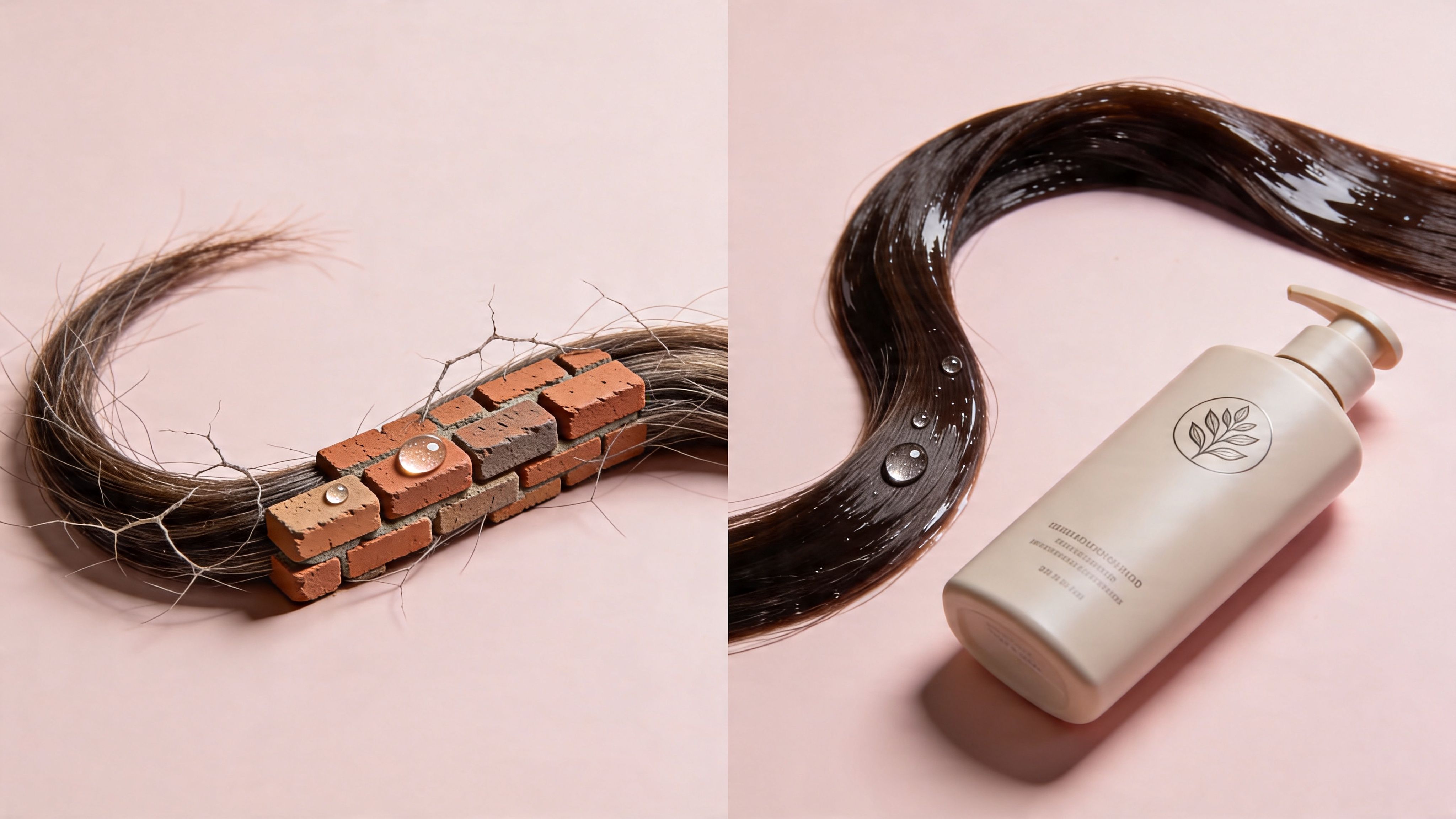
To get that deep-down moisture you're after, you have to clear the path first. Product buildup from styling creams, gels, and even leave-ins can form a waterproof-like film that blocks your deep conditioner from ever reaching the hair strand. A quick rinse or co-wash just won't cut it.
Your best bet is to wash your hair with a gentle, sulfate-free shampoo. Sulfates are harsh detergents that can strip away your hair’s natural moisture, making already thirsty curls feel even more brittle. A good sulfate-free formula will get rid of buildup without causing that dreaded stripped, squeaky-clean feeling.
Pro Tip: If you frequently use products with heavy butters or non-soluble silicones, you'll need to bring in the big guns. Use a clarifying shampoo once or twice a month to completely reset your curls and remove any stubborn residue that’s blocking moisture.
Get Your Hair to the Ideal Dampness
Once your hair is clean, the next step is getting rid of excess water. This is where a lot of people go wrong. Applying your deep conditioner to sopping wet hair is a waste of time and product—it dilutes the formula and causes it to slide right off your strands.
On the flip side, applying it to dry hair makes it a nightmare to distribute evenly and you'll end up using way more product than you need to.
The sweet spot is damp, not dripping. Your hair should feel wet, but you shouldn't have water running down your back.
To get there without causing a frizz-fest, ditch your regular terry cloth towel. Its rough texture snags on your curls and can lead to breakage. Instead, gently squeeze the water out with one of these:
- A Microfiber Towel: These have a much smoother weave that soaks up water without roughing up your hair's cuticle.
- An Old Cotton T-shirt: A great, no-cost alternative that's just as gentle on your delicate strands.
Understand Your Hair’s Porosity
Your hair is clean. It's damp. You're almost ready. There's just one more piece of the puzzle you absolutely need: your hair's porosity. Porosity is all about how well your hair can absorb and hold onto moisture, and it will make or break your deep conditioning routine.
- Low Porosity: The hair cuticle is very tight and compact. This type of hair resists moisture, so products often feel like they're just sitting on top.
- High Porosity: The hair cuticle is raised and has gaps. This hair soaks up moisture like a sponge but loses it just as fast.
Knowing your porosity is a total game-changer. If you have low porosity hair, for instance, you might feel like deep conditioners just don't work for you. It's not the product; it's your technique! You need a little extra help to lift that tight cuticle.
To figure out where you stand, you can use the IsItClean collection of hair analysis tools. Knowing your porosity unlocks the ability to tailor your application method—which we'll dive into next—and turns your routine from a guessing game into a targeted, effective strategy.
Fine-Tuning Your Deep Conditioning for Your Hair Type
There’s no such thing as a "one-size-fits-all" deep conditioning routine. The real magic happens when you stop following generic advice and start listening to what your hair actually needs. Your success boils down to two key factors: your hair's porosity and its unique curl pattern.
When you understand these two things, you can finally stop guessing. You'll know exactly how to apply your deep conditioner to transform it from just another product into a high-performance treatment that delivers consistent, hydrated results.
How to Deep Condition Based on Hair Porosity
We've talked about how porosity determines the way your hair absorbs and holds onto moisture. This single trait should be your main guide for applying your deep conditioner. It’s the difference between a product that works and one that just sits on top of your hair.
The flowchart below breaks down how to prep your hair based on its porosity, even before you grab your deep conditioner.

As you can see, starting with clean, damp hair is a given, but knowing your porosity is what dictates the rest of your routine.
Your hair's porosity level presents distinct challenges, but with the right technique, you can make your deep conditioner work smarter, not harder. This table breaks down the best approach for low, medium, and high porosity hair.
Deep Conditioning Approach by Hair Porosity
| Hair Porosity | Key Challenge | Recommended Technique | Ingredients to Look For |
|---|---|---|---|
| Low | Cuticles are tightly packed, resisting moisture. Products tend to sit on top of the hair, causing buildup. | Use gentle heat (steam, thermal cap) to lift the cuticles and help the product penetrate. Apply to clean, damp hair for 15-20 minutes. | Lightweight hydrators like glycerin, aloe vera, and honey. Avoid heavy butters and oils. |
| Medium | Cuticles are flexible, allowing moisture in and out at a normal rate. This is the "ideal" porosity. | Standard application works well. Focus on consistency—deep condition regularly to maintain hair health and moisture balance. | A balanced mix of moisturizers and light proteins. |
| High | Cuticles are raised and porous, absorbing moisture quickly but losing it just as fast. Hair is prone to frizz and dryness. | Use the "squish to condish" method to physically push moisture into the hair shaft. Layer with a leave-in and sealing oil to lock it in. | Rich ingredients like shea butter, avocado oil, and ceramides. Proteins can help fill gaps in the cuticle. |
Ultimately, tailoring your technique to your porosity means you’re either helping moisture get in (low porosity) or helping it stay in (high porosity).
Adjusting for Your Specific Curl Pattern
Beyond porosity, your curl pattern—from loose waves to tight coils—changes how you should distribute product for even coverage. If you're not sure where you fall on the spectrum, you can find your curl pattern using our interactive hair type quiz.
Knowing your type is more important than ever. The curly hair market is huge, with North America holding about 42% of the global share. The U.S. market alone was valued at USD 1.47 billion and is expected to reach USD 1.90 billion by 2030. This means more products for specific curl needs, but you have to know your hair to choose the right ones. You can explore more about these market trends and their impact on product innovation.
Once you know your type, use these tips:
For Wavy Hair (Type 2): Your waves get weighed down easily. Apply deep conditioner from the mid-lengths to the ends, staying away from the roots. Use a "praying hands" motion to gently smooth the product down your hair, which helps prevent frizz and won't disrupt your wave pattern.
For Curly Hair (Type 3): To make sure every single curl gets some love, work in sections. Clip your hair into four or more sections and apply the conditioner thoroughly to each one, from root to tip. This is the only way to avoid those dreaded dry, patchy spots.
For Coily and Kinky Hair (Type 4): Your tight coils are the most fragile and need the most moisture. Be generous with your product! Take your time, detangle gently with the conditioner in your hair, and use your fingers or a wide-tooth comb to ensure every strand is fully saturated.
By combining what you know about your porosity with techniques built for your curl pattern, you create a powerful, personalized strategy. This is how you unlock your hair's full potential.
If you're ready to stop the guesswork, you can build your personalized hair routine with our advanced tool. It uses your unique hair profile—porosity, curl type, and more—to create a weekly schedule that tells you exactly what to do and when for your best hair days.
Decoding Ingredients to Find Your Holy Grail Product
 The ingredient list on your deep conditioner is your roadmap. A truly great product isn't just about what it has, but also what it doesn't. Honestly, learning to read a label is one of the most powerful skills you can build on your curly hair journey.
When you know what to look for—and what to run from—you can finally pick products that deliver real, lasting results. This is how you transform your deep conditioning sessions from a hopeful guess into a reliable routine.
What Your Hair Wants to See on the Label
When you scan a deep conditioner label, you’re basically looking for a good mix of moisturizers (humectants and emollients) and strength-builders (proteins and ceramides). Each one has a very specific job to do for your curls.
- Humectants: Think of these as moisture magnets. They pull water from the air right into your hair shaft for serious hydration. Keep an eye out for glycerin, aloe vera, honey, and panthenol.
- Emollients: These are the sealers. They lock in all the moisture the humectants attracted, while also creating that amazing slip and softness we all crave. You'll see them as rich butters and oils like shea butter, avocado oil, jojoba oil, and coconut oil.
- Ceramides: These are lipids (fats) that are naturally part of your hair’s cuticle. They’re like the glue holding your hair’s protective layer together. Adding them back helps patch up damage, boost moisture retention, and cut down on frizz.
- Proteins: If your hair feels weak, stretchy, or is highly porous, protein is your best friend. It fills in the gaps in the hair's structure, literally rebuilding it from the inside. Look for hydrolyzed proteins (like wheat, silk, or oat) because their molecules are tiny enough to actually penetrate the hair shaft.
Finding a product with the right balance is everything. For a curated list of clean and effective options, you can explore the hair products analyzed on IsItClean to find your next favorite.
Ingredients to Avoid at All Costs
Just as important as finding the good stuff is knowing what to avoid. Some common ingredients can completely sabotage your hard work by causing buildup or stripping your hair of moisture.
Here are the main culprits you’ll want to steer clear of:
- Harsh Sulfates: Ingredients like Sodium Lauryl Sulfate (SLS) and Sodium Laureth Sulfate (SLES) are aggressive detergents. They’re rare in deep conditioners, but they can sneak into "cleansing conditioners" and will strip your hair of its natural, protective oils.
- Non-Soluble Silicones: Heavy silicones like dimethicone basically wrap your hair in plastic. It feels smooth at first, but that coating prevents moisture from ever getting in. The only way to remove them is with a harsh sulfate, which just creates a vicious cycle.
- Drying Alcohols: Not all alcohols are bad for hair, but the short-chain ones are a problem. Watch out for alcohol denat, isopropyl alcohol, and ethanol. Over time, they will dehydrate your curls, leading to frizz and brittleness.
Trying to memorize all of this can feel like a chore. To make it easy, you can use a tool to instantly analyze your ingredients with the IsItClean Ingredient Checker. Just snap a photo of the label, and it'll tell you what's good and what's not.
The Critical Protein-Moisture Balance
This is where things can get tricky. Your hair needs both protein and moisture to thrive, but getting the balance wrong can cause major issues.
- Moisture Overload: If your hair feels mushy, overly soft, and your curls fall flat almost immediately, it's likely over-moisturized. It's begging for protein to give it some structure back.
- Protein Overload: If your hair feels brittle, straw-like, and snaps easily when you touch it, you've probably gone too heavy on the protein. It’s become too rigid and is desperate for moisture.
The only way to know what you need is to listen to your hair. If it feels weak and limp, grab a deep conditioner with protein. If it feels dry and rough, go for a moisture-focused, protein-free formula instead.
Your hair's needs can change from one week to the next depending on the weather, your styling habits, and its overall condition. If you're completely stumped, taking a quick protein overload test can diagnose your hair's needs and point you to the right product for your next wash day.
Understanding what's in your products takes all the guesswork out of deep conditioning. Once you become your own ingredient expert, you can build a routine that guarantees your curls are hydrated, strong, and vibrant every single time.
Building Your Perfect Deep Conditioning Schedule
Figuring out how often to deep condition is where so many of us get tripped up. There’s no single magic number. That common advice to "deep condition once a week" might be perfect for your friend, but it could leave your hair feeling greasy and weighed down, or for others, it might not be nearly enough.
The truth is, your ideal schedule is a moving target. It changes based on your hair's current health, its porosity, your styling routine, and even the season. It’s all about learning to listen to your hair and giving it what it needs, when it needs it.
Factors That Influence Your Deep Conditioning Frequency
Instead of locking yourself into a rigid schedule, it's much more effective to learn the signs that your hair is asking for a treatment. A few key factors will tell you when it's time to ramp up the moisture.
Hair Damage: If your hair is recovering from heat, color, or chemical treatments, its internal structure is compromised. It’s weaker, more porous, and loses moisture in the blink of an eye. For hair like this, a weekly deep conditioning session is non-negotiable for rebuilding strength and hydration.
Porosity Level: As we've covered, porosity is everything. High-porosity hair struggles to hold onto moisture, so it absolutely loves weekly treatments. On the flip side, low-porosity hair, which repels moisture, can easily feel over-conditioned on a weekly schedule. It often does best with a session every 10-14 days. Not sure where you land? Take a second to check your hair porosity with our simple test.
Environmental Stressors: Don't underestimate what the weather is doing to your hair. Dry winter air literally sucks the life out of your curls, while summer brings humidity, intense sun, and chlorine. During these challenging seasons, you’ll probably need to bump up your deep conditioning to weekly, even if you normally go longer between treatments.
Listening to Your Curls
Your hair will always tell you what it needs. You just have to pay attention to the signals.
If you notice your curls look dull, feel rough to the touch, or are frizzier than usual, that’s a clear sign. It’s time for a deep conditioning treatment, even if you’re "not due" for one according to your calendar.
But what if your hair feels too soft, almost mushy, and your curls are limp and struggling to hold their shape? You're likely over-conditioning. That’s your cue to pull back and maybe swap your usual moisturizing mask for one with a little protein to bring back some structure and balance.
Your hair's needs are not static; they change with the seasons, your styling choices, and its overall health. A flexible, responsive approach to your routine will always yield better results than a rigid, one-size-fits-all schedule.
Building a Truly Custom Routine
Does keeping track of all these variables feel a bit overwhelming? It doesn't have to be. The best way to get consistent results is to stop guessing and start building a real strategy. A well-planned routine takes the guesswork out of the equation and ensures your hair gets exactly what it needs.
This is exactly why we built a tool to do the heavy lifting for you. Instead of trying to remember it all, you can build your personalized hair routine with the IsItClean Hair Routine Builder.
This smart tool takes your unique hair profile—curl type, porosity, damage levels, and any other concerns—and generates a detailed weekly and monthly calendar. It tells you precisely when to use a clarifying shampoo, when to reach for a moisture-focused deep conditioner, and when to work in a protein treatment. It’s like having a personal curl coach, making sure every product is used at the perfect time for maximum benefit.
Common Questions About Deep Conditioning Curls
So you’ve got the basic deep conditioning routine down, but your results are still a little... unpredictable. It happens. You start wondering if you’re using the right product, if you left it on too long (or not long enough), or why your hair sometimes feels amazing and other times just meh.
Let's clear up some of the most common questions and get you on the path to consistently great curl days.
Rinse-Out Conditioner vs. Deep Conditioner
We get this question all the time: "Can I just leave my regular conditioner on for 30 minutes and call it a deep conditioner?" The short answer is no. They’re built for completely different jobs.
Your daily rinse-out conditioner is designed to work fast. Its main purpose is to smooth the hair's outer cuticle and provide enough slip to get the knots out. The molecules are larger and meant to sit on the surface, doing their thing in just a few minutes.
A deep conditioner, on the other hand, is a true treatment. It’s formulated with a much higher concentration of potent ingredients—things like emollients, humectants, and proteins—that are small enough to penetrate deep into the hair shaft. It’s all about repairing and hydrating from the inside out.
Think of it this way: your rinse-out is like a daily face moisturizer, while a deep conditioner is your intensive weekly face mask. You wouldn't skip one for the other, right?
Can You Leave a Deep Conditioner on Overnight?
It seems logical—if 20 minutes is good, a full eight hours must be incredible. But this is one of those times where more is definitely not better. Leaving a water-based conditioner on overnight can lead to something called hygral fatigue.
This is when your hair cuticle swells too much from being wet for so long. It weakens the hair’s internal structure, making your curls feel mushy, limp, and almost too soft. Over time, this causes serious elasticity loss and breakage.
The magic really happens in the first 20-30 minutes. After that, the product has done its job. Leaving it on longer doesn’t add benefits and can actively weaken your hair. Always stick to the time on the label.
What to Do If Your Hair Feels Greasy or Weighed Down
Nothing is more frustrating than finishing a deep conditioning treatment only to have your curls feel heavy, limp, or even greasy. If this is happening, it’s a sign that something needs to change. It usually boils down to a few common culprits.
- You're using too much product. It's easy to go overboard. Try starting with less and only adding more if you feel your hair needs it, focusing just on your mid-lengths and ends.
- You're not rinsing well enough. Lingering residue is the number one cause of that weighed-down feeling. Make sure you rinse thoroughly with lukewarm water until your hair feels clean and slippery, not coated.
- The product is too heavy for you. If you have fine or low-porosity hair, rich butters and heavy oils are a recipe for disaster. You probably need a more lightweight, water-based formula that won't sit on top of your strands.
If your hair constantly feels heavy, it might be time to look at your whole routine. A tool like the Routine Analyzer is perfect for this—it can help you spot sneaky ingredients across all your products that might be causing buildup. Finding the right products for your hair is what makes all the difference.
At IsItClean, we know that understanding your hair is the first step to loving it. The cycle of guessing games and one-size-fits-all advice just leads to a bathroom full of half-used bottles and a lot of frustration. It’s time to stop guessing and create a plan that is as unique as your curls. Our Hair Routine Builder looks at your specific hair type, porosity, and goals to create a clear, step-by-step plan. You'll know exactly what to do and when, so you can finally achieve the healthy, defined curls you've been working toward. Take the next step and build your personalized hair routine today.