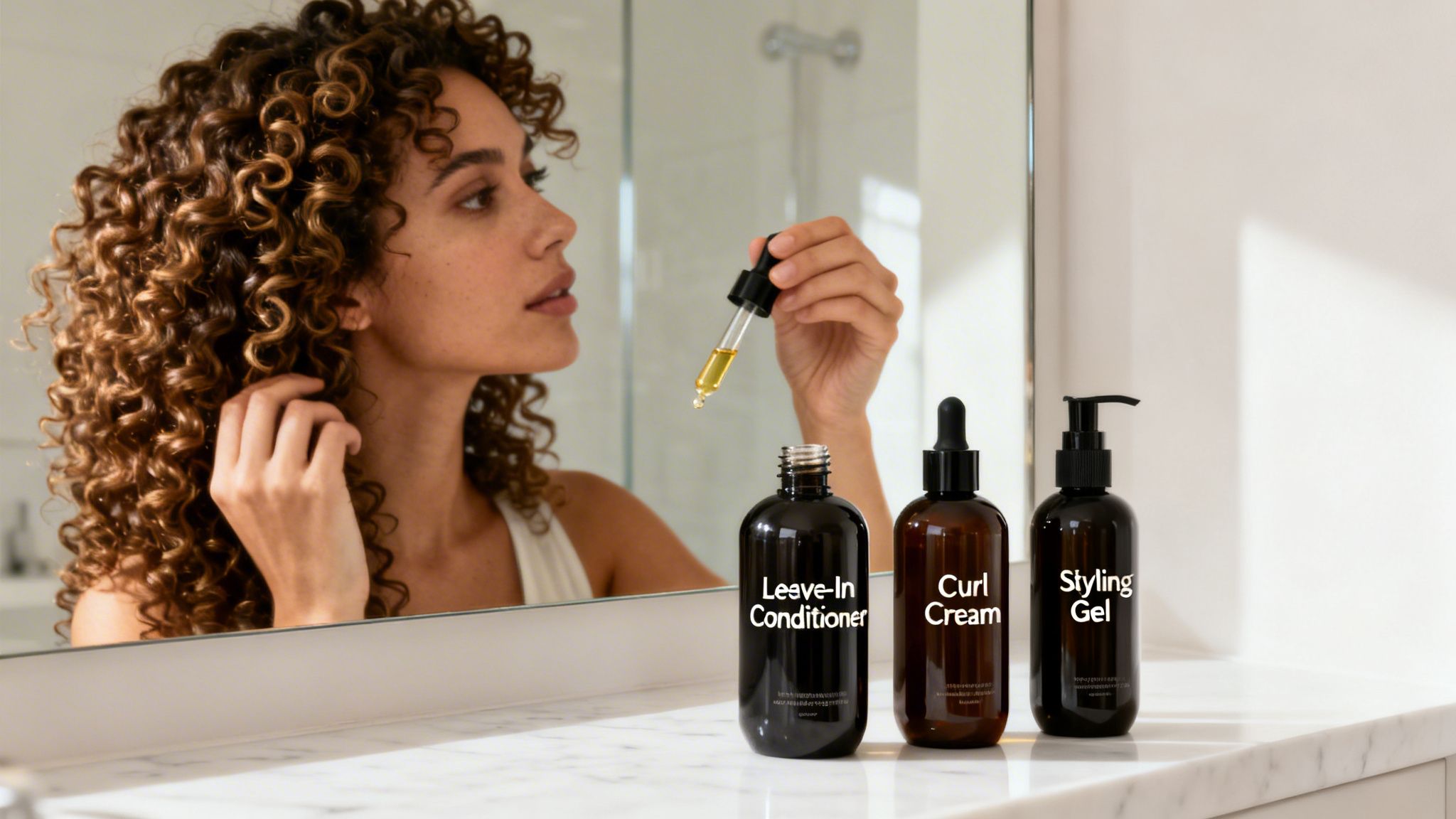
If your bathroom cabinet looks like a graveyard for half-used curl creams and gels, you're not alone. We’ve all been there, lured in by promises of perfect definition only to be left with frizz and frustration.
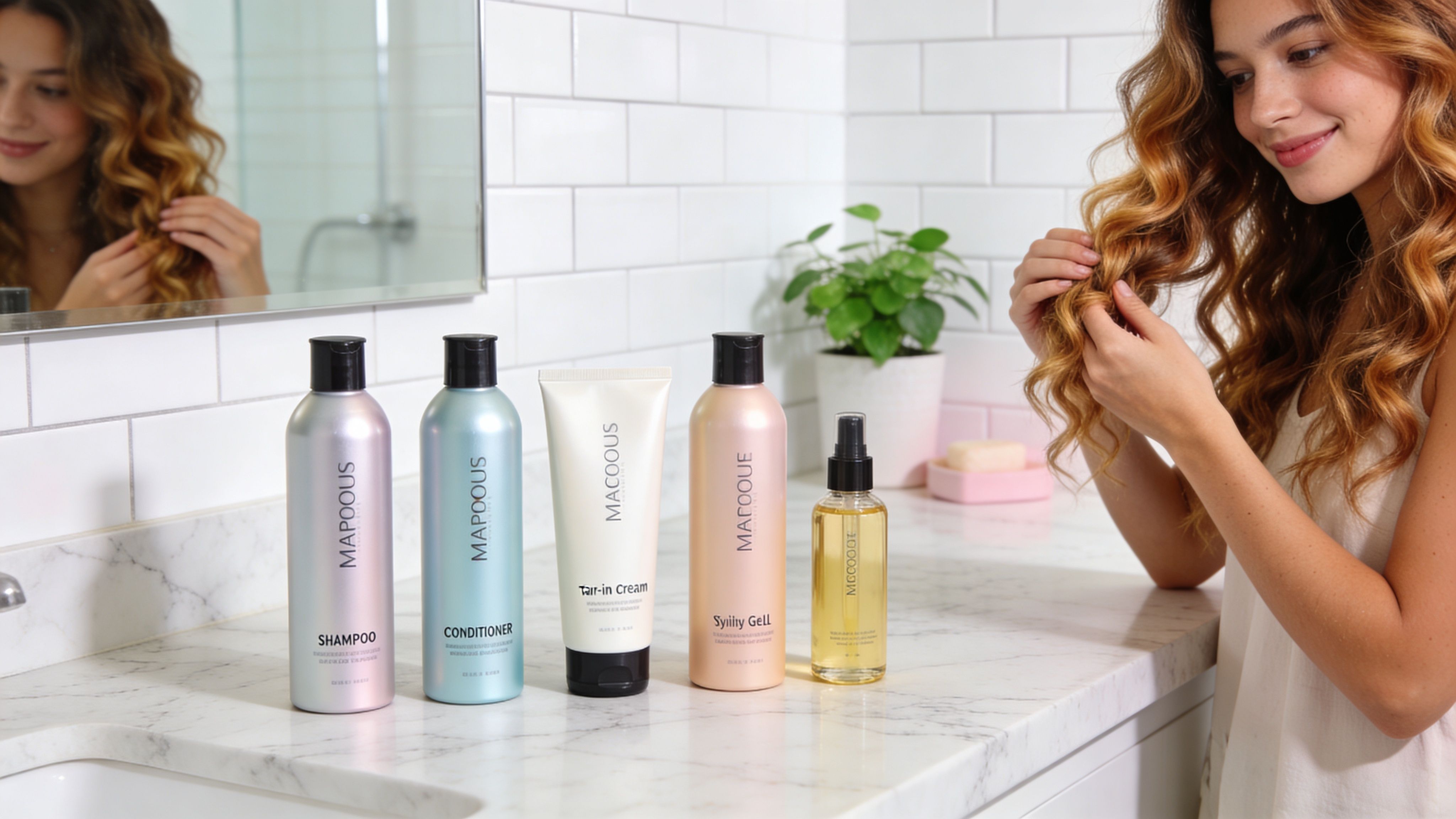
The secret isn't finding one single magic bottle. It’s about building a simple, foundational toolkit: a gentle cleanser, a deeply hydrating conditioner, a leave-in conditioner for lasting moisture, and a styler—like a gel or mousse—to lock it all in. Once you get these four core pieces right, the cycle of trial and error finally ends.
Your Search for the Perfect Curl Products Ends Here
This is your definitive guide to finding products that work with your curls, not against them. We're cutting through the brand hype and marketing noise to focus on what really matters: your hair's unique needs, based on science.
This isn’t about one-size-fits-all advice. It's about empowering you to read an ingredient label, understand what your hair is telling you, and build a routine that gives you healthy, predictable results.
Whether you have loose, gentle waves or tight, springy coils, the basic product categories are the same. For those with wavier textures, you can find more specific tips in our guide to building a simple wavy hair routine.

The Foundational Toolkit
Every great curly hair routine is built on a few essential product types. Each one has a specific job to do, and they all work together to cleanse, moisturize, and define your curls. Think of this as your starting lineup, which you can always customize later.
The most common mistake isn't buying the wrong brand; it's using the wrong type of product for the job or using a great product incorrectly. Knowing how and when to use each item is just as critical as the ingredients inside.
To stop the guesswork, let's break down the core components of your toolkit. Knowing what each product does and which ingredients to look for will completely change how you shop.
To get started, here's a quick look at the core products every curly-haired person needs.
Your Foundational Curly Hair Product Toolkit
This table outlines the four essential products that form the backbone of any solid curl routine.
| Product Type | Primary Purpose | Key Ingredient Focus |
|---|---|---|
| Sulfate-Free Shampoo | Gently cleanses the scalp and hair without stripping away the natural oils that keep your curls hydrated and happy. | Gentle cleansers like Cocamidopropyl Betaine instead of harsh sulfates like Sodium Lauryl Sulfate. |
| Hydrating Conditioner | Replenishes moisture after cleansing, helps detangle knots, and smooths the hair cuticle to fight frizz and add softness. | Emollients (Shea Butter, Avocado Oil) and fatty alcohols (Cetyl Alcohol) for moisture and slip. |
| Leave-In Conditioner | Provides a lasting layer of moisture that protects hair after washing and creates the perfect base for your styling products. | Humectants like Glycerin and Aloe Vera that draw moisture into the hair strand all day long. |
| Styling Product (Gel/Mousse) | Defines your curl pattern, gives your style hold, and creates a protective "cast" that locks out humidity and frizz. | Film-forming polymers (PVP, Polyquaternium) provide hold. Natural options include Flaxseed and Aloe. |
With these four pillars in place, you have everything you need to build a routine that delivers consistent, beautiful results.
Understanding Your Hair's Unique Needs
Before you can find the right products, you have to learn to listen to your hair. Think of it like a conversation—your hair has its own language, and the two most important words are curl pattern and porosity.
Nailing these two is the difference between a graveyard of half-used bottles under your sink and a simple routine that just works.

Most of us start (and unfortunately, stop) with our curl pattern. This is the system that classifies curls by their shape, from wavy (Type 2) to curly (Type 3) to coily (Type 4). You can find out your pattern with a simple hair type quiz. The letters A, B, and C just add a bit more detail on how tight those curls are. A 2A is a loose, beachy wave, while a 4C is a super-tight, Z-angled coil.
And while your curl pattern gives you a clue—tighter curls usually need more moisture—it’s only telling you half the story. The real secret to unlocking your best hair is understanding a much more important factor.
Hair Porosity: The True Game-Changer
If your hair is a sponge, porosity is how easily that sponge soaks up and holds onto water. It all comes down to the structure of your hair’s outer layer, the cuticle. This one thing dictates how products get into your hair shaft, and frankly, it matters a lot more than your curl pattern when it's time to go shopping.
Low Porosity Hair: The Fortress
- What it is: The cuticles on the hair shaft are packed down tight and flat. This creates a barrier that makes it tough for water and products to get inside.
- The Sponge Analogy: Think of a brand-new, dense kitchen sponge. Water beads right up on the surface and takes forever to actually soak in.
- What it needs: Lightweight products are your best friend. You need formulas that won't just sit on top of your hair, creating buildup. Heavy butters and thick oils are a big no-no.
High Porosity Hair: The Sieve
- What it is: The cuticles are raised or have gaps in them. This means your hair drinks up moisture in a second, but it loses it just as fast.
- The Sponge Analogy: This is like an old, well-used sponge full of holes. It soaks up water instantly but can't hold onto it for long and dries out super quickly.
- What it needs: Richer creams, butters, and sealing oils will help fill those gaps in the cuticle and lock that much-needed moisture inside. You can dive deeper into building a routine for this hair type in our guide: https://isitclean.app/high-porosity-hair-routine.
Medium porosity hair is the happy middle ground. Its cuticle layer isn't too tight or too open, so it absorbs and retains moisture pretty well, giving you more flexibility with your product choices. Part of understanding your hair also means knowing how to tackle dryness and damage when they pop up—learning how to repair damaged dry hair is key for any hair type.
Knowing your porosity is like getting a cheat sheet for product shopping. A heavy cream that’s a miracle for your friend with high porosity hair might leave your low porosity curls a greasy, weighed-down mess—even if you both have the exact same 3B curl pattern.
How to Discover Your Hair Porosity
Guessing your porosity is a fast way to waste more money and get frustrated. The good news? Figuring it out is incredibly simple. You can take a quick hair porosity test online, or do it yourself at home.
The easiest at-home method is the float test. Just take a single strand of clean, product-free hair and drop it into a glass of room-temperature water. Wait a couple of minutes and see what it does.
- If it floats: You almost certainly have low porosity hair.
- If it sinks slowly: You've likely got medium porosity hair.
- If it sinks right away: You're looking at high porosity hair.
Once you know your curl pattern and your porosity, you're finally equipped to decode product labels and build a routine that truly speaks your hair's language.
Decoding Product Labels Like a Pro
Walking down the hair care aisle can feel overwhelming. But the ingredient list on the back of any bottle is its resume—it tells you exactly what the product will do for your hair, if you know the language.
Learning to read these labels is the single most powerful skill you can develop on your curly hair journey. It’s not about memorizing every chemical name. It's about understanding why certain ingredients are heroes for curls, and others are villains. The unique structure of curly hair makes it naturally more fragile and dry, so what works for straight hair can be a total disaster for us.
The Villains of Curly Hair Care
Some ingredients are notorious for causing problems for curls. While they might not be "bad" for everyone, they often throw off the delicate balance our hair needs to thrive.
Harsh Sulfates (Sodium Lauryl/Laureth Sulfate): These are heavy-duty detergents that create that super-satisfying lather. The problem? They’re too good at their job. They strip away dirt and buildup, but they also strip away the natural oils your curls desperately need, leaving them dry, frizzy, and unhappy.
Drying Alcohols (Alcohol Denat, Isopropyl Alcohol): You'll often find these short-chain alcohols in hairsprays and some gels because they help products dry fast. But that rapid evaporation literally sucks moisture out of your hair shaft, making your curls brittle and prone to snapping.
Certain Silicones (-cone, -conol, -xane): Think of silicones as a plastic-like coating for your hair. They give you that instant slip and shine, which feels amazing at first. But most of them aren't water-soluble, meaning they build up over time, block moisture from getting in, and leave your curls looking limp, weighed down, and lifeless.
The Heroes Your Curls Are Craving
On the flip side, a great product label will be full of ingredients that hydrate, strengthen, and protect. These are the good guys you want to see on your team.
Humectants (Glycerin, Aloe Vera, Honey): These are total moisture magnets. They work by pulling water molecules from the air right into your hair strand, giving you that deep, lasting hydration.
Emollients (Shea Butter, Avocado Oil, Jojoba Oil): If humectants pull moisture in, emollients are the security guards that lock it down. These oils and butters seal the hair cuticle, preventing that precious moisture from escaping. This is what gives your hair that soft, smooth feeling.
Proteins (Keratin, Collagen, Silk Amino Acids): Your hair is literally made of protein. When you add protein to your products, you're essentially patching up the weak, damaged spots in your hair's structure. This adds strength, elasticity, and helps your curls hold their shape.
This world of ingredients is only getting more complex. The global hair care market is expected to hit a massive $145.79 billion by 2033, which means more products and more confusing labels on the shelf. You can read more about these market trends and their impact on consumers to see why understanding ingredients is more important than ever.
To make things easier, you can use a tool to instantly analyze your ingredients and check if a product meets your standards.
The Protein-Moisture Balance
This is one of the most important—and often misunderstood—concepts in curl care. The key to healthy curls is maintaining the right protein-moisture balance.
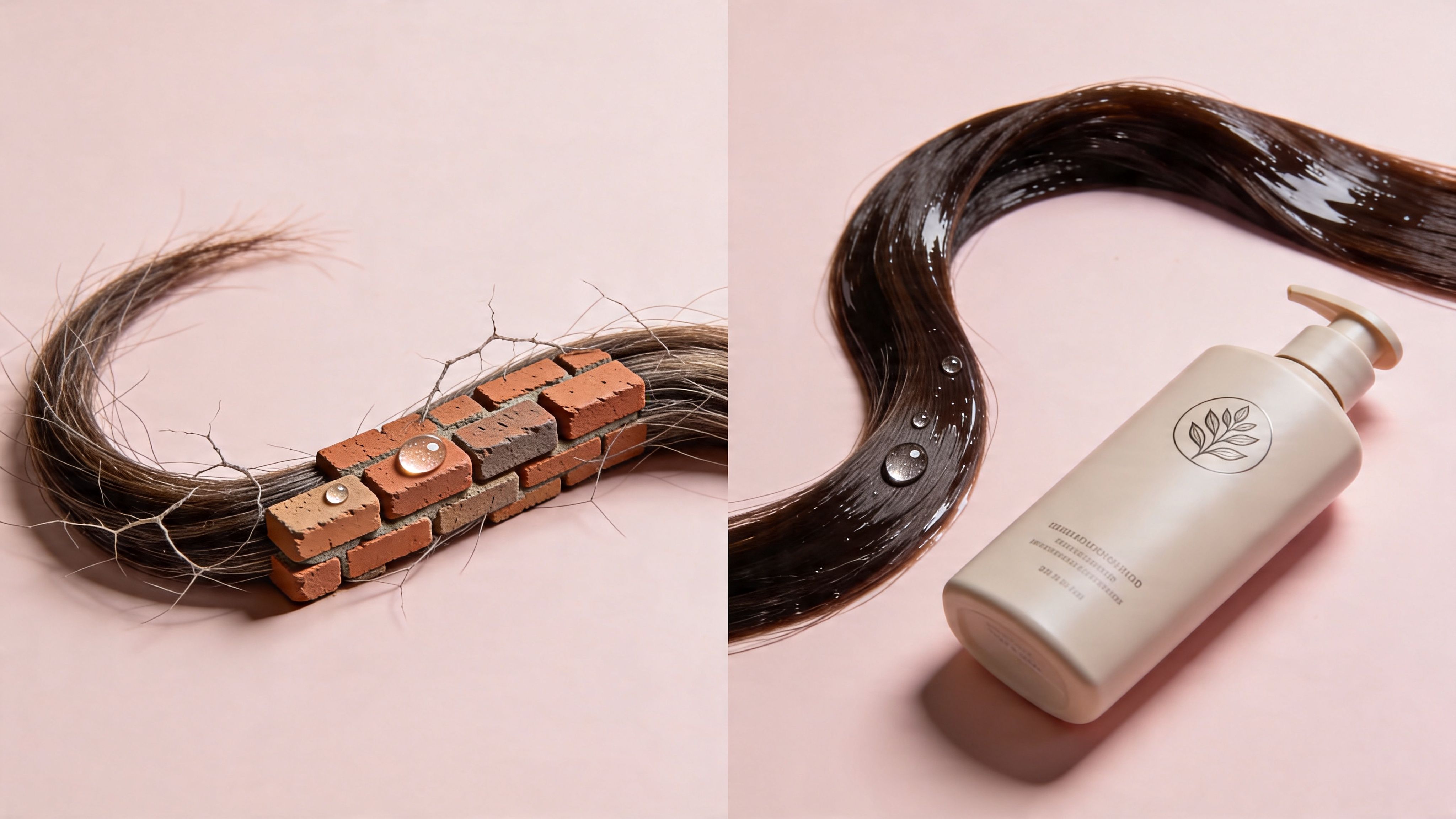
Think of your hair like a brick wall.
The "bricks" are protein, giving the wall its structure and strength. The "mortar" holding it all together is moisture, giving it flexibility.
If you have too much moisture and not enough protein, the wall becomes mushy and weak (limp, overly soft curls that won't hold a shape). If you have too much protein and not enough moisture, the wall becomes brittle and cracks easily (straw-like, snapping hair).
Learning to listen to your hair is a game-changer. Here’s how to tell what it's asking for:
- Your Hair Needs Moisture If: It feels dry, rough, or has a lot of frizz. It might also look dull and snap easily when you gently stretch a strand. Your hair is thirsty! Look for products with humectants and emollients.
- Your Hair Needs Protein If: It feels mushy, gummy, or overly soft, especially when wet. Your curls might look limp and struggle to hold their pattern. This is a cry for structure. Grab a product with keratin, collagen, or amino acids.
If you think you might have gone too far with the strengthening treatments, you can take this quick protein overload test to be sure.
Once you can spot these signs, you can stop guessing and start giving your hair exactly what it needs. The next step is to put all this knowledge together and build your personalized hair routine, making sure every single product is a perfect match for your curls.
How to Build Your Personalized Curly Hair Routine
Knowing which ingredients to avoid is one thing. Putting that knowledge into practice is where the real magic happens. A great curly hair routine isn't just a random collection of good products—it's a system where every single step builds on the last.
Think of it like baking a cake. You can have the finest flour and sugar, but if you mix them in the wrong order or skip the baking powder, you’re not going to get the result you want. We'll walk through the four essential steps—Cleanse, Condition, Style, and Protect—to build a routine that gives you consistent, beautiful curls.
To make this easier, it helps to have a mental checklist for spotting the common culprits on an ingredient label.

This visual guide cuts through the noise, helping you quickly check labels for the biggest curl disruptors so you can confidently choose products for your new routine.
Step 1 The Cleanse
The foundation of every routine is a clean slate. But for curly hair, "clean" should never mean "squeaky." Harsh cleansers strip the natural oils our hair desperately needs, locking you into a frustrating cycle of dryness and frizz.
Low Porosity Hair: Your hair is prone to buildup, so you’ll want a lightweight, sulfate-free shampoo that cleanses well without heavy oils or butters. You might also need to clarify more often—maybe once or twice a month—to get rid of any residue sitting on top of the hair shaft.
High Porosity Hair: Your hair can handle, and needs, a lot more moisture. A co-wash (a cleansing conditioner) or a very gentle, creamy sulfate-free shampoo is perfect. These products cleanse while simultaneously putting moisture back into your porous strands.
Every great routine starts with a healthy scalp. A purifying cleanser like the Nutrafol Root Purifier Shampoo is an excellent way to prep your hair and scalp for all the good stuff to come.
Step 2 The Condition
Conditioning is completely non-negotiable for curly hair. Period. This is where you load up on moisture, melt away tangles, and smooth the hair's cuticle to get it ready for styling.
The trick is to apply your conditioner to soaking wet hair. This helps it spread evenly and absorb fully, instead of just sitting on the surface. A popular technique is "squish to condish," where you cup water in your hands and scrunch it upwards into your hair. This motion helps the hair drink up both the water and the conditioner, encouraging those beautiful curl clumps to form.
For many curlies, conditioner isn't just a rinse-out step. Leaving a tiny, dime-sized amount in your hair (especially for medium-to-high porosity types) acts as a fantastic primer for your stylers, adding an extra layer of moisture and slip.
Step 3 The Style
This is where you define your curl pattern and lock it in. Always apply your styling products to very wet—even dripping wet—hair. This is critical. It helps distribute everything evenly and captures your curl pattern before frizz even has a chance to show up.
Layering for Your Porosity:
Leave-In Conditioner (The Primer): Think of this as your base layer of moisture. Low porosity hair needs a watery, spray-based leave-in, while high porosity hair will love a creamier, richer one.
Curl Cream (The Definer): This product encourages your curls to clump together beautifully. It provides a soft hold and another dose of moisture. Again, go lightweight for low porosity and richer for high porosity.
Gel or Mousse (The Protector): This is the game-changer for long-lasting curls. A gel or mousse forms a protective "cast" around your curls as they dry. This cast locks in all that moisture, defines your curl shape, and blocks out humidity. Once your hair is 100% dry, you just gently scrunch out the cast to reveal soft, defined curls that last.
Skipping that final layer of hold is often why curls fall flat or poof up into frizz by midday. For a deeper dive into application methods, check out our detailed curly hair routine guide that covers everything from washing to refreshing.
Step 4 The Protect
Don't let all your hard work get ruined overnight. Friction from a standard cotton pillowcase is a curl's worst enemy, causing frizz, tangles, and messing up your pattern while you sleep.
- The Pineapple: Gather your hair loosely into a high ponytail on the very top of your head. Use a gentle tie, like a scrunchie or an Invisibobble, to protect your curls from getting crushed.
- Satin or Silk: Sleeping on a satin or silk pillowcase creates far less friction than cotton. You can also wrap your hair in a satin bonnet or scarf to get the same benefit and preserve your style for day two (and three!).
You’re Part of a Global Curl Movement
If you’re just starting to embrace your natural curls, you’re not alone. Far from it. You’re stepping into a massive cultural shift where people all over the world are finally ditching damaging treatments and celebrating the hair they were born with. This isn't just some fleeting trend—it's a real movement, and it has some serious economic power.
For decades, the beauty industry basically ignored curly and coily hair, focusing almost entirely on products for straight styles. This left millions of us with hardly any good, safe options. But now, that’s all changing. The demand from people like you is forcing brands to finally listen, be more transparent, and create products that actually work for our hair.
The Booming Market for Curls
The numbers don't lie. The curly hair care market is blowing up, valued at around $5 billion in 2025. It’s set to grow by 6% to 7% every year, pushing it toward $9 billion by 2033. That explosive growth is happening because we, the consumers, are demanding better. You can see the full market projections here to get a sense of just how big this is.
This boom is especially huge in North America and Europe, where people are more conscious of ingredients than ever. We’re all reading labels, doing our research, and saying no to formulas packed with junk. At the same time, emerging markets in places like the Asia-Pacific region are also seeing incredible growth as more people choose to go natural.
This isn’t just about buying products. Your journey is part of a consumer-led revolution demanding higher quality, ingredient transparency, and safer formulas for every single curl type.
How to Navigate a Crowded and Confusing Shelf
All this new innovation is fantastic, but it has one major downside: the hair care aisle is more overwhelming than ever. With thousands of products from hundreds of brands all screaming for your attention, how do you find what’s actually right for you?
This is where having a smart system becomes a game-changer. The sheer variety of products makes it clear that you need a way to cut through all the marketing hype. Instead of wasting money on endless trial-and-error, you can analyze your current routine to see what’s working and what isn’t.
That's why it's not enough to find a few good products—you need a cohesive routine. You can build your personalized hair routine today with a tool that gets the nuances of different curl types in this ever-expanding market. A solid routine ensures every product works together, saving you time, money, and a whole lot of frustration on your path to perfect curls.
Common Questions About Finding Your Holy Grail Products
Even when you've got the science down, the path to perfect curls can still be a little bumpy. Let's clear up a few of the most common questions that pop up when you're trying to find those "holy grail" products.
Think of this as your troubleshooting guide for the real world.
How Often Should I Wash My Curly Hair?
There's no magic number here. The answer depends entirely on your scalp, your lifestyle, and your specific hair type.
Wavier hair (think Type 2) often gets oily faster and might need a wash every 2-4 days. On the other hand, curlier and coilier textures (Types 3-4) can typically go much longer, somewhere in the 3-7 day range, without feeling greasy.
The best advice? Just listen to your scalp. If it’s itchy, flaky, or your curls feel impossibly weighed down, it’s definitely time to wash. If your hair feels constantly dry and brittle, you might be washing too often.
If you’re still not sure, a quick scalp sensitivity quiz can give you a better picture of what your scalp really needs.
Why Do My Curls Fall Flat After Wash Day?
Ah, the classic wash-day wonder that turns into second-day sadness. This is one of the most common frustrations, and it almost always comes down to two things: hold and protection.
First, you need a styler with enough muscle to keep your curl pattern defined. A good gel or a firm-hold mousse applied to soaking wet hair is non-negotiable. This creates a protective "cast" that locks your curl clumps in place as they dry.
Second, friction is the enemy of curls. Sleeping on a silk or satin pillowcase is a game-changer for reducing frizz and preserving your style overnight. You can also protect your hair by gathering it into a loose "pineapple"—just a high, loose ponytail right on top of your head.
In the morning, a quick refresh is all you need. Lightly spritz your hair with water, scrunch in a tiny bit more product, and you're good to go.
What Is the Difference Between a Leave-In and a Curl Cream?
This is a great question because they look and feel similar, but they have very different jobs.
Leave-In Conditioner: This is all about hydration. Think of it as a lightweight moisturizer that you don't rinse out. Its main purpose is to give your hair a lasting dose of moisture, making it softer and easier to detangle.
Curl Cream: This is a styling product. While it definitely adds moisture, its primary role is to encourage your curls to form defined clumps, provide a soft, touchable hold, and fight off frizz.
Many curlies get the best results by layering them—applying the leave-in conditioner first for that deep hydration, then following up with the curl cream to style and define.
If you have very fine hair, you might find that one or the other is enough. It's all about experimenting as you build your personalized hair routine and learn what your unique curls love.
Alright, you’ve made it this far. You now understand the why behind what makes your curls happy—from porosity and protein balance to spotting the good and bad guys on an ingredient list. This is the stuff that gets you out of the frustrating trial-and-error cycle for good.
That bathroom cabinet overflowing with products that didn't work? We're done with that. Instead of grabbing a new curl cream and just hoping for the best, you can now walk down the hair care aisle with confidence, ready to make choices that lead to healthy, predictable results.
This is where all that knowledge clicks into place. The final step is building a smart, personalized routine where every product works together, from your cleanser to your styler. It’s about creating a system that delivers moisture, definition, and strength on every single wash day.
Ready to stop guessing and start building a routine that actually works for your hair? The IsItClean Hair Routine Builder takes all the guesswork out of the process. You'll get science-backed product recommendations and a step-by-step plan perfectly tailored to your hair's unique needs. Say goodbye to trial-and-error and hello to your best curls ever.